









There is something irresistible about the scent of thawing earth. We are drawn back to the task of farming by this primal exhalation of soil as if the ground had held its breath all winter, waiting to whisper those sweet nothings in our ear, and compelling us to put another seed into the ground.
And while we’re busy planting we are likely to be bombarded in our other ear by the desperate call for fresh vegetables from an anxious chef who has finally reached his limit with the subtleties of glazed parsnips. Eating with the seasons is all well and good, but when the temperatures are in the sixties and the cherry blossoms are in bloom, most people automatically assume that the tomato glut is just around the corner. It’s our task to gently instruct on the true nature of the seasons; but we should be listening as well, because it’s never too late to find that exotic seed that will make our fortune.
In the restaurant world you can’t go wrong with basic ingredients that define summer, but there are some crops that have the potential of becoming as popular as arugula or basil – if you can get them to grow in your region.
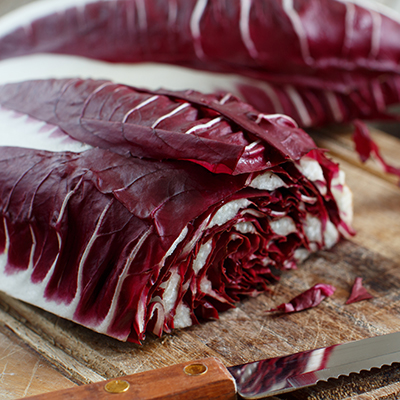
The most alluring family of plants that show promise for consistent sales for the small market gardener is the chicory. The so-called dandelions (Italian and Red Rib) have been prominent for many years and have gained a faithful following both in the restaurant and retail trade. Radicchio, endive and escarole are also popular, but they represent only the tip of the chicory iceberg.
The dandelion branch of the family boasts many types that are distinct from the common Italian (as if Italians could be considered common). Catalogna Puntarelle, which most farmers know as a slender, non-serrated leaf, also has a heading cousin which is highly prized by chefs. It’s often referred to as asparagus chicory and there are at least two varieties ‘Catalogna Brindisi’ and ‘Galantina’. It’s always important to make this distinction with chefs because when you claim that you’re growing puntarelle they’ll be thinking of the heading type. (You can find seeds for these varieties in the Seeds from Italy catalog, www.growitalian.com.)
The difficulty in cultivation arises, as it does with most chicories, with climatic conditions. Each one of these varieties has evolved in a particular valley in Italy, so growing them in North America can be problematic. But it’s worth experimenting to satisfy your chef. The seed is cheap and pronouncing the name “puntarelle” correctly over the phone will soften the heart of a hard nosed buyer. (It’s something like Poon – tă –rèl-lă.)
Other noteworthy chicories that are often requested are the Treviso Radicchio (the conical red type) and Belgium Endive. The later obviously takes more effort, but commands a premium price (minimum $5 per pound wholesale.) Another new arrival in this category (at least to Americans) is the Pan di Zucchero. This is a heading type between a Belgian Endive and a radicchio which grows to the size of a small romaine lettuce and requires less care than Belgian endive. Testimonials in seed catalogs claim that it’s as sweet as Belgian endive, but again weather conditions will likely determine the final result. Seeds for Zucherro are available from both Seeds from Italy, mentioned above, and Fedco Seeds, www.fedcoseeds.com.
Not to be outdone by their southern neighbors the French offer some unique plant varieties that chefs are often clamoring for. During the spring when cultivated asparagus abounds there is always a call for wild asparagus. This is not the common garden escape that is often found along fence lines and fields, but a distinct species native to the Pyrenees Mountains and common throughout Europe. It is a variety of Star of Bethlehem (Ornithogalum pyrenaicum) with a slender stalk and tight cluster of buds. Also known as Spiked Star of Bethlehem, Bath Asparagus (and who knows what to the Romans who apparently dedicated entire fleets to search the Mediterranean for this delicacy) finding a source for this plant seems near impossible. Apparently the only way to find this rarity is to actually go foraging for it. Time to brush up on your Euell Gibbons. (Editor’s note: J&J Cactus and Succulents says they have them for $3 per bulb; http://www.jjcactus-succulents.net) Another more accessible French appropriation is crosne, a spiral shaped tuber that comes from a member of the mint family – Stachys affinis. Also known as Chinese artichoke, Japanese artichoke, knotroot and Chorogi, this root is native to Asia and was introduced to Europe in the late 19th century. It was first cultivated in France near the town of Crosne, where it got its name and European pedigree. The flavor is relatively bland and can be eaten raw or cooked, lending itself more as a garnish than a staple. Harvesting and cleaning can be tedious so pack size should be relatively small (one to five pounds); and the price should reflect its rarity (certainly no less than $5.00 per pound.) Plant sources can be found at Companion Plants in Athens Ohio. Other sources can be found by doing a simple internet search.
Of course, finding the right mix of produce to offer a restaurant doesn’t depend solely on the exotic. Farmers are in an enviable position these days because chefs are receptive to just about any produce we can offer that is fresh, high quality and local. Have a conversation with a chef about what’s growing in your fields – including the weeds. They’ll try just about anything once and tell you exactly how they want it picked and packed. The most common vegetable can become a rare culinary masterpiece. Baby vegetables are a prime example of transforming the mundane into the glamorous. But it’s more than the temporal beauty of the product that you offer that attracts the attention of a buyer. The story that comes with it on delivery to the back door is the bit of terroir that you won’t find in a seed catalog.
As the marketing director for the Tuscarora Organic Growers Cooperative, Tony Ricci was in constant contact with chefs throughout the mid-Atlantic. He is now a full-time vegetable farmer himself. He can be emailed at ghfarm@pennswoods.net.
Copyright Growing For Market Magazine.
All rights reserved. No portion of this article may be copied
in any manner for use other than by the subscriber without
permission from the publisher.