










“We don’t do weddings”. That is our hard and fast rule around here. We’ll grow you the flowers and have them ready for you in buckets, for you to arrange, but we don’t do weddings. No boutonnieres, no bride’s bouquets. Frank doesn’t want to know how many bridesmaids there are. Don’t even mention the cake table. Corsages? See a florist.
That was until our son announced his wedding. He and his sweetheart got married on New Year’s Day. “We’ll do the flowers,” Frank volunteered. “We’ll grow all the flowers. We’ll do the arrangements. We’ll put on a big show.”
Then reality hit. First they wanted lilac colors. Then purples. No, make that aubergine. No, we’ve changed our minds. We want purple and blue. Actually, we want white. No, make that blue and white. Allright, already!
Blue flowers. New Year’s Day. Ugh. The planting dates had long passed when the final decisions were made, and Frank had several greenhouses full of lilac and purple flowers coming along nicely. But blue…well, we were scrambling. Blue flowers are hard to come by any time of the year, but in January, on very short notice? Might as well ask for elephants and trumpets. At least we had a lot of nice white stock and lilies. Thank heaven for our friend at the wholesaler in Austin. He shipped in blue iris and saved the day.
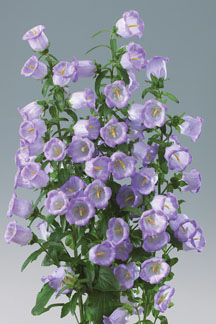
We are always looking for blue flowers. Here in Texas, hot colors are always popular, and we grow a lot of zinnias, marigolds, celosias and so forth for our bouquets. But if we can get even a touch of blue in the mix, it lights up the other colors. Statice, delphiniums, and ageratum are all stalwart crops. But a surprising number of our blue flowers come from the bellflower, or Campanulaceae, family. (At right: Campanula ‘Muse Lavender Blue’
Probably the most familiar flower in this group is the biennial known as Canterbury Bells, or Campanula medium. There are single and double forms of this flower. Flowers come in white, pink and blue. Actually, the blue is not a true blue. As Liberty Hyde Bailey wrote in Hortus Second, “In this enumeration the flowers may be called ‘blue,’ as is the custom, but are probably prevailingly in tones of violet.” This is the case for most of the flowers we’ll mention, although some do come pretty close to true blue.
Campanula medium is a true biennial, and dies after blooming. It also has a very long chilling, or vernalization, requirement, which means it needs a long cold period to initiate flowers. For northern growers, there is a wide selection of old-fashioned single, double, and “cup and saucer” varieties that grow well with a long cold period. But most of the cut flower industry is growing the newer, non-vernalized varieties such as the ‘Champion’ series. Another new series is called ‘Muse’. These varieties will bloom without chilling, and are very nice for high tunnel production. They also will do well outdoors. ‘Champion’ series comes in four colors, ‘Muse’ in six.
Campanula seed is very small. The newer varieties are pelleted. We sow the seed in 392-cell trays and cover the seed with just a dusting of vermiculite. The seed will germinate in about 10 days. The seedlings are tiny, and it is important to water them carefully as they germinate. If the seeds are washed around as the root is emerging, the seed can roll, and the root can end up pointing up, and the seed will die.
The seedlings grow slowly but steadily, and in about eight weeks they are ready to be bumped up into a 72-cell tray.This gives us a larger, stronger seedling to set in the field. They are grown in a cool greenhouse (night temperature 55°F) and when the roots fill the cell, they are set out in field beds and in high tunnels. The time from seeding to field transplanting is about 12-14 weeks. The plants are very cold hardy, and we set plants out into the field in January here in Texas. That’s a bit extreme for northern growers, but you can set the plants out in the fall or very early spring. The earlier the better, because you want to grow as large a plant as you can before long days set in and the plants are triggered to bloom. This schedule applies to the non-vernalized varieties. For the old-fashioned types, you need good strong plants established before the fall. Start the seeds in May or June and set out in late summer so the plants can grow a good crown of leaves before winter.
In the high tunnel, we plant six rows of plants in a 4-foot wide bed, with just 6 inches between the plants down the row. This forces the plant to grow a single, tall stem, and in the high tunnel stems can get over 3 feet tall. Tenax support netting is a good idea. Plants are susceptible to Southern Blight (Sclerotinia), so keep the weeds controlled in the beds to provide good air flow around the base of the plants. If you have a dark, humid environment, increase the spacing between the plants or decrease the number of rows. Southern Blight will appear as a cottony, white mass at the base of the plant, and the plant wilts and dies suddenly. Rogue out dead plants and provide good air flow for the best control. Soil solarization and crop rotation has been effective for us. In the field, the plants are spaced 4 rows per bed, with 6 inches between the plants down the row.
Canterbury bells can be a touchy flower for post-harvest handling. We have learned to cut it very tight. Generally, the bud at the top of the stem will color up and open first, and then the lower buds begin to open. We cut the stem as the first, top bud is about to open, a day before it opens. The other buds will be quite green, but they will all open. If we miss that bud, we wait until the side buds start to color before cutting. The top bloom will be fully open or even turning brown, but we just snap it off and you can’t tell the difference.
The biggest post-harvest problem we have is honeybees. They get in and pollinate the flowers, and the flowers go down almost immediately. Cutting tight will avoid this. We place the cut stems in a hydrator, and then the stems go right in the cooler for conditioning. The stems have a sticky white sap, but this has never caused any problems.
Other Campanula species
Another nice campanula for cuts is the Peach-leaved bellflower, or Campanula persicifolia. This one is a true perennial. The stems get about 2 to 3 feet tall, and the bell-shaped flowers grow along and at the top of the stem. This plant does not do well here in the deep south, and our plants have struggled and died, but in all honesty we didn’t give them all the attention we could have. They do like cooler soil than we have in the summer, so we may try them again with better summer mulch.
This plant can be grown either from seed or from divisions. Seed is easily found, and can be grown just like Canterbury bells. Divisions are good for selected varieties, or for getting into production faster. You can divide clumps in early spring before growth begins. Both single and double varieties can be found. Walter’s Gardens has a nice double blue variety called ‘La Belle’ (888-925-8377, waltersgardens.com).
There are many other tall campanula species that are worth trying as cuts, but we know that our Texas climate won’t work for them, so we don’t even try. For a great selection of campanulas, see the Jelitto Seed catalog (502-895-0807, jelitto.com).
Platycodon grandiflorum, or balloon flower, is another Campanula family plant that will give you blue flowers. You can actually get close to a true blue with this one. The name comes from the buds, which color up completely before opening and inflate like balloons before popping open into beautiful blue stars with heavy substance. It is also available in pink and white, and a few double forms are available. One variety, ‘Royal Puffs’, never opens and remains as blue balloons.
The tall “florist” types are easily found in most catalogs. Geoseed (888-645-2323, geoseed.com) offers two colors of the double ‘Hakone’ series. The Fuji series was once the standard cut variety from seed, but seed is hard to find. The Jelitto Seeds catalog has a wide selection of Platycodons, including the Fuji series. Walter’s Gardens has Fuji available as plants in 3 colors. Platycodon post-harvest handling is similar to the Canterbury bells.
Trachelium is a Campanulaceae family plant that has long been a standard crop for us. It gives us blue shades as the heat of July sets in and the delphiniums burn up and blow away like tumbleweeds. Trachelium has long stems with flower heads that look like they belong in the carrot family; wide panicles with clusters of tiny flowers. But if you get out your magnifying glass, you’ll see that each tiny flower is a miniature version of a bellflower. The flowers have a great vase life, and come in several shades of blue, purple and burgundy, as well as white. Trachelium is technically a perennial, but we treat it as an annual.
Trachelium seed is even smaller than campanula, and is almost always pelleted. We sow it the same as Canterbury bells. We start them in 392-cell trays, bump them up into 72s, and then set the plants out in early February here in Texas. The plants are fairly frost tolerant when well-rooted, but we cover them with .9 oz floating row cover. Temperatures below 20 degrees will kill them to the ground. They’ll grow out of it, but they seem sort of dazed and confused after that, with erratic growth.
We set them in the field, four rows in a 4 foot wide bed, nine inches between the plants down the row. When the plants are 4 to 6 inches tall, we give them a hard pinch, removing about 2 to 3 inches of the tip. This forces strong shoots from the base, and we typically get about six good stems per plant. All the beds get Tenax support netting because the flower heads will hold a lot of water in a rainstorm, and they fall easily.
There are several series of trachelium available for cut flowers. We use the ‘Hamer’ series, which are named for goddesses. This series has many colors, but we usually stick to the blue (‘Pallas’), purple (‘Pandora’) and white (‘Helios’). There is also a ‘Summer’ series that blooms later that the standard series, and does better in hot weather. We grow both types to get a longer bloom time. For example ‘Summer Pallas’ will bloom about 2 weeks after ‘Pallas’, giving us a longer cutting window. Other that that, they are practically indistinguishable from each other. The ‘Lake’ series is also a nice series for cuts, and has a wide range of colors.
Because we usually cut trachelium in hot weather, we have to handle it delicately. We cut early in the day, using hydrator. The stems go right into the cooler, still in the hydrator, to condition for a few hours. The stems are cut just as the first flowers are starting to open. This is very important with the white, because the old flowers will go brown, and ruin the overall quality if picked too late. On the purples and blues, the browning is not too visible,.
We sell a lot of trachelium as straight bunches, but it really carries our bouquet sales for several weeks in July. Trachelium stems have an annoying sticky sap that is next to impossible to get off your hands. We try to bunch it last so we don’t end up sticking to everything else after that!
As for the wedding, it all went off without a hitch. Pamela loaded up the truck and drove to Connecticut with a truckload of supplies. Frank flew up with boxes of flowers, and Fed Ex’ed even more. We set up a veritable mobile florist shop in the hotel basement. But we will never begrudge the florists a dime for any work they ever do. Its hard work! 15 dollars for a boutonniere–sounds like a deal to us! It took us a day and a half to make 30 table bouquets, 8 small bouquets for the wedding party, a couple million boutonnieres, entry arrangements, serving table arrangements, altar arrangements and flowers for the cake. And yes, Frank even put ribbons on the pews. Pamela’s brother Jonathan, who has a degree in Theater set and costume design, saved the day when we were presented with the archway leading to the altar which was to be completely decorated with white lace, tule and flowers. Frank got weak in the knees and looked around to see if the bar was open a day early. Yes. we pulled it off, but we’ll leave the florist work to the florists and the farming work to the farmers after this. Of course, we still have three more kids to go. Frank has already tried to bribe the next one to elope!
The Arnoskys own Texas Specialty Cut Flowers, www.texascolor.com
Copyright Growing For Market Magazine.
All rights reserved. No portion of this article may be copied
in any manner for use other than by the subscriber without
permission from the publisher.