










The first time I tried to grow leeks, I purchased bare root plants from a certified organic greenhouse. I remember being somewhat disappointed at having purchased what appeared to be a full box of tangled grass seedlings, but I dutifully tilled up my selected bed and planted them deeply in the soft soil. As all too often happens in mid spring, I turned my back on the bed and the next time I looked there was a swath of lovely green lawn carpeting the bed. I tried to do some hand weeding while I could still guess the location of my rows, but the tomatoes needed stringing, the first planting of peppers was ready for the field, the new irrigation system was straining my plumbing abilities, and the leeks slowly submerged into a sea of weeds. The few scraggly leeks that survived were not even nearly worth what the initial transplants cost me.
It was close to a decade before I ventured back into the world of leek cultivation, and in the meantime I had a few good laughs reading about how leeks didn’t like to compete with weeds, particularly grasses. I eventually became convinced that with just a few tweaks to my developing growing systems, I could successfully add leeks into my market garden array of crops. My primary goal was to grow long shanked, sparkling white leeks that would make a statement in my farmers’ market display without creating additional equipment needs or special cultivation set-ups in the busy spring season.
Here in the Pioneer Valley of Western Massachusetts, I start the leeks in three succession plantings beginning in early February. I start with ‘Varna’, a summer leek that matures in 60-80 days, and do a second sowing three weeks later. In late March, I do a third sowing that is half ‘Varna’ and half a winter variety such as ‘Bandit’. This scheduling means I can harvest the long-shank summer leek for a month beginning in late August, and the cold-tolerant winter leek in time for my final market of the year around Thanksgiving. Several other organic leek varieties look like they would thrive under my system, and I hope to trial them against ‘Varna’ this season. I like starting the leeks directly in my standard 72-cell tray, with three to five seeds in each cell. This does require some thinning to three plants or less per cell, but the transplant quality is easy to maintain with a decent, compost-based potting soil and regular, mild feedings of liquid fish/kelp fertilizer. I usually finish my succession with a cold-hardy, thicker shank, winter-type leek. Due to the difference in days to maturity, the last planting can be split between summer types and winter types. I have used ‘Bandit’, ‘American Flag’ or some of the open-pollinated heirlooms almost without preference. Johnny’s Selected Seeds has described the gold standard of leek transplants as “pencil thick,” and while this is an admirable goal, I have had good success with plants that are more in the range of ball point pen refills.
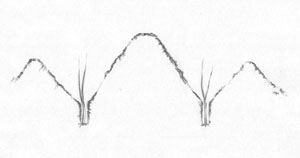
Bed preparation ideally begins with a soil test at the end of the previous growing season so that I have time to begin correcting any deficiencies with appropriate amendments. Leeks thrive in rich soil with a neutral PH and on my silty loams a liberal application of compost and a sprinkling of lime in the fall usually get things off to a good start. I prefer winterkilled oats as a cover crop prior to leeks to avoid any problems with rye surviving as a competitor in the bed. Transplanting time begins in the late spring, after the ground has had some time to warm up deeply. My primary tillage tool is a 36-inch wide Italian spading machine, which produces a deeply prepared bed with good soil structure, usually in one patient pass. I have attached two short pieces of chain to the end of the bed-leveling flap on my machine so that they effectively mark two parallel rows, 18″ apart on the bed. My primary cultivation machine is an IH Cub, and I set my two hilling discs to cut down those marked rows, throwing a mound of soil into the center of the bed. I then reverse the discs to gently throw the soil outward and create mounds on the edges of the bed. The hilling discs are usually already mounted on the tractor because they have been used for planting potatoes and dahlias earlier in the spring. My goal is two 8-inch deep trenches 18 inches apart down the length of the bed. If you looked at a cross section of the bed it would resemble a capital “W,” although the middle peak would be higher than those on the edges of the bed.
Now I begin to transplant. To make the planting holes I use my homemade garlic dibble, a 3½ foot length of 2 X 2 with six-inch sections of broomstick inserted at six-inch intervals, shown below:
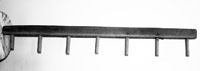
The dibble is thrust into the center of the trench and wiggled slightly to gently set the soil into round holes. By overlapping the dibble into one existing hole on each thrust, it is easy to maintain the 6″ spacing down the row. The plants are then popped out of their cells and pulled apart with no particular regard to saving any potting soil on the roots. Individual plants are poked down into the fresh dibble holes with a finger, and watered in with fish/kelp solution. It is not necessary to fill the dibble hole with soil. Done this way, I see very little transplant shock, but if after a week or ten days you see any plants that have died, it is easy to use a single dibble or sharpened stick to fill in the rows with leftover plants.
We do a fair amount of hand cultivation in our market garden, and at this point in the growing season the leeks fall into that category. Depending on the season and the inherent weed pressure in the bed, it can be a week or two before a green haze of weeds forms on the slopes of the trenches. Some of my cultivation crew members prefer a well-sharpened, light Coleman hoe while others go for the more aggressive scuffle hoe, but the general idea is to slice the weeds off the slopes of the trenches and create a small cascade of soil and plant material down into the bottom and around the leek plants. You should not bury the growing tip of the young leeks, but just as little as an inch or two of leaf showing is fine. This is the start of the hilling process that creates the long white shank that commands a high price at market.
These hand cultivations are done as needed through the spring, scraping the two sides of each trench before any weeds are deeply rooted, and gradually filling in the trench by the end of June. By early July, particularly if there have been any strong downpours throughout the spring, I like to top dress the bed lightly with an OMRI-listed (Organic Materials Review Institute, www.omri.org) blended organic fertilizer. Nitrogen is the limiting nutrient in my fields, so I use a 7-2-4 formulation at 10-15 lbs. per 150-foot bed. With the extreme amounts of rain we endured here in the Northeast during July 2008 I ended up doing three top dressings on the leeks, just to break even on the nitrogen. After the hand cultivations have leveled the bed, the leeks are as thick as my fingers and starting to grow rapidly. Just as soon as possible I begin cultivating with my old IH Cub tractor, using exactly the same cultivator knife set-up that is used on the sweet corn, broccoli, cauliflower and snap beans. You can achieve the same result with hand tools, and either a broad-bladed potato hoe or a rolling cultivator with a hilling blade could be an effective tool for the job. The cultivator knives throw the soil several inches high against the leek plants on each side, and with each successive pass during the early to mid summer what were once the mounds in the center and on the edges of the bed are transformed into shallow trenches. By the end of July, a cross section of the bed would look like a capital “M,” with the two rows of leeks poking out of the tops of two new soil mounds. The trench in the middle of the two rows tends to be several inches deeper than those on the edge of the bed. The timing of the final cultivation is not too critical, with the primary concern being to hill up the most soil possible without damaging too many outer leaves on the final pass.
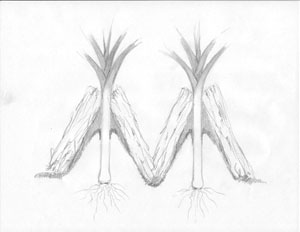
You might think that plenty of soil has been moved into position to blanch a long white shank, but the real secret to great, long-shanked leeks is to finish the bed by mulching very deeply and blanching them even further up the shank. While it is certainly possible to use any of a great number of mulching materials to achieve this effect, I have not found anything that is as effective as baled rye straw. Our farm is located in a wind alley, and any loose mulch eventually tends to go airborne. Baled straw usually separates into sturdy flakes, and those flakes make the ideal leek mulch. The structural quality of the straw flakes means that there is no worry about the mulch settling and becoming too shallow for effective blanching. Each flake is laid in the trench with the long side down, leaning up against the shanks of several leeks. The center trench will hold two flakes that lean out against the two rows of leeks, and the two outer trenches hold single flakes that lean toward the center of the bed. The visual effect of the bright yellow straw making two long ridges down the row with a fringe of blue-green leek leaves exploding out the top can be quite striking.
There is little to no maintenance required once the mulch has been laid. Besides doing a fantastic job of blanching the leek shanks, the mulch also performs all of its normal beneficial functions. Moisture is preserved, soil temperature is lowered, soil tilth is improved, soil organisms thrive, and weeds are suppressed. If I happen to come up short on straw, I may begin digging leeks at a skinny stage, relying on just the hilled soil to blanch them adequately. I think of this as priming the pump for the great big leeks to come, and their tender eating qualities can entice customers to try some quick-cooking leeks on toast during the last serious heat of the summer. I usually wait until the second week of August to begin seriously digging leeks, and the soil is always moist and cool under all that straw. With just a little advance planning I can have my winter leeks growing beside the summer leeks, and it is fairly easy to transfer the flakes of straw onto the adjacent bed, getting double duty from the mulch.
At the market, these leeks are real customer magnets and true conversation starters. Mostly folks want to know, “How in the world did you do that?” And they come back week after week looking for those gorgeous leeks. With about two feet of snowy white shank, neatly trimmed leaves and a Rasta tangle of well-rinsed roots, they really make a very positive impression. More than one of my local chefs has willingly paid the retail price for these leeks, for the entire season, because there is usually three to four times the amount of usable shank as compared to wholesale commercial leeks. It has been a long time since I lost my first planting of leeks to the weeds, and it is all the more satisfying to have brought this most regal member of the lily family to higher heights, and greater lengths.
Certified organic leek seed is available from High Mowing Seeds and Johnny’s Selected Seeds. Certified Organic leek plants are available from Deep Grass Nursery. All three companies have display ads in this issue.
Dan Pratt grows on a 6.5 acre certified organic market garden in Hadley. MA. He sells primarily at the Amherst Farmers Market and to local chefs and natural foods co-ops. More info at: www.astartefarm.com.
Copyright Growing For Market Magazine.
All rights reserved. No portion of this article may be copied
in any manner for use other than by the subscriber without
permission from the publisher.