









Like most operations on the farm, transplanting is very flexible when done by hand. You can plant at any spacing and in a wide variety of soil conditions. Also, like most operations, it can be back-breaking work and at some point after long hours of pulling plugs out of trays and bending over to plant the seedlings, we all start thinking about ways to do it faster, more accurately, and with less labor cost.
Mechanical transplanters can offer all of these improvements but there are also potential drawbacks to using them. There are many options out there, everything from hand-operated jab planters, to multiple-row units that are super adjustable down to very close spacing and can plant multiple beds in a single pass. I’ve spent a lot of time looking for a transplanter that would work on a small, highly diversified operation, I’ve tried a few out, and I’ve never found one that fit all of the criteria I was looking for. Part of this was a failing on my own part to imagine how my systems could change from those that were optimized for hand transplanting to those that incorporated more machinery. I say that to make clear that using a transplanter, or mechanizing any operation, will usually mean a shift in thinking. For example, typically in mechanical operations, the task is done more quickly but the set-up takes longer. This means that you might switch from frequent, smaller plantings of crops to larger, less frequent blocks in order to take advantage of the faster transplanting and to minimize the number of times you need to set up the tractor with the transplanter and transplanting crew.
There is only one “mechanical” transplanting system I can think of that only takes one person and that’s the system that Katie Kulla wrote about in the August 2008 issue of Growing For Market. That system uses a self-propelled crawler that leaves the operators’ hands free to hand transplant. Every other system, including the jab style planters sold by Johnny’s Selected Seeds (the only ones I know that aren’t motorized), needs at least two people. For a farm big enough to consider mechanical transplanting, this probably isn’t a problem, but finding tractor time and a skilled driver may be difficult on a smaller farm. In addition, a creeper gear on the tractor is pretty much a necessity for all but widely spaced crops. I’ve seen farms idle an oversized tractor in a low gear, and I’ve done it myself, but it’s less than ideal and the pace can be pretty frantic for the person trying to pull plugs and stuff them in the planter or in the ground, especially if you’re trying for an in-row spacing of a foot or less.
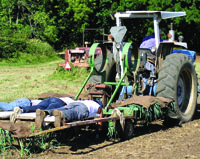
My favorite tractor-pulled transplanter design, for simplicity and versatility, is a simple sled, or trailer that’s pulled behind the tractor. I’ve seen lots of farm-made variations on this idea, but the basic setup is the transplanting crew sitting, or lying prone, on the sled while it creeps down the bed, and they plant by hand. This is a hybrid between hand planting and mechanical planting that keeps most of the advantages of hand planting while eliminating the really hard part of shuffling, bent over, down the bed and carrying trays of plants back and forth. Usually there’s some sort of marker that is at least marking the planting lines, and the in-row spacing is determined by rhythm or trowel.
There are two basic upgrades from this system which provide better metering (regular plant spacing) and more speed. The first is a water wheel planter, and the second is using some sort of opening shoe and closing wheels or disks, just like a basic seed drill. The water wheel planter is basically a big wheel for each row that has pointed dibblers set around the wheel at the spacing you want the crop. These make a hole for each plant that a plug can be inserted into. If it’s set up with the water feature it also injects water into each hole. Buckeye Tractor Co. (www.buctraco.com), one of the companies that makes these, has photos on their web page. This type of mechanical transplanter is one of two types I’ve seen that will plant through plastic mulch. The other is a more complicated design which allows the operator to place the seedling plug without having to bend over, and to change crop spacings by changing the drive ratio instead of having to remove and remount dibbles.
The second upgrade I mentioned is to add a simple opening shoe to pull a little furrow for the plug to go into (or even bare root plant), and then maybe follow that with a pair of closing disks or press wheels to fill in around the plant. This obviously doesn’t work with plastic mulch, but can be augmented with some weight and a heavy coulter to work in a no-till situation. This is something that can be farm-built with a bit of square tube, flat bar, clamps, and simple shovels and cultivating disks. I’ve made rough versions and used them for planting potatoes but unless you have a lot of steel sitting around and like to fiddle a lot it’s probably worth looking for a used or new planter.
I’ve been talking about mechanical transplanters as a general category but there’s a company called Mechanical Transplanter and their website shows a good variety of these types of planters and the various metering mechanisms available. Other manufacturers include Holland, and Checchi and Magli. (Shown in the photo below).
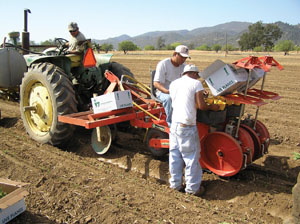
Here are a few notes to keep in mind when buying and using transplanters. Usually you need one person to drive the tractor and one person per row on the transplanter. Frequently, transplanting crews also have another person follow the transplanter to fill in skips and to right misplants. Some transplanters will plant rows as close as 12″ but many will not go less than 24″ between rows. You can plant multiple lines on a bed using a single line transplanter by driving up and down the bed multiple times, but lining up the rows for mechanical cultivation is very difficult. If you buy a used transplanter, make sure you can get parts for repairs, as many but not all of the old models are still made. Different planters are made with different plants in mind. Some work best with small plugs, some are optimized to work with larger plugs, and some work with bare root plants. On small plantings you might not save labor hours by using a transplanter. Even without labor savings, many farmers prefer using a transplanter because it doesn’t wear them out like planting by hand.
Josh Volk farms and writes at the edge of Portland, Oregon. He also helps farmers around the country improve their farming systems. He can be found at www.slowhandfarm.com.
Copyright Growing For Market Magazine.
All rights reserved. No portion of this article may be copied
in any manner for use other than by the subscriber without
permission from the publisher.