











Call it climate change, call it La Niña or just call it crazy Texas weather, but for the last three years we have endured a withering freeze each April. This year’s freeze took out our larkspur, lilies and the first three crops of sunflowers, among many other things. Many crops were in full bloom. Our average last frost date is in late March. But during one 10-day period in April we covered and uncovered all the tender crops four times due to frost. The last one got down to the mid twenties and stayed there for hours. Even under double row cover, we were toast.
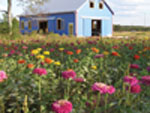
Disaster? Sure. End of the world? Hardly. This is Texas. We’re used to these things. Hurricanes, droughts, floods, tornados, ice storms, hail, locust plagues, and so on. Once we had them all happen in the same year (we’re not kidding!). It thins out the competition! Our typical response when disaster strikes is to plant more! Frank goes into the greenhouse and starts cranking out seedlings. We’ll have them in the field in a few weeks, and in a couple of months, we are back on track. That’s the beauty of this business.
The workhorse of our disaster response has to be the zinnia. This crop is our #2 moneymaker overall, after sunflowers, and when times are tough, the tough just plant more zinnias. They are fast, productive and relatively inexpensive. And there are many new varieties that make this crop more than just your grandmother’s garden flower.
Zinnias have been a specialty cut flower since flower growing has been an occupation. Our guru Fritz Bahr, a grower and author from the 1920s, states, “it will pay you to plant freely of the Giant Dahlia-flowered Zinnias.” We couldn’t agree more. We start sowing zinnias about three weeks before the last (expected!) frost date, and we seed about 6,500 plants a week, every week, through the season. Zinnia seed germinates easily, and can be started in plug trays or direct-sown in the field. We grow all ours in plugs because the grasshoppers eat the small seedlings as they germinate in the field, but many growers seed them directly, and they do fine. On a small scale, the cucumber plate of an Earthway seeder works to sow lines of zinnia seed. But even if you direct-seed most of the crop, an early crop in plug trays will get you into the game much earlier.
Fritz Bahr says “Zinnias will grow and even flower where other plants won’t; but if you wish them to do their best, you should plant in good and deeply cultivated soil.” We give our zinnias a bed rich in compost and cottonseed meal. We space the plants 4 rows in a 4-foot-wide bed, with 9-inch spacing down the row. This is really tight, but it gives us tall plants that grow together and support themselves better in bad weather. If you are direct seeding, we’d recommend only 2 rows in a 4-foot bed since there will be more plants in the row.
Zinnias are a warm season crop native to Mexico and Central America, so don’t put them out before the last frost. (Yes, we lost our first planting.) They will germinate slowly in cool soil, so we start our plug trays in the warm greenhouse (60 degree nights). Once they are up the seedlings will grow fast, and they can be moved to a cooler house to keep the plants from stretching. We use a 128-cell tray for zinnia plugs, and they go out when the first set of true leaves is developed and the roots hold together.
There are lots of varieties of zinnias available, but for cut flowers, the standard variety is Benary’s Giant. This is a large dahlia-flowered type with a high percentage of double flowers, strong vigor and pretty good disease resistance. Benary’s Giant in available in many colors and as a mix. We usually plant the mix, but of the separate colors, we are particularly fond of the coral, purple, orange,and crimson because of their exceptional vigor and larger flowers. Benary is also planning to release a new color this year–Wine. It looks like a beautiful deep plum purple–a nice addition to the series. There is also a ‘Lime’ in the series, but it is much smaller and less productive than the series. Nonetheless, it is a vast improvement over the old ‘Envy’ green zinnia, and it sells very well.
We also grow a lot of Benary’s ‘Oklahoma’ zinnia series. This is a small-flowered variety with tight, beehive flowers. In comes in a smaller range of colors, but we make our own mix. We take equal parts of the colors scarlet, yellow, and carmine and mix this with about 2 parts of the old ‘Cut-and-come-again’ mix. This mix isn’t as fully double as the ‘Oklahomas’, but it has a wider range of colors, and softens the strong colors in the ‘Oklahoma’ series. We use thousand of these in our basil-zinnia bouquets.
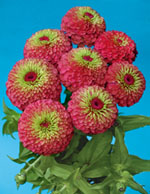
Another new variety this year is called ‘Queen Red Lime’. It is a cherry-red, double flower that has a bright green center. It is an interesting color combination, maybe not for everybody, but we are going to try it.
‘Uproar Rose’ is a spectacular flower with large, fully double blooms, but it is a hybrid, which makes the seed much more expensive. The color is an intense rose-magenta, and we sell every bloom we grow, but the stems are a bit shorter than the Benary’s Giants. With the higher seed cost, this one should be started as transplants.
‘Peppermint Stick’ is a novelty variety that we grow. It has small double flowers that are streaked and flecked with red over a white or yellow background, giving the “peppermint” effect. Another nice novelty, if you don’t mind cutting small stems, is the old variety ‘Persian Carpet’. It has very small, double and semi-double flowers, but the colors are like little jewels.
Zinnias are subject to their fair share of pests and diseases. Aphids are a problem on young seedlings in the greenhouse, and thrips can get in the growing points and distort the young leaves and buds. The aphids usually disappear when the plants are set out, and thrips can be controlled with Conserve (Spinosad). Diseases are usuallymore of a problem than insects, and zinnias are notoriously susceptible to powdery mildew. There are a number of sprays, organic and non-organic, that can control mildew to some degree, but we just try to outgrow it. We keep our plants well watered and fed and growing fast, and we plant new plants every week and mow old plants down when they get infested. Regular overhead watering can control powdery mildew on a small scale by washing the spores off before they germinate. Another disease that can be a problem, especially with cold fall rains, is alternaria. This fungus shows up as small, irregular brown spots, often with a lighter center. It starts on the older leaves, but in a bad year, it can be a problem even on the newest leaves right under the bloom. We’ve not had any luck controlling it with sprays, so if it gets bad on an old bed, we plow it in.
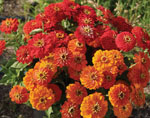
We cut our zinnias just as the flower completely fills out. We don’t wait to see yellow anthers or stigmas, as some growers will, but if the flowers are cut too young, they don’t hold up. We avoid flowers that still have a lot of quill-like petals sticking up straight from the center of the flower. It is a bit tricky, because the fully double flowers will always have tight petals in the center, but after a few cuttings you should be able to see how the flowers fill out and find the right stage to cut. If there is a ring of yellow small flowers in the center, we consider that too old.
Of all the challenges that face the zinnia grower, post-harvest handling has been the most vexing. Do you use hydrator or preservative? How do you keep them from melting down. Can you put them in a cooler? Well, we have tried every trick in the book, and here is our method.
First, zinnias are susceptible to something called bent neck.This is usually caused by too much hydration, and not too little, as many growers think. When the stem gets too full of water, it distorts into a curve, similar to dandelion stems in a glass of water. Once it is curved it is impossible to get it to grow out of it. We have stopped using hydrator in the field, and cut only into plain water. Second, stem meltdown. This is caused by bacteria, and we have eliminated this problem by being scrupulously clean and using a biocide. When cutting, no stems are to be laid on the ground. We have one crew member whose sole job is to take the handfuls of stems directly from the cutters and take them to the (very clean) buckets. The buckets are transported back to the shed, where the flowers are immediately moved into clean, new buckets of holding solution (Chrysal #2). There they stay until they are processed. The stems are re-cut, banded and sleeved and they go into another new, clean bucket of holding solution, this time with a tablet of Chrysal CVBN (Gerbera tablets, available at chrysalusa.com). These things are the magic bullet for zinnias. This is a time-release chlorine that keeps the bacteria from growing, and they have made all the difference with zinnia vase life. They are also very effective with sunflowers. They are expensive, but worth every cent for zinnias. Complaints about zinnias not holding up have dropped to zero. We also store zinnias briefly (2 or 3 days) in a 36-degree cooler with no ill effects.
So take Fritz Bahr’s advice, and make zinnias pay! They are a sentimental crop that reminds people of their grandparents, and they don’t ship well, so they are perfect for a local market. And for those of you who have not heard us mention Fritz Bahr in the past, you are in for a treat. Mr. Bahr was an old-school florist and grower in the first half of the 1900s, and he wrote what we consider to be one of the best books we know of on flower production: Fritz Bahr’s Commercial Floriculture. It came out in several editions between the 20s and the 40s, and you should be able to find one on the used book websites. It’s a classic read and Mr. Bahr’s outlook is nothing but positive. Late freeze? Ha! We are sure he would say it’s just an opportunity to try something new!
Pamela and Frank Arnosky are the owners of Texas Specialty Cut Flowers in Blanco, Texas. To learn more, visit www.texascolor.com.
Copyright Growing For Market Magazine.
All rights reserved. No portion of this article may be copied
in any manner for use other than by the subscriber without
permission from the publisher.