











Last month I talked about how we use tractor-mounted pallet forks for moving posts. We’ve also found the pallet forks useful as a harvest aid for heavy crops that are coming out of the fields in large enough quantities to be stored in big bins. Specifically, we’ve used them consistently in garlic, onion, and winter squash harvests. With all of these crops, we have different approaches depending on how big a crew we have available, how big the crop is and how many row feet will fill a bin. On all of the crops we use a 4’x4’x2’ deep bin. I also designed stackable racks a few years ago for drying onions and garlic. Consult the photos on the next page as you read the descriptions.
Building and using bins
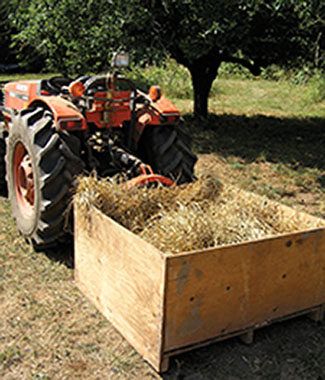
I was never successful in finding used fruit bins and I found I could make my own in small quantities for less than whatit cost to buy them new. I use 1 ½ sheets of ¾ or 5/8 inch plywood, three 4’ pieces of 2×4 and four 23” pieces. I cut one 4’x4’ piece of plywood for the bottom, two 4’ by 27” pieces for the sides, and two 4’ x 21” pieces for the remaining sides. I screw a 4’ 2×4 flat and flush with one 4’ edge of the 4’ by 27” plywood. Then I screw two 23” 2x4s flush with the 21” edges of the shorter plywood sides; this leaves 2” sticking out of one side (the same side on both). Now the 4’x4’ bottom will sit up on the 4’ 2x4s and the Short sides will screw to the long sides which have a 2” air gap along the bottom edge. I screw the third 4’ 2×4, on edge, to the center of the bottom piece of plywood, parallel to the other two 2x4s. This supports the center when it sits flat on the ground.
These bins will hold just about as much squash as our tractor will lift when they are filled just below the top. To use them in the field we first windrow the squash and then drive slowly down the windrow while teams of two load the bin. In most situations we find it fastest to stop every 30 feet or so and have one person toss squash to the second person standing over the bin, catching and carefully placing the squash. Then we move forward to the next section of squash. With onions or garlic we pull them in uncured, tops on, to be cleaned in the barn. With the tops on it’s easy to grab large bunches of bulbs and carry them to the bin as the tractor creeps forward. If we don’t have a tractor available we just set bins in the field and the crew has to hand carry to the bin, which gets hauled out later.
Racks
One of the things that I really like about using the bins for squash is that we don’t have to handle the squash much.Once they’re loaded we can store them and move them around in the bins using the forks. With the onions and garlic, the bins don’t offer enough air flow for curing, so once they’re in the barn we have to transfer them to better curing spaces (although we have missed that step a few years and gotten away with curing them in piles in the bins. It was very stressful, though. We’ve lost some that way, too.)
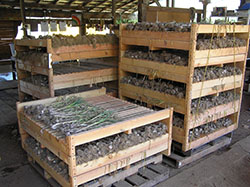
To limit handling, I built 4’x4’ stackable racks from 2x4s, lath, and thin plywood I had sitting around. As with the bins, there are three 4’ 2x4s on the bottom, although the center one is ripped in half to make a 2×2. The lath is stapled (using a pneumatic roofing stapler) across the 2x4s with 1-inch gaps for air flow. Two 4’ 2x4s run parallel to the lath on the edges and small rectangles of plywood connect the bottom 2x4s to the top 2x4s, adding a little stability and sticking up a little to keep the racks together when stacked.
With garlic in the field, we can lay about 200 green heads on a rack then stack another rack and continue loading. Eight racks can be stacked tied down to a pallet and then carefully driven out of the field and into the barn where they’ll cure. Unfortunately we’ve found that onions are too heavy to move out of the field on the racks – the racks aren’t strong enough to resist swaying with the weight of the onions. But they can be stacked on the racks once they are in the barn.
Copyright Growing For Market Magazine.
All rights reserved. No portion of this article may be copied
in any manner for use other than by the subscriber without
permission from the publisher.