





There has been a lot of attention in the media lately to “multi-plot” farms, where a single farmer grows on other people’s back and front yards, aggregates the produce from the many gardens, and then sells through CSAs or farmers’ markets.
I’ve had a little experience of farming on more than one site, and found it really challenging. The “out of sight, out of mind” principle has always applied in full force for me in these situations. The inconvenience of hauling equipment, tools, and freshly picked produce has meant that, for me, the “second” site is never as well managed as the main growing area. The thought of having eight, ten, fifteen plots brings up images of weedy lots and unhappy homeowners.
But I’ve also heard from my customers and other community members a strong interest in having their yards put to good productive use. I have a little bit of a “not again” reaction when someone approaches me with “I’m not a gardener, but I have some land if someone wants to use it” as they look at me hopefully, like maybe I have a long line of would-be farmers just lined up waiting for space.
So, as I’ve heard about these multi-plot farms, I’ve felt somewhat skeptical but hopeful. Could moving back and forth between all these small sites be a good use of a farmer’s time? Can you produce enough vegetables on typical backyard garden spaces to justify the hassle factor?Wouldn’t it be great if this impulse to make these small plots be productive could be channeled?
I talked to three farmers: Wally Satzewich of Saskatoon, Saskatchewan, who with his wife Gail Vandersteen has run Wally’s Market Garden since 1999; Steve Mann, who started the In Your Yard CSA in Kansas City, Missouri, this year; and Kipp Nash, who with his wife, Kimberly Bryant, has been running Community Roots Urban Gardens in Boulder, Colorado since 2005. I had some specific questions I was curious about, from the farmers’ perspective.
The basic setup is that a farmer “rents” backyard or frontyard space from multiple homeowners. Each yard is treated as a part of the whole – okra may be planted in one yard, tomatoes in another, greens in another. The farmers move from plot to plot, setting up a weekly schedule to make sure each plot is visited and worked regularly. All the produce is brought to a central location, with a wash-stand and some kind of cooling/storage for the vegetables, as well as storage for tools and supplies. The produce is aggregated and then sold through typical market garden channels, like farmers markets and CSAs. These are for-profit farm businesses, though they also have other community-directed goals for the farms, such as improving the quality of life in a specific neighborhood, helping urbanites relate more fully to their physical environment through the garden, building micro-economies and increasing food access for low-income people.
Q. What is the arrangement between you and the home/land owner?
I found a range of operating agreements between the farmer and the landowner. In general, the land is cash-free andhomeowners apply to be a garden site, and it is considered a privilege to be chosen. Water is supplied at no cost, though Kipp Nash agrees to pay any excess of $40 or more over the previous year’s bill.
Steve Mann asks that the landowners pay him half of what they would normally be paying a mower or landscape company; he is doing them a landscaping and soil-building service. They get a CSA membership for themselves, and they can, if they choose, designate a second membership for a charity. The homeowners are responsible for getting the second share delivered.
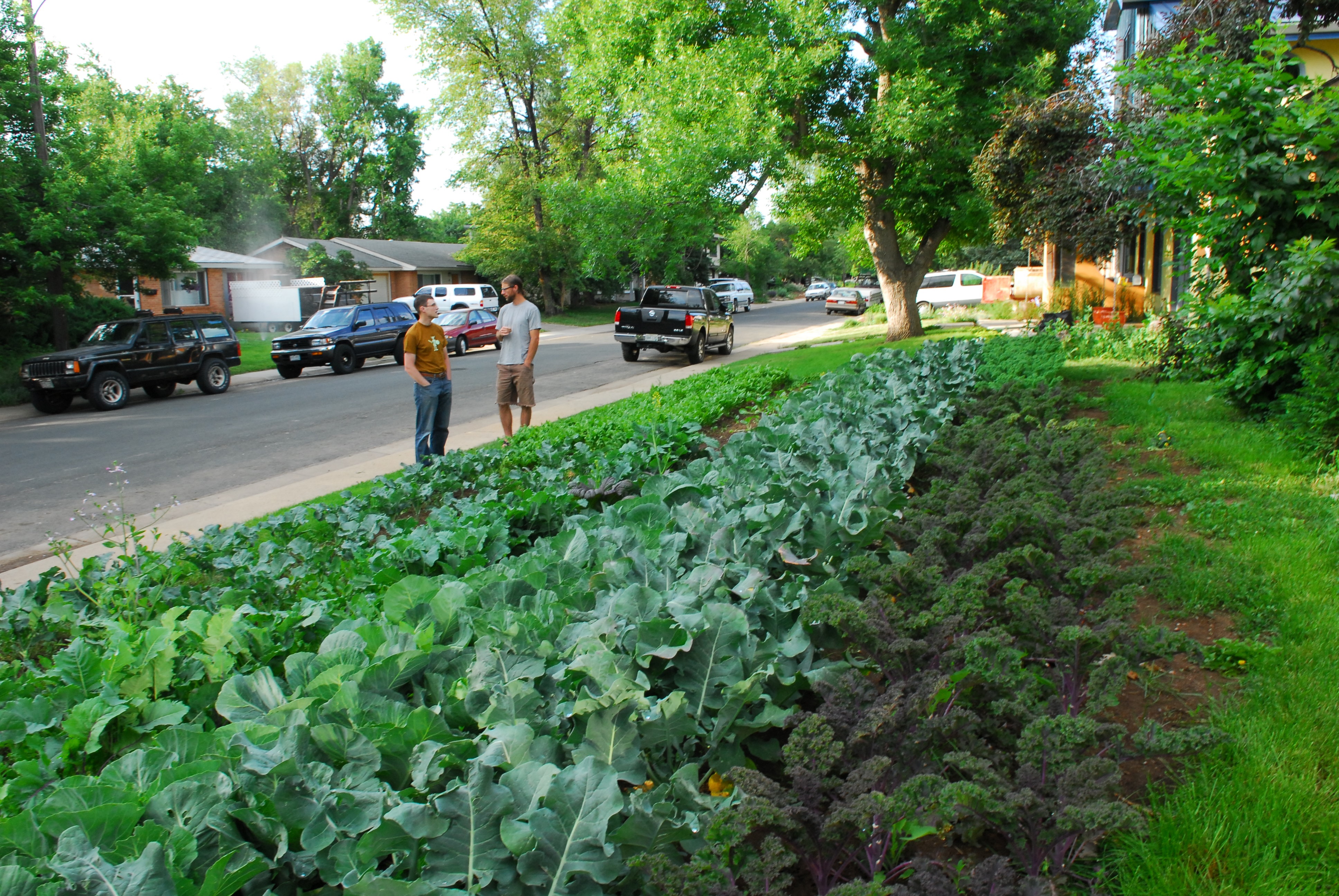
Kipp Nash requires that the owners pay some of the up-front costs. In a wonderfully clear application form that the landowner is required to fill out, he states: “Community Roots is happy to build a garden in your yard. We will prepare the soil, build beds, plant it out, weed, harvest, and keep tidy. New garden installation does require a small investment, however. As homeowner, you will be expected to pay up front for the following items: Sod Removal ($100), Compost/Soil Amendments ($175), Fencing ($?), Soil Test ($30). These are small fees considering that, in return, you will receive fresh vegetables, a landscaping service, and healthier soils than you have ever had.”
The landowner pays for any long-term improvements. Steve Mann asks that they pay for any perennials he plants. Wally doesn’t have written agreements with his homeowners, feeling that if the relationship works, they’ll come back the next year. If he is a good manager, and it is a good site, he has land security. “Over the years you gain some lots, you lose some, but we maintain a couple of solid, core plots.”
Q. How do you manage the logistics of multiple sites?
Being well organized, as on any farm, is key. Each of the farmers had a weekly schedule that they set up to visit each site. Thinking through the logistics of which crops were labor-intensive and really mapping out, in advance, which crops went where and why, seems essential to making multiple sites manageable. Kipp found in the first years that he had sites that were too far-flung; now all of them are within a 1 ½ mile radius and most of them are within ¼ mile.
Kipp moves from site to site mostly with a bike and bike trailer, and he uses a truck when he needs to haul a rototiller. He uses a lot of volunteer help and has paid help. Wally and Gail manage it with a farm vehicle and their own labor. Steve Mann uses volunteer labor — his CSA memberships include a work commitment, his homeowners help with their gardens, and he also has active support from a local “Food not Lawns” group.
Wally and Gail do their planning using standard bed sizes of 2’x25’ or 2’x12’. Most beds are planted twice a year, some are planted three times; they manage their beds “incredibly intensively,” he said, and have dollar goals for each bed. Steve’s various In Your Yard CSA sites seem much more individualized to the homeowner and to the specific site; they each have a name, and, based on the pictures and descriptions on his website, seem to have their own unique character. Kipp started out with each of the gardens growing the same produce; he now specializes the gardens, some are all in root vegetables, others just in beans, for example. That kind of specialization makes the management and the harvesting process easier.
Not surprisingly, when you think about it, the flip side to the hassle of managing multiple sites is that the farmers also have multiple microclimates that can work to their advantage. Pests and disease problems are more isolated, each site has different soil and different exposures to the sun and the wind, and each behaves somewhat differently when the temperatures rise, or fall. Produce is harvested and then hauled in a vehicle or on a bike trailer to the central site, generally the farmers’ own home. There they are washed, packed, and cooled. When asked what recommendation he would have for a new farmer starting a multi-plot operation, Wally says “invest in a good cooling system right off the bat.”
Q. What are the economics of your operation?
Kipp Nash now aims for gross sales of $20,000 per 1/4 acre, and thinks he and his wife can achieve $30,000 on 1/3 of an acre, with a net of $15,000. He drives a school bus, part time, for a steady income and for the health insurance.
Wally is hoping to gross $50,000 from his farm this year, and says that he and his wife are making a living solely off their farming. “It pays the bills, absolutely” which is an accomplishment for any farmer in these times.
Steve Mann, in his first year of running a multiple site garden, is aware he is in a learning curve about how to manage this kind of an operation as a business with profound social and environmental commitments. He is officially retired from Sprint and he supplements his income with off-season computer work. His goals, for the immediate future, are to pay the bills and pay for his gas.
In short, the income/expenses and the profit goals for these multiple plot gardens look pretty much like the economics for just about any small to mid-sized market garden.
Q. Why do you do this, rather than finding a single site where you have more control and can have everything at hand that you need?
“I like calling it Neighborhood Supported Agriculture” said Kipp Nash. “I’ve seen the impact of having my CSA distribution in our driveway, of meeting the neighbors because they come by to see what is happening. There are some magical things about this for me. I would like to see more and more neighborhoods coming together around food issues and sharing our spaces and our resources. I’d like to see neighborhood food swaps, where the woman with the pear tree who can only eat so many pears shares her excess with the neighborhood gardener who has a garden that produces too much for his family.”
He hasn’t quite settled on always farming this way, as his original plan was to be a more traditional organic market gardener, with land out in the country, not land in a suburb, and he holds onto that possibility of rural farming for the future. For now, he seems pretty engaged in the process of transforming neighborhoods through a local food economy; he is starting an institute to promote neighborhood supported agriculture programs.
Wally Satzewich came from a more traditional model of growing vegetables. Before he became an urban farmer, he grew between 10 and 20 acres of vegetables out in the country. He used big equipment, drip line irrigation, struggled with finding labor in the rural community. Over time, he figured out that he was making more profit on salad greens grown on a small piece of land than he was on the rest of the farm. He and his wife sold their farm and much of their equipment, and moved into town where he got offers of free land and where his expenses dropped dramatically. “The economics were great. We had less overhead, less expenses. Instead of buying 5,000 pounds of seed potatoes we buy a couple hundred. Our irrigation system was always tricky, we were always having to mess with it. Now, we turn on 15 water faucets. The two of us manage the farm. We still feel like farmers, we’re still doing the manual labor, but it is a lot more manageable and profitable.”
Steve Mann is a man with a mission. He gets inquiries almost every week from people wanting him to grow in their backyards, from all over sprawling Kansas City. He isn’t sure how the money side of all this will work, but is personally compelled by the need for humans to change how they live and how they grow their food.
“Maybe what we need is some kind of a city block master gardener, someone who can grow food for the people on their own block,” he said. Climate change looms large in his farming motivations, as do human communities. “I get energy from the future and have a vision of my great-great-grandchildren talking to me and asking me about what I did to save this great green earth.”
Katherine Kelly is the executive director/farmer of the Kansas City Center for Urban Agriculture. She can be reached at katherine@kccua.org.
Copyright Growing For Market Magazine.
All rights reserved. No portion of this article may be copied
in any manner for use other than by the subscriber without
permission from the publisher.