











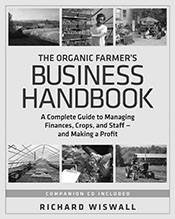
The Organic Farmer’s Business Handbook dispels the notion that there’s no money in farming. Richard Wiswall, who is a vegetable and herb grower in Vermont, asserts that farming can produce a decent livelihood — and he shows how to make it happen.
Market farmers are notoriously bad at keeping records, analyzing sales, and otherwise watching out for the bottom line. And it’s no wonder, given the fact that most small farmers grow dozens of different crops, market in multiple channels, and are always overworked. Who has time to do financial analysis?
Wiswall admits that he operated the same way in his early years of farming, and he is able to joke about it now. “Thank goodness for the IRS,” he writes in the introduction. “Annual tax filing is often the only reason farmers look at their bottom line; without a Schedule F, the farm’s current checkbook balance would be the only indicator of financial health.”
But after 10 years of long days and little money, Wiswall became uncomfortable with his seat-of-the-pants management style. “A person involved in any other line of business would think it ludicrous that many farmers don’t keep track of where the money comes from and where it goes. Every year, farmers may handle large sums of money — $50,000, $100,000, $200,000 or more — yet only have $20,000 net income in a good year and break even or even lose money in a bad year. And that’s with working your tail off! Why? Do you think the auto parts store or shoe store runs a business without knowing the numbers?”
Wiswall started his financial rehabilitation by keeping a crop journal and creating crop enterprise budgets, as described in the excerpt beginning on page 1, so he knew which crops were making money and which weren’t. He continued on to learn about cash flow projections, balance sheets, and other accounting basics. He also started keeping track of production standards, such as how many pounds of carrots a worker should be able to pick in an hour. And he explored production efficiencies, including tools and equipment that make work faster and therefore more profitable.
Wiswall shares all of this information in The Organic Farmer’s Business Handbook. In a relaxed, conversational, empathetic style, he gently leads the reader to the inevitable conclusion that business is an important part of farming, and that it ain’t rocket science. You can do this, he insists. You can farm smarter and make more money.
“One of the main goals of this book is to help create more prosperous, less stressed-out farmers,” he writes. “I’m not saying that farming is only about making money, but I am saying that a fair and decent return is both justified and necessary.”
Among the many topics covered in this book: marketing strategies and pricing, hiring and managing employees, bookkeeping, saving for retirement, taking a profit vs. reinvesting in the farm, business plans, and passing on the farm upon your death. He also offers some sage advice about farming with your spouse, which he and his wife, Sally Colman, have done together since 1981.
The books comes with a companion CD with five files. There’s a job description for farm workers that can be edited to fit your farm’s particulars, and a timesheet to help you calculate earnings, witholding, and tax payments. The other three files are Microsoft Excel workbooks, which contain self-calculating worksheets that can be edited, using your own numbers, to create enterprise budgets. In other words, you can open the carrot budget printed on the preceding page, change the numbers to reflect your own costs and labor, yields and prices, and see what kind of money you are making from carrots on your farm. Wiswall’s enterprise budgets for 24 vegetable crops are included in this self-calculating format. His top earners per acre: parsley, basil, kale, tomatoes, cilantro and dill.
My only quarrel with this book is its title. This is not a book for organic farmers — it’s a book for all market farmers, organic or not. Wiswall is a veteran market farmer who sells at farmers market, through a CSA, and wholesale. He has given a gift to his colleagues in the market farming world, in that his advice is so directly applicable to this type of farming. It would be beneficial to other kinds of farmers, as well, because accounting and financial management are similar no matter what the crop.
The most impressive aspect of Wiswall’s writing is that he was able to make a book about number crunching so inspiring. If you are serious about farming as a business, this book will help you make it a successful business. And a successful business is a sustainable business.
The Organic Farmer’s Business Handbook is softcover, 8 x 10 inches, 200 pages with CD-ROM. It is on sale now for $30 plus $4 shipping from GFM Books, PO Box 3747, Lawrence KS 66046; 800-307-8949; www.growingformarket.com/store
Copyright Growing For Market Magazine.
All rights reserved. No portion of this article may be copied
in any manner for use other than by the subscriber without
permission from the publisher.