











A movie trailer on the website of Dutch flower breeder Maruwa B.V. opens with dramatic space-odyssey style music over the words “Twenty years ago, passion became reality.” Then it cuts to a couple of guys in a field, inspecting and measuring a patch of steely blue flowers.
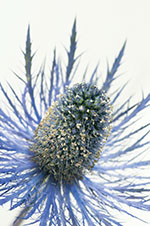
The flowers are Eryngium, often called sea holly or eryngo, and they do seem to inspire passion — or at least enthusiasm — among flower growers when they first encounter them. Eryngium are unusual flowers, spiky, sculptural, totally modern. They are popular in Europe and Japan, and slowly gaining a following in North America. The ‘Supernova’ and ‘Orion’ varieties that are found on the wholesale market in the U.S. are part of Maruwa’s Questar series, which is patented and licensed to growers in California, the Netherlands, and Africa. The company holds botanical information about the plants close to the vest, not uncommon for breeders, and presumably these varieties were patented because they are different from the species.
But anyone can grow Eryngiums that are as interesting as the patented varieties. Eryngium is an enormous genus — 230 species worldwide, 35 native to the U.S.— and the majority of them produce thistle-like flowers of metallic blue, purple, green, or white, with bracts and stems suffused with color. There are perennials, biennials and annuals. There are species that like cool, wet weather and species that prefer hot, dry weather. Some have airy clusters of tiny flowers surrounded by lacy bracts, others have big, solid flowers surrounded by spiny bracts. All are long-lived as fresh flowers, and they air dry easily.
Diane Szukovathy of Jello Mold Farm in Mt. Vernon, Washington, uses Eryngium in the bouquets she sells at upscale supermarkets in Seattle, where many people are sophisticated gardeners. “We’re pushing the edges on grocery store bouquets; we try to put in things that even gardeners won’t know,” she said. One favorite combination is an all-thistle theme: Eryngium with artichokes. On the other extreme, numerous wedding websites show Eryngium used in bridal bouquets as an accent to rounded, romantic flowers like roses and lisianthus.
The only problems with Eryngium, in general, is that it is susceptible to root rot and powdery mildew. Oh, and then there’s the smell. Some growers find that some species, at some times of the year, smell terrible (“like cat crap” is how one flower grower put it). This is not a universal reaction. Tom Wikstrom of Happy Trowels Farm in Utah says he has never noticed a bad smell, nor had a complaint about it. Paul Sansone, a flower breeder and former Eryngium grower in Oregon, says it only smells bad when wet. Diane Szukovathy, the Washington grower, says that it smelled bad early in the season, but by September had no smell. The two species I have in my house as I write this have no smell whatsoever. This may be another of those flower mysteries.
Here are the species most commonly grown in the U.S. for cutting and drying. The perennials, noted by their hardiness zones, require a special cold germination treatment, which will be explained at the end of the article.
E. alpinum, Alpine sea holly, is native to Europe’s alpine meadows. It has deep blue, star-shaped blossoms and filigreed bracts on 24 to 36-inch stems. It requires alkaline, well-drained soils and dislikes heat and humidity. The cultivars ‘Blue Star’ and ‘Superbum’ were bred for cut flower use. Despite their spiny appearance, they are soft to the touch. Zones 5-8.
E. amethystinum, Amethyst sea holly, has smaller flowers with a purple hue. “I like this one because it grows about 24” with more compact branching, so makes excellent structure for a medium sized bouquet,” Diane said. Zones 5-9.
E. giganteum ‘Miss Willmott’s Ghost’ has white flowers surrounded by silvery, spineless bracts. It is a biennial, blooming the second year from planting, but self-sows generously thereafter. Dislikes heat and humidity. Requires cold germination.
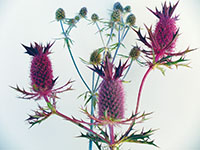
E. leavenworthii, Leavenworth eryngo or false purple thistle, is native to the tallgrass prairies of eastern Kansas and Oklahoma. It has big flowers, 2 inches tall by 1 inch wide, in a reddish-purple color with spiny bracts. Stems are 24 inches tall. It requires well-drained soils, and does well in hot, dry areas. It flowers in September. Zones 4-8.
E. planum, sea holly, has numerous small blue blossoms with spiny bracts on long stems. Hardy in zones 4-8, it cantolerate slightly acid soils and heat, though the color is better in cooler temperatures. Seeds germinate rapidly and easily. Two cultivars, ‘Blue Glitter’ and ‘White Glitter’, will bloom the first year from seed. ‘Silver Salentino’ is less white than silver. Diane says, “I catch it in the green stage just before it blooms. It makes for good bouquet texture and structure and I don’t have to worry about potential odor issues.” E. planum, and especially the cultivar ‘Blue Glitter’ seems to be the source of most of the complaints about its smell.
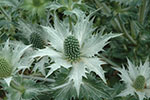
E. yuccifolium, rattlesnake master, has clusters of round, 1-inch, white flowers atop 24 to 48-inch stems. The flowers can be cut green or light brown and used in dried arrangements. Hardy in zones 3-9, it is also heat and drought-tolerant.
Cold germination
Eryngium seed is difficult to start, and the germination rate can be less than 50 percent. The best results are obtained from collecting mature seed and immediately planting it in a cold frame outdoors, to provide the same conditions it would encounter in its native environment. Jelitto, the Dutch perennial seed company, recommends that cold-germination seeds be handled this way:
Sow in 72-cell or open flats, and keep moist and warm (64-74°F) for the first two to four weeks. Then lower the temperature to between 25 and 39°F for four to six weeks. Flats can be covered with snow, which will keep the temperature in the optimum range and keep the media moist. The melting snow helps destroy the seed shell and help germination.
Ken O’Dell of Spring Valley Nursery in Paola, Kansas, says that he plants cold-germination seeds in 4-inch deep flats in fall and puts them in a cold frame outside. He cautions that the cold frame should have hardware cloth on the bottom, sides and top or mice will get in and eat the seeds during the winter.
Sources
Jelitto Seed, www.jelitto.com, 502-895-0807, has seeds of all the varieties mentioned and many good photos.
Gloeckner Seed, www.fredgloeckner.com, 800-345-3787, has ‘Blue Glitter’ and ‘White Glitter’ seed.
Copyright Growing For Market Magazine.
All rights reserved. No portion of this article may be copied
in any manner for use other than by the subscriber without
permission from the publisher.