









I’m primarily a vegetable grower, but I enjoy experimenting with all sorts of other crops: flowers, herbs, berries, fruits and, especially, seeds. Growing crops for seed adds a series of challenges beyond mere vegetable growing in the harvest and separation of the actual seed from the rest of the plant. Grains and dry beans, also known as pulses, lend themselves easily to mechanical harvest and separation but I’ll start here with the least mechanized approaches and work up to the more mechanized. With beans, the most basic approach is to pick the dry pods and shell them by hand. This gives very high-quality, clean seeds but is very labor intensive. You can do the same thing with wheat, corn, and pretty much any type of grain, but the smaller the grain, the more laborious the process.

Basic threshing
To speed the seed separation process you can thresh the seed, which is to say you can give the plants a thrashing until they give up their seed. For all grains and beans this process starts with cutting the plants or at least picking the seed heads (known as pods on beans and ears on cereals). I’ve found that pulling by the roots is a bad idea as it tends to bring along small dirt chunks that are similar in size and density to seeds and are hard to separate out. For that reason, I try to keep the plants out of the dirt as much as possible while I’m harvesting and dirt out of containers that I’m transporting plants in.
The simplest way to thresh is by laying down a tarp on a firm surface, spreading out the whole plants, or just the seed heads and then “dancing” on them until most of the seed heads have shattered. The twist is more effective here than a hop. A second tarp over the top helps keep the seed clean and one suggestion is to only go for most of the seed heads and not wait for all of them to shatter, as this will pretty much never happen.
The time-tested threshing technique is to use a flail instead of your feet. The flail can be a stick but usually it’s a long stick with a shorter heavy stick attached to the end with some sort of joint. There is a definite point of diminishing return here, where the extra threshing will not efficiently remove the last stubborn seeds from their heads without extraordinary measures and those seeds should probably be thrown out with the chaff before you waste too much time on saving them.
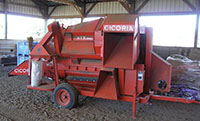
If you want to take a small step up in the threshing department, a simple yard chipper-shredder might be your best bet.I’ve used an old 5 hp Rotohoe, unmodified, with success on everything from chickpeas to wheat and oats. Gene Logsdon’s excellent book, “Small-Scale Grain Raising,” has a design for a thresher that Rodale’s Research and Development folks came up with. That design floats around the web in various spots and can be found with a little google searching. For beans and peas there are two interesting “shellers” I’ve used which work for fresh shell beans as well as dry beans. The smaller of the two is from Taylor manufacturing and it uses rollers to squeeze beans out of the shell. The larger is the Rotofingers from Welborne. Both do a good job of separating the beans from the chaff. There are some small, portable threshing machines on the market that will also work with small grains. These are designed either for small-plot research or developing countries, and would be well-suited to farms doing at least an acre, and they could be easily shared by small farms. I would suggest sizing your thresher to match the volume of material you want to process, as the setup and cleanup take more time on larger machines.
Basic winnowing
After threshing, you need to further separate, or winnow, the chaff from the seed. This can be done in a strong wind, but I find it easier to use a box fan to create the wind. I simply pour the material to be separated in front of the fan and into a container below (Rubbermaid totes work well for this). The chaff is lighter than the seed so it blows away. This takes 5 to 10 repeat pours in some cases to get the seed really clean but it works amazingly well, is relatively fast, and with a little practice there are lots of fine adjustments that can be made by varying the pouring height, the fan speed and the pouring speed. I use a tarp to catch the chaff and it also acts as a safety to catch seed if I accidentally miss the container when pouring.
Washington State University did some work on small-scale dry bean production and has posted the designs for a winnower as well as two threshers on their web site, http://vegetables.wsu.edu/NicheMarket/smallScaleThreshing.html. The winnower is a squirrel cage fan with baffles that allows you to pour beans into a separator. The chaff blows out the top and the beans fall through a chute in the bottom. I’ve seen these in action and they work well.
You’ll notice quickly that if you shake the containers of seed and chaff back and forth the larger chunks of plant material will rise to the top and the smaller particles will settle to the bottom. You can easily skim the big pieces off by hand, or by using a sifting screen, saving a little time in front of the fan. Similarly, you can use a screen that is smaller than your seed to sift out small particles. These concepts are incorporated into basic seed cleaners, such as the Clipper seed cleaner. Seed cleaners use different screens with different size and shape holes, as well as fans, to clean seeds quickly and throughly. They come in sizes from desktop to room sized. Simple ones use just two screens that shake, the first lets seeds through, but not big chunks, and the second takes small pieces away while the fan blows away very light material. Seed cleaners, with a good set of screens, can also be used to separate different sizes of seed. One word of warning with seed cleaners is that they take a bit of time to set up properly and a lot of time to clean out between batches, and they don’t work as well if you’re not feeding enough seed through them. They are also loud and create a lot of dust. Make sure to size the tool appropriately or you might find yourself going back to the fan method which takes very little setup and cleanup.
Combining the processes
If you have more than a few acres to devote to grains or beans you might consider a used combine. The combine combines the harvesting, threshing, and initial cleaning of seed crops. Newer combines are quite large, unless you get one specifically for research plots, but older ones can be found down to 8’ wide. Early combines were made to pull behind tractors (or even horses), and the Allis Chalmers All Crop is still used for specialty seeds and is flexible enough to find good uses on small diverse farms. Combines come in a wide range of shapes and sizes and they are definitely for farms with mechanically minded folks who don’t mind spending time making adjustments, taking apart and cleaning out the machine between crops, and doing repairs. The smallest combines might harvest as little as an acre but they probably are more useful for single-variety plantings of 5 to 10 acres.
For more information
Along with Anthony Boutard of Ayers Creek Farm in Oregon (who has also written on dry beans for GFM), I have created a blog in an attempt to stimulate discussion on growing and harvesting small grains and pulses. Please join us at www.grainsandpulses.blogspot.com.
Josh Volk, a regular contributor to GFM on tools and equipment, farms and writes at the edge of Portland, Oregon. He also helps farmers around the country improve their farming systems. Visit www.slowhandfarm.com.
Copyright Growing For Market Magazine.
All rights reserved. No portion of this article may be copied
in any manner for use other than by the subscriber without
permission from the publisher.