




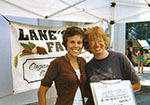
Erin Aquino wrote this essay last year for the newsletter of Lane’s End Farm in Lowell, Indiana, where she grew up. Erin’s parents, Liz and Corey Aquino, have been growing organic vegetables for 18 years and selling through Chicago and local farmers markets as well as an 80-member CSA. “This was very inspiring to us as parents and farmers, when we wonder if this was the right thing to do for our lives and our family,” said Liz, who is pictured at right with Erin.
I am because you are.
The preceding phrase comes from an African-derived philosophy called Ubuntu. The idea is simple, yet crucial. I am connected with you, therefore, my actions have a direct relationship with you and vice versa. I live and breath, you live and breath, our lives, and our breath are one.
I was introduced to the notion of Ubuntu through an Americorps (America’s Peace Corps) program, City Year. City Year is a nonprofit organization that works with ‘at-risk’ urban youth, and it is my new employer. For me, I am because you are means that I will spend my life helping others that are less fortunate than me. While City Year will teach me how to work in inner-city schools and further my understanding of non -profit work, I cannot accredit City Year for teaching me the idea of Ubuntu. While the term entered my vocabulary only a week ago, the philosophy was ingrained in me as a young girl growing up on a small organic farm.
I am not the only idealistic farm worker that has become devoted to solving social problems. My cousin is in a remote village in Mali for the Peace Corps, my uncle quit his cozy computer job to become a 2nd grade teacher (not quite as cozy, I think), and my good friend dedicates her time and heart to understanding social injustices in Chicago all the way to Nicaragua. What do we all have in common? We have all harvested garlic, cleaned lettuce, and weeded tomatoes on the farm.
While other factors are at play in each of these people’s lives, the relationship between farming and social awareness/action becomes uncanny as my friends and family move from the farm and into the ‘professional’ world of humanitarian work. To go further, I firmly believe that local and organic farming plays a pivotal role in creating an ethically global citizen.
Farming forces people to become acutely aware of the their environment. Through this awareness comes the understanding of peoples’ relationship with the environment, and subsequently, the world. If I do not pull weeds out of the bed of lettuce, this neglected bed will disappear into a shroud of weeds. The bed of lettuce depends on me to keep it alive. And I depend on the lettuce to keep me alive. The lettuce and I are no longer mutually exclusive, we are intractably intertwined. I am because the lettuce bed survived, and the lettuce bed is because I am.
How does this relate to caring about the impoverished village in Africa, or gang violence in Chicago?
Farming helps us to examine the world and care about our position in it-down to our physical relationship with the trees, the ground, the soil, the plants, the food. If we take time to care about tending to our lettuce crops, how can we ignore the relationship with our families, neighbors, and those that are half-way across the world, but just a click away. Farming helps us to realize that we are all connected. What we do, affects others. Our desire for cheaply made clothes, makes a market for children workers in China. I would never directly support such an injustice, but I still buy my clothes from Wal-Mart… We are because they are. And these connections can be inherently beautiful and good.
In this globalizing world, we cannot ignore the relationships that exist all around. If I step on a plant, it dies. And if I ignore the homeless on the street , the poverty in Guatemala, or the violence on the south side of Chicago, I might be doing just as much harm as stepping on the plant. I must consider how my actions or inactions affect these people. Farming brings us to the heart of it all, our relationship to the world, and our care for it. I am because you are.
I do not mean to be negative about the world’s problems. The world offers innumerable beauties and graces everyday, and being able to farm is one of them. I am privileged to be able to write this letter to CSA members who have made ethical decisions with their lifestyle and place in the world. You have made steps to connecting your community with nature and people through local farming. But you have also progressed to a more ethical way of living that works to limit the amount of waste Americans produce through commercial farming. Thank you.
Perhaps, on a more self-involved note, I must take time to thank my parents for allowing me the opportunity to farm and to relate and live with this world. I begin my first post-college job in the heart of the concrete jungle of Chicago. However, without my hands in the soil, my feet in the mud, and my heart in the farm, I know I would not have the drive ‘to serve others’ if it was not for spending my youth as a farmer.
I am because of my family’s decision to advocate for ethical farming methods.
I am because of the farm.
I am because you are.
Copyright Growing For Market Magazine.
All rights reserved. No portion of this article may be copied
in any manner for use other than by the subscriber without
permission from the publisher.