











Tomato prices in May and early June in northern Indiana, where we farm, are nearly triple that of mid-summer tomatoes. Customers can’t wait for the first local tomatoes! But prices are high for a reason — early tomatoes cost more to grow, mostly because of heating costs.
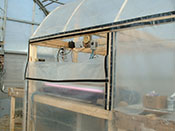
Our market is open year-round, so we are always looking for ways to extend the seasons in both directions. Last year we grew tomatoes in an unheated hoophouse. We were impressed by the high yield and quality of the hoophouse tomatoes. This year we want to take our tomatoes to market even sooner by adding heat and starting earlier. But rather than heating an entire greenhouse in mid-winter, we have built a mini-greenhouse inside our large greenhouse to give tomatoes an early start.
The structure
To create the mini-greenhouse, we stacked two 3’ x 14’ tables on top of two other tables to give us a 6′ x 14′ structure. The bottom table has hardware cloth on it, but we removed the hardware cloth from the upper tables. We drilled holes into the upper table frame with a 1 1/8” butterfly bit. The holes were drilled at an approximate 45 degree angle. Then we inserted 1-inch PVC pipe into the holes to make hoops above the upper table. We draped plastic across the hoops and all the way to the floor. We secured it all the way around with Velcro — staple-on Velcro is attached to the wood, and stick-on Velcro to the plastic. In order to access the plants, we created a window. The Velcro creates a nice seal and allows us to easily ventilate at the top, where cold air does not reach the plants, and the window allows for easy access to the plants. Velcro is available at many hardware stores or on the Internet. We purchased ours through E & R Seed, which sells it as a way to secure the ends of roll up sides to greenhouses.
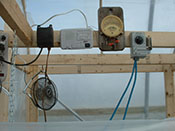
We also added some simple, low-cost systems to better control the atmosphere. We wired an extension cord to a weatherproof thermostat to control two space heaters under the table. We placed the thermostat in the middle of the mini-greenhouse, close to the plants. We use a thermostatically-controlled germinating mat under the seed trays. A lamp with full-spectrum light bulbs is programmed to turn on early in the morning. And we use a Thermalarm wired to a wireless intercom to alert us with a buzz in the house if for some reason temperatures are outside a set range. The buzz is much more pleasant than the loud siren horns commonly used and much cheaper than telephone-connected alarm systems.
Ben Hartman and his wife, Rachel Hershberger, own and operate Clay Bottom Farm in Goshen, IN. They sell at the Goshen Farmers Market, to the local food co-op, and to area restaurants. They also operate a CSA. Their website is www.claybottomfarm.com and Ben can be reached at benchartman@hotmail.com.
Copyright Growing For Market Magazine.
All rights reserved. No portion of this article may be copied
in any manner for use other than by the subscriber without
permission from the publisher.