



Getting a farmers market started from the ground up isn’t an easy task. It takes lots of coordination between market stakeholders, your municipality and other vested parties to create bylaws, establish rules, regulations, find a suitable location, and of course find farmers to sell at your market. Once your market is established, the work doesn’t end there and you’ll need more than just a passion for local food and farming to keep your market afloat. Farmers market organizations across the country employ these tactics to create vibrant markets and, in a nutshell, here are a few of the tips, tricks and strategies that market managers anywhere and everywhere can utilize to do the same.
No matter if your market is in the city or in a rural area, big or small, indoor or outdoor — one thing all market managers have in common is that they are working with limited resources. Because the success of a farmers market is dependent on the success of the vendors at that market, management is often strapped until the market is established in the community.
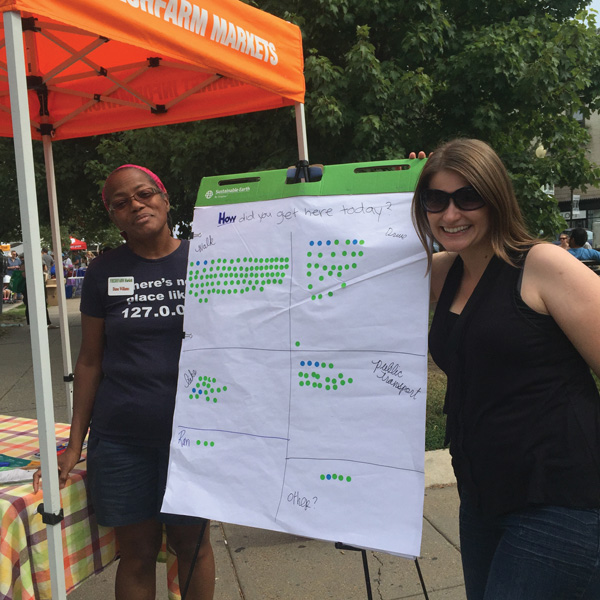
Establishing a new market can take time to accomplish, as you might find your market shoppers want something different than what your market originally set out to offer, or it’s taken a few years to set a consistent schedule and reliable supply of the foods that your shoppers want to buy. Finding the right product mix takes time and there is no formula, but you can do informal dot surveys at your market to poll your shoppers on what products they routinely shop for and what products they would like to see more of. If you have an email list, you can also send out shopper surveys electronically. Google Forms is a great free resource you can use to create polls, questionnaires and even market application forms that you can share via email.
Below: A dot survey is a quick way to learn more about your customers, information that can be used for marketing and grantwriting. Diane Weiums, left, and Brittany Beck show the results of a survey about how people get to the FRESHFARM Dupont market in Washington, D.C. Photos courtesy of Nikki Warner.
Catering to the shopper in the way of product mix is just one way that you can successfully manage your market, but without the farmer you’ve got no shoppers so it’s very important to build relationships with the folks that apply to sell at your market. In order to do that, it helps for market managers to know where their vendors are coming from, literally, with a site or farm visit. Taking a field trip to see how your farmers operate their business, seeing it for yourself, learning how they prepare for market and even driving the route they have to travel to get to your market is a great to get to know them and it plants the seed for good rapport.
Going on site visits also makes you a better-qualified source for information about the farmers and producers at your market. Assuming you have a market information table, it’s inevitable that someone will come by, surprise, asking for information about a specific vendor so consider yourself an ambassador for each one of them and in the case that someone comes to you with a question, be prepared to have some answers. The better a source of information you can be at your market, the more you are able to engage with those who take time out of their day to pay you a visit. Chances are they will learn something new from you and share that information with someone else; the ripple effects of interactions like those are what help build successful markets and a following of loyal shoppers and supporters.
In addition to being a resource of information to market shoppers, successful market managers are also great resources to their market vendors. Keep your eye open for grants, scholarships, news articles and other opportunities that pertain to the work that your market farmers and producers do. No matter if your market charges vendors a flat fee or a percentage of sales, give them more than a 10×10 space and a license to sell, be their advocate because your success depends on theirs!
Now that you’ve established the warm and fuzzies with your market vendors, it’s time to discuss the flip side of market management —enforcing rules and decision-making. Not all decisions can, or should, be made by majority rule, so it falls to you to decide what is best for the health, the safety, and the reputation of your market. Even if you have good relationships with your vendors, you’re bound to do something that someone doesn’t like. If it’s in your nature to be a people pleaser, this can be devastating, but you have to remember that this isn’t a popularity contest. It’s a job. If you are in the position where you’ve made or are about to make a decision someone doesn’t like, own it and if you are unsure about a decision you need to make or a rule you need to enforce, know when it’s time to ask for help and reach out to your stakeholders, colleagues or peers for their feedback and guidance.
With all the work that goes on behind the scenes at the farmers market, it’s easy to overlook the things that, if left unchecked, can cause big problems for you down the road, starting with safety. Work with your municipality to make sure that your permits are all up to date, that you know whom to call if you need to tow a car or report an incident or theft. Food safety is also a very important, if not the most important, ingredient in serving food to the public, so show your vendors and shoppers that you take their safety seriously and get adequate food handler training and certification. Many municipalities now require that there be at least one person with a food handlers license anywhere that food is served outdoors, including farmers markets, so be proactive because the training is worth the investment and enforcement of legal food safety standards should be a part of your market’s rules and regulations if it isn’t already. If you find yourself facing a health violation at market, corrective action must be taken immediately. To avoid these types of situations, help point your vendors in the right direction before the market season begins.
Winter is a great time to conduct group food safety training, and it’s possible to get a discount the more participants you have. Group meetings or trainings before the busy market season begins are also a great opportunity for you to share information about rules, paying fees, and recommended equipment vendors should bring with them to market. Tent weights are mandatory at an outdoor market, as is a first aid kit, sturdy tents, tables and bungee cords. Let vendors know what you expect from them in order to have a safe and successful season.
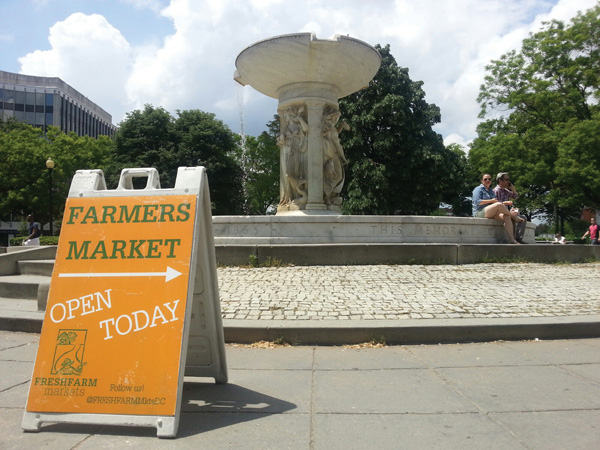
Another sign of a well-managed market is a good-looking market. Invest in some signage; vinyl banners and plastic A-frame signs with removable coro-plast sign panels are both affordable and durable options for outdoor markets. Chalkboard signs and matching tablecloths are also great touches, but make sure they are clean and kept in good condition, and they are replaced when they are not. Keep your market materials stored in waterproof plastic bins, and keep things organized by sealing them in gallon sized (or larger) Zip-Loc bags. It’s also a great idea to keep a market binder onsite that includes copies of your market permits, vendor contact information, a market map, email sign-up forms and any other information you need to keep handy. Consider making a market report form to keep in your binder as well, and use that sheet to record attendance information, weather, volunteer hours, customer counts, and new foods at market. Keeping track of your market data on a weekly basis is a great way to learn more about the health of your market, to track the seasonality of produce at your area, and identify peak hours. This data can come in handy if you ever want to apply for grants, or if your vendors apply for grants of their own. Collecting data shopper demographics and peak market hours are important, and can come in handy especially if you are considering having paid sponsors table at your market.
Below: Sturdy directional signs, like the one FRESHFARM sign below, are a good investment for a market.
The market information booth isn’t the only important place to have a nice display; take a look at your market vendors and see if you can find where their booths could use a little jazzing up. Add height to a display with some apple crates, help them lay out produce to create a colorful and eye catching contrast of colors, or find a volunteer with artistic tendencies who is willing to draw up some nice signs or flyers for your vendors. There is an art to creating a great market display, so look around you, especially if you get the chance to visit a farmers market that isn’t your own, to get some ideas and inspiration.
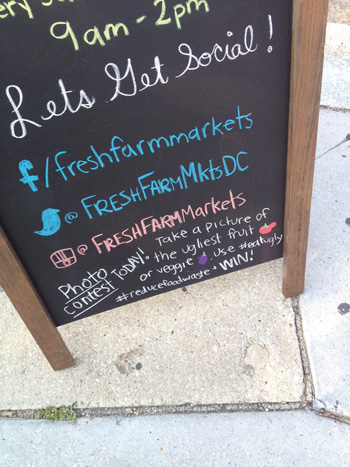
When you’ve got happy vendors, satisfied shoppers and a great looking market, it’s time to promote it! Paid advertising is a great option if you can afford it, but if you can’t, don’t sweat it. You may have noticed over the years more and more market shoppers who whip out their phones to snap pictures of produce. While it might be annoying, especially for the farmers who would rather make a sale than be the subject of an amateur photographer, from the marketing perspective this phenomenon has a name: user generated content. Log into Twitter, Facebook and the food fanatics’ favorite, Instagram, and you’ll see where all those heirloom tomato and paw-paw pictures end up. Jump in on the conversation and create an account for yourself on social media; the photos of your market are already out there so follow those folks who are serial snappers and then share photos of your own, from the farms you visit, new foods as they come into season and more. Market managers are lucky to be surrounded by so much beauty and bounty, so share your perspective with the social media world. It’s fun, it’s free and it will be another way you can engage and communicate with your fans about important market announcements and the seasonality of items available at your market.
Below: Chalkboard signs are a great way to promote special events, such as this one advertising a photo contest for the ugliest fruit or veggie at the market. The author notes that customers are taking photos anyway, so you might as well use it to promote the market.
Another option that involves little or no cost is to make your own weekly newsletter. Mail Chimp, Tiny Letter and Constant Contact are all great services you can use to communicate with your market shoppers and farmers alike. Shoppers love to get updates from the farms they buy their food from, and gathering that information yourself will help keep you in the know while promoting your market at the same time, a total win-win.
Keys to good farmers market management are strong communication skills and a genuine curiosity and interest in the world of business and agriculture. At the end of the day it’s market management’s job to think of the farmer first. Learning about market vendors, working with your municipality, being proactive about food safety, being (and staying) organized, in addition to being a source of information for your shoppers and vendors ultimately empowers your market vendors to grow the best produce and give the best shopper experience they can give.
Good food and a sense of community are the ingredients that make for successful farmers markets, not coupons and gimmicks, so start with these tips and you’ll be well on your way to a successful market season!
Nikki Warner has managed farmers markets that are a part of the FRESHFARM Markets network in Washington, DC. She is moving to a small farm in Minnesota this spring and will be managing markets in the Minneapolis area part-time. Follow her on Instagram at @nikkididit.
Copyright Growing For Market Magazine.
All rights reserved. No portion of this article may be copied
in any manner for use other than by the subscriber without
permission from the publisher.