










Excerpted with permission from their book Deadhead: The Bindweed Way to Grow Flowers.
If I took you back in time to show you how Jeriann and I became flower farmers, you wouldn’t believe we would ever be making a living, much less a good living. Our knowledge reservoir didn’t register empty but came close—I’d grown up on a dairy farm and worked on a two thousand acre potato and grain operation for a decade, but I couldn’t tell my peonies from my asters.
Our first farm, loaned to us by Jeriann’s parents, was an old riverbed that sported fist-sized gravel so plentiful it provided enough drainage for a neighbor’s pump to run all summer without creating a pond. Our infrastructure included a five horsepower tiller, a hoe, a shovel and a rake. We sold from the hatchback of our car and then—Woohoo!—from the back of a pickup with a camper shell. We had no cooler, just utilized the basement in the high heat of summer to keep flowers cool.
With high hopes, I sent out letters to over thirty prospective florists in the valley announcing our operation, and received not a single response. Failing there, we persevered, selling at a farmer’s market twenty miles away, sometimes only making thirty dollars a day. The first summer I sold fresh flowers on a bucket route I made about four hundred dollars selling to mom and pop shops and florists in our hometown—less by tenfold what we may make at a single stop now.
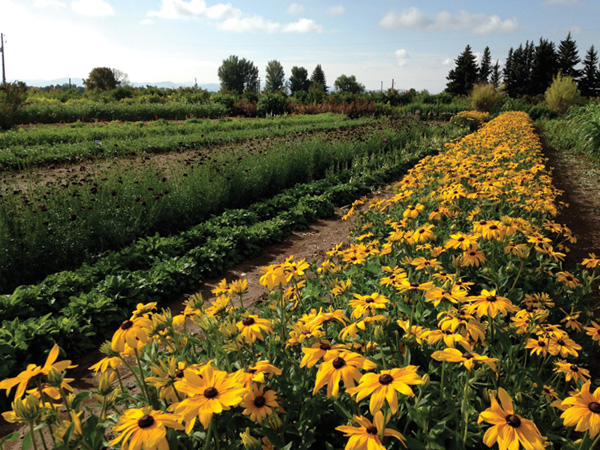
Below: Scabiosa and rudbeckia growing at Bindweed Farm in Idaho. Photos courtesy of Ralph Thurston.
Our ignorance was a blessing, because had I known how pathetic our operation really was I would have quit.
The story I tell tracing our steps from near nothing to two hundred thousand dollars in annual sales might well be fiction since neither I nor Jeriann can recall exactly how it happened—not because we have Alzheimer’s, but because events happen so quickly, erratically and organically on a farm that they defy memory.
Since a teenager, I raised leafcutter bees, a valuable insect that pollinates alfalfa seed, but over time commercial agriculture became more efficient, farming from road to road, eliminating fencelines, tree lines and all wild areas, shrinking forage area for bees. In an attempt to keep the bees thriving, I planted two acres of wildflowers on my in-laws’ unused property to create extra habitat. Since Jeriann was artistic and interested in dried flowers, I added a small plot of about eight hundred square feet for that project, planting a hundred small packets of different species from a dried flower seed specialist in hopes of finding out if leafcutters preferred one flower over others, with a secondary hope that the flowers might be harvested and sold (though to whom, I had no idea—I hadn’t gotten that far).
The field was stunning (if you ignored the weeds) and from the tiny plot of never-before-seen-by-us flowers, some wholly unsuited to our climate and soil, Jeriann made wreaths that we sold at craft fairs that winter, enough to justify further trials. We shortened the list of drieds, eliminating obvious failures, increased their area, and expanded our sales from craft fairs to a local farmer’s market and a couple craft stores.
It seemed an easy step from growing drieds and selling them at the farmer’s market to picking a few fresh flowers to have along with our offerings, since we were already growing some varieties usable as both, like larkspur and statice.
And when a florist showed up at the market and bought a few things and asked us to stop by her shop, it seemed a no-brainer to expand our fresh flower sales to a bucket route that included other area shops.
And when we saw other wholesalers at the florists it seemed it might be easier to sell exponentially more product to them, even if at half the price.
And then when one of our wholesale buyers sold out and another went broke, we had to think fast or get real jobs, so to stay in business we realized we needed to copy and tweak what they had done. We’d learned enough in conversations and a short stint working for a wholesaler during the Valentine’s Day rush to see that the resort designers bought far more flowers, particularly the kinds of flowers we grew, than the area florists we were selling to, and so we decided to do a bucket route that catered to the resorts.
And we haven’t looked back.
After two decades of mistakes we now make a good living working from mid-March to mid-September. We owe nothing on our house, our land, our vehicles. We grow ninety-plus species of flowers, shrubs, bulbs and grasses on about four acres, all in a zone five climate with only 120 days between the last frost in May and first one in September. Almost half of our sales come in two months, July and August, with earlier sales supplemented by a couple of heated greenhouses, each two thousand square feet, a hoophouse of equal size, and a three thousand square foot shadehouse. Selling to about twenty clients in two mountain resorts within two hours driving distance, we make fifty trips a season.
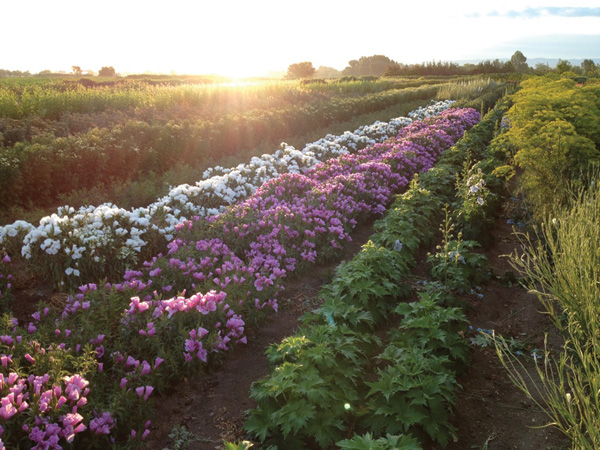
Below: A summer sunrise at Bindweed Farm. Godetia is in full bloom on the left and delphinium is just starting to bloom in the center.
Jeriann and I do almost all of the work ourselves, me on the beast end of things in the field, she on the beauty end attending to processing and clients, sales and service, though we have two part-time employees who work 600 hours a season washing buckets, driving an extra van on the route, weeding and spraying and helping with all the odd jobs associated with a farm. If you don’t include our hours in the expense column, we cleared a hundred thousand dollars last year, a big difference from that first summer of four hundred dollar sales.
And did I mention we get November, December, and January off, and only work a few hours in February, March and October? And part-time in April and September?
If you’re thinking about flower farming, you’re probably leaving a job, tired of working for someone else and longing to be your own boss. But if you’re like me, you might discover that working for someone else probably wasn’t as bad as you thought and you may be embarrassed at how bad an employee you were. You may come to sympathize with your former employers once you act from a position similar to theirs. When you work for yourself, you can call in sick and you can leave jobs undone and you can even do them poorly, but you and no one else will pay. When you’re the boss no one rides you about your performance, or inspires you, or lays out your day, and there’s no one else to point fingers at, no one to whom to complain. And if you hire help, you may find that being an employer is just as emotionally wearing as being the employee.
On the other hand, there’s nothing like taking a break when you feel like doing so, grabbing a bite when you’re hungry, and not having to answer for every movement—you may find that the freedom of working for yourself outweighs the increased responsibility, though there’ll be days when you wish you could turn the farm off and it would all just go away.
Once you make the choice to turn from employee to entrepreneur, you’ll need to start building an empire, with networks of associations with customers and service people, plant and plug vendors. You’ll need to develop an infrastructure of devices you may not be familiar with: tractors, tillage equipment, coolers. You may have to hone your people skills and better your work habits. As you grow and learn you’ll inevitably run into the difficult decisions that come with opportunity, as hoe turns to hand tiller turns to tractor, as back yard turns to leased land turns to purchased land, as air conditioner turns to cooler turns to bigger cooler and yet a bigger one, as row cover becomes greenhouse, as delivery van becomes truck, and along the way you may find that everything you do was in some way a mistake: if you’d only known, you’d have bought more land, built more greenhouses, built a bigger shop, a bigger cooler, not planted that woody. Unless you want to be buried by regret, you’ll laugh all that off.
How do you get from there to here? Well, it’s like the old question, “how do you eat an elephant?” The answer: “one bite at a time.” We couldn’t have envisioned what we’ve become, couldn’t have imagined we could actually do the amount of work we do or sell the amount of flowers we sell. But here we are, and we’d like you to get here, too, because the world’s a better place when people are running their own show, reaping the rewards (and yes, disappointments) of their labor, feeling responsibility and freedom simultaneously, and most importantly, being out in the natural world and feeling the sheer joy as each new species comes to bloom. There’s really nothing like it.
Ralph Thurston and Jeriann Sabin run Bindweed Farm in Idaho.
Copyright Growing For Market Magazine.
All rights reserved. No portion of this article may be copied
in any manner for use other than by the subscriber without
permission from the publisher.