




By Jesse Frost
Research shows that the majority of Americans are now using social media, so it stands to reason that the majority of your future customers are, too. And because these sites are mostly free to join and cheap to advertise with, social media presents an incredible marketing opportunity for farmers. Turning your activity on social media into sales, however, is not as straight forward as simply signing up for a Facebook or Instagram account. Or so I learned.
You see, my wife and I have a decent social media presence for our farm Rough Draft Farmstead, but in our six years of running our own operation, that presence has not necessarily translated into sales. Selling ourselves has always been fairly easy. Selling our CSA, however? Not so much. So in hopes of taking better advantage of Facebook, Instagram, Twitter, and the like, I decided to call a few social media and marketing experts to get a better understanding of how it all works, and how better to work it.
In so doing, I learned some simple concepts about using social media that I had overlooked as well as some game-changing “bigger picture” ideas that not only revolutionized how I think about our farm’s social media, but also helped us to entirely sell out of CSA shares three weeks before the first delivery for the first time since we’ve been farming. Further, we even have our first waiting list. So let’s dig into what I learned and what we changed.
Being social
For a small business, the inclination with a tool like social media—which, for our purposes, will primarily consist of Facebook, Instagram, SnapChat, Twitter, and a few others I’ll discuss below—is to simply use it for marketing. In other words, you start a page and begin pushing your product. But successful marketing on social media, as odd as it my sound, is not about marketing. Not really. As social media consultant Janet Flout, founder of Tatu Digital Media put it to me, “Don’t think of it as marketing at all. Think about it like having conversations with real people.”
“Social media,” she puts it succinctly, “is about being social.” You’ve got to engage with people and tell the story around your product. Make it something people can relate to and want to be a part of.
I spoke with Nick Burton of Paris Victory Gardens and creative director for Bootstrap Farmer, who does social media consulting for farms as well as other industries. He gave a good example of how “being social” works for a business. He described how, when he’s working with large brands, a lot of the work he does in the beginning is to tie that brand into the culture around the product. So he’s worked with motorcycle companies for instance where, long before they start any advertising, they begin posting videos and content that ties their brand into the biker lifestyle.
“Tying your brand into your local community,” Says Nick, “even before you get started is pretty powerful.” He says that in order to get local people to “care about what you’re selling, it’s good to get out in the community and connect them to what you’re doing.”
As farmers, we can create a story that, when the time comes to sell our CSAs or get people to market, those who’ve been following that story can have an opportunity to become a part of it. We tell our stories, we engage, we invite people to be a part of it, and I think that’s powerful. It’s also powerful, as Erin Benzakein wrote in her October 2017 Growing for Market article, to be the face of your product—to put a farmer behind the brand if you’re comfortable with it.
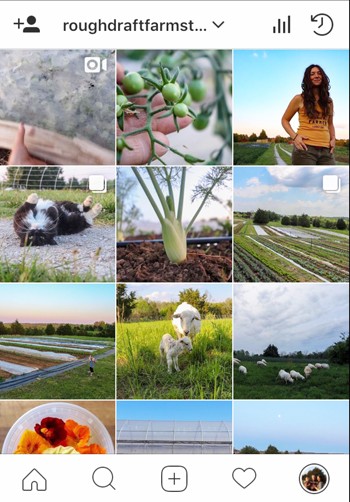
In our posts, we have tried to include more of ourselves and our crew (with their permission). We have also made sure to enrich our captions with additional information about what we have going on around the farm and farm life in general. We have attached hashtags like #kentucky #kentuckylife to get people in the area to find us more easily. And our engagement is up.
This idea of “being social,” telling your story, and connecting to your community can be a million different things, but what it doesn’t have to be, says Nick, is a post for everyone. Focus on your target demographic and don’t worry about appealing to the masses. Just tell your story to the people you want to hear it.
Finding your voice
If you’re going to have just one social media page, make it Facebook. According to the Pew Research Center, 68% of Americans currently have accounts there, and that’s a huge population (though as you’ll learn below, there is at least one social media site with more users).
There are also many other platforms and whether you want to engage with those is entirely up to you. Instagram seems to me like another no-brainer, but quality photos are essential to success on this site. Twitter is a very social place to talk shop or politics or what have you—going there to sell may not be as fruitful. Snapchat, the newest of the bunch, is a very specific thing and tends to be filled with younger, more high school and college-aged members. None of the experts recommend it for business unless that’s your target demographic. Try a few out and don’t feel pressured to be on every site. Focus on the ones you enjoy, and the places where your customers are. You do not need to be on every site.
For our farm, we still have a Twitter account, but it is rarely used. I use Twitter personally, but not for the business. We also have a Facebook page and have had a lot of success with Instagram. We don’t have a farm Snapchat account, but we do engage on a couple other platforms, and learned from our social media experts that we’d been entirely neglecting another one.

The overlooked social media
There are thousands of social media sites, but when I talked to Simon Huntley of Small Farm Central he brought up one brilliant form of social media our farm had all but forgotten about, the original social media: email.
Email is something we check every day, communicate through, and yet for myself I basically assumed it was dead in terms of marketing.
“Facebook would like you to think that,” says Simon, “Twitter would like you to think that. Anyone who is doing marketing knows that email is alive and kicking. And it might be changing, it might be less effective, but just look at the numbers.”
Simon explains that if you look at average open rates for emails “it’s something like 20 percent industry-wide, most farms are able to do more than that. I’d say between 30 percent and 40 percent for farms.” By contrast, the average Facebook post, he says, is opened five or six percent. “So it depends on a lot of factors, but your open rate for a post on Facebook is going to be much lower than 40 percent.”
That was a huge revelation for me. The week I spoke with Simon we sent out an email to our small list of past members about our CSA being open for sign ups and immediately got two more shareholders. Needless to say, building and utilizing our email list suddenly became a priority for our farm.
Also, we’ve been experimenting more with video. All the social media experts I spoke with said videos are very popular right now, and that these videos don’t have to be incredibly professional. The nicer the better, but simply posting a video of the farm or “going live” on Facebook or Instagram—which both platforms are currently prioritizing—is a great way to increase engagement.
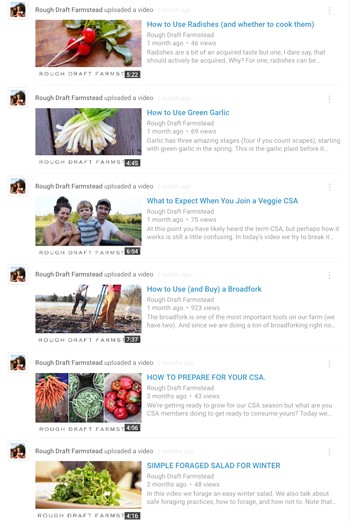
But what about social media sites like YouTube? This is the site I mentioned above that has more users than Facebook—five percent more according to Pew Research. I was blown away by that statistic, and though none of my experts really spoke about YouTube, we have been uploading videos about how to use different items in our CSA—how to cook, store and clean—for our shareholders. There is a lot of potential there, and it is worth exploring as another social media option for telling your story and engaging.
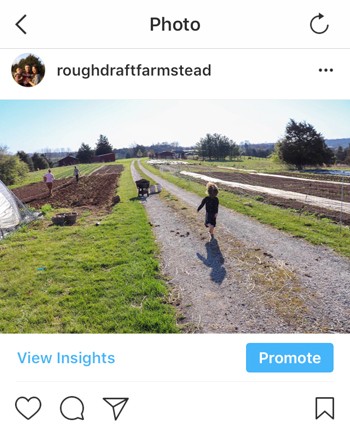
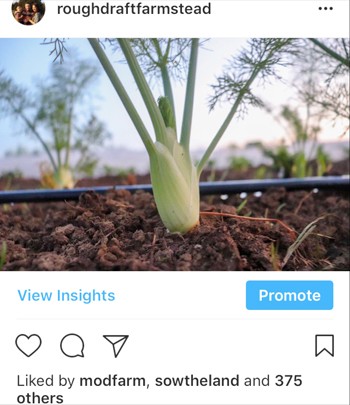
Photo quality is critical to success on instagram. The better the quality the higher the engagement. You can also promote photos and see a analytics or “insights” to know how they’re working. Photos with a mix of farm and family are always a hit with our CSA customers and help to put a face and family behind the food we grow.
Advertising
Absolutely nothing changed my perspective on social media marketing quite like an idea Simon Huntley introduced me to: cost to customer acquisition.
The idea is that every business has a number they are willing to spend on promotion to acquire a customer. “This is a key stat for most businesses,” says Huntley and every farmer has one whether they know it or not. Any flyers you print, any business cards, any advertising whatsoever is all added into this cost.
So for example maybe a larger business is spending $200 per customer, but they know that customer is going to yield them $3000 over a lifetime. For larger companies with tens of thousands of customers this is a great investment. However, Simon says farmers are rarely willing to pay anything for finding customers—even now at a time when advertising is shockingly cheap, especially in comparison to the days of newspaper ads, and days spent pounding the pavement.
It doesn’t have to be $200, but shouldn’t it be something?
After our conversation, I decided to stop being so cheap myself. This concept more than any other, changed my thinking and I believe it revolutionized our marketing plan. We wanted to fill out our CSA, but we’re also looking to double it next year, and I was feeling intimidated about the prospects of being able to achieve such a task at the rate of growth we’d been experiencing—every new member felt like a battle. Then I started thinking about this stat.
We had been doing some Facebook advertising and it had been mostly successful, picking up a handful of new members (plus page likes and follows which could yield members later on). However, we’d already spent $50 on an ad and I wasn’t really eager to buy another. But when I thought about my customer acquisition cost, that’s only around $1.25 a person, plus maybe a $1 for flyers. And each customer could easily yield over $1,000 in their lifetime with our farm, if not multiple thousands. And they’re only worth $2.25 each to find?
So immediately we started another Facebook promotion. These cost roughly $3 a day. In the one we chose, you get six different ads, which you can customize the photos, text, link, location, et cetera. Moreover, you can watch your stats and adjust them in real time and make adjustments when an ad is not getting enough clicks—the ability to monitor analytics being another huge advantage of social media advertising. Within two weeks, our CSA was full and we had a waiting list. And our cost to customer acquisition is now still only $3.75 for the year with perhaps a little more if you count our website costs. However, with the value of a good CSA customer, I would be willing to double or even triple that without question now, especially with a bigger CSA.
To make the most of social media, I think it helps to advertise in concert with all of the above strategies—and said advertisements have to be good—but I think it also simply helps to change your thinking about what your goals are on social media, and take advantage of the tools available. In some ways, social media has given us what small businesses have always wanted: a way to sell our products by just being ourselves. For farmers, your future customers don’t want to be marketed to, they want to connect with their food and the people who grow it—they’re already looking for you, they just need to know you exist.
Jesse Frost is a vegetable grower and freelance journalist in central Kentucky. He has written for The Atlantic, Civil Eats, Modern Farmer, Hobby Farms and others.
Copyright Growing For Market Magazine.
All rights reserved. No portion of this article may be copied
in any manner for use other than by the subscriber without
permission from the publisher.