











By Sam Hitchcock Tilton
This is the true story of an urban farm started in New Orleans, Louisiana, on land abandoned after hurricane Katrina, as told by its resident goat to the author. There are lots of practical details and good ideas for farms both in cities and in the country, so read on.
Most people don’t think much to see a goat munching grass off in the corner. Oh sure everyone wants to pet and coo over an adorable baby goat, but an old bearded goat, they’ll look at for a moment and then move on. Well, one good thing about being old is having learned how to take the bad with the good. And when nobody thinks much of you it sure is easy to observe what is going on. And that is just what I have been doing from my pen in the back corner of Paradigm Gardens for the last four years.
Sure, a goat writing an article, that’s different. But you know how much people today say we need to hear from diverse perspectives, and I would think the opinion of a goat counts as diversity (rather than lunacy). And who better to tell you from an objective perspective how an overgrown baseball field in New Orleans has been transformed into a nationally recognized urban garden and outdoor event space that provides full-time incomes for the two proprietors?
Four years ago when this all started, I was just a stray New Orleans goat and that baseball field was some of my best grazing, so I was none too happy when two shirtless boys, Joel Hitchcock Tilton and Jim Sealy, started coming with machetes and sling blades to tame my lush and verdant garden of eatin’. I wasn’t too worried though as I thought that the thick kudzu vine, nut grass and bramble would wear those puny boys out soon enough.
I was wrong, and in less than a week they had the place cleared and cut low and started the process of digging thousands of old bricks out of the ground in preparation for vegetable beds. I noticed them noticing me as I continually peeked my head out from around the corner, waiting for them to give up so that I could have my smorgasbord back. It wasn’t all bad, since they would pile up the weeds and branches in nice neat piles as if they were serving me dinner. As I began to come around more often we built a rapport and Joel and Jim started to grow on me. I still didn’t fully understand their fetish for working long days in the hot sun and digging up bricks, but I’ve met weirder humans for sure.
After a while those two boys and I made a deal, much like that made millions of years ago between my forefathers and the microbes in my gut: I would live in a small pen in a back corner of the garden, they would supply me with a mate, allow me to raise a family, and feed me the lushest weeds from my former pasture; in return I turn those weeds into compost and they can use my children shamelessly to promote their garden for new-age goat yoga. So far this arrangement has worked out for all of us. Although from the confines of my pen I have begun to miss contact with the wider world, so recently I sat down with Joel to ask him about Paradigm Gardens and share this emerald gem with you GFM readers:
Joel, why did you decide to start Paradigm gardens?
We had been growing on two vacant lots: 48 raised beds with two small hoop houses and a chicken coop for six years. At that point the purpose of our garden was not to make money but rather to serve the neighborhood, however it wasn’t even self-sustaining. It was subsidized by my teaching salary. The purpose of Paradigm Gardens was to try and create a viable multi revenue-stream garden and business, one that we could make a living at without grants, donations, or volunteers.
What was your vision for Paradigm Gardens before you started?
We had solid relationships with New Orleans chefs from our years of gardening. So with Paradigm, our idea from the beginning was to create an intensely productive garden and public/private event space that had three member chefs who paid a yearly membership fee. This membership fee, like a Costco membership, would grant them the ability to purchase produce from us. However, unlike a Costco membership, the member chefs co-develop our crop plan, and have exclusive promotional rights. They can also host one event each year at the garden free of charge.
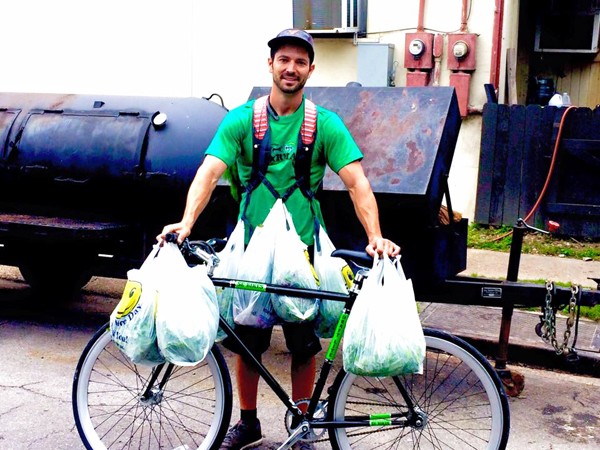
By virtue of our tight relationship with these renowned chefs, our project immediately gained legitimacy. The free promotion that we got from their wait staff benefitted us greatly; waitresses would tell their customers about the wonderful produce they get from “their” farm five minutes away and the unique and memorable events we hosted with the whole restaurant crew.
What made you choose the site?
Oh Oatmeal, don’t be coy. You know that moment we laid eyes on your scruffy beard, the supple yet commanding hand of providence had inexorably linked us.
Joel, although you’re correct to compliment my beard, your verbose flattery will get you nowhere, please answer the question.
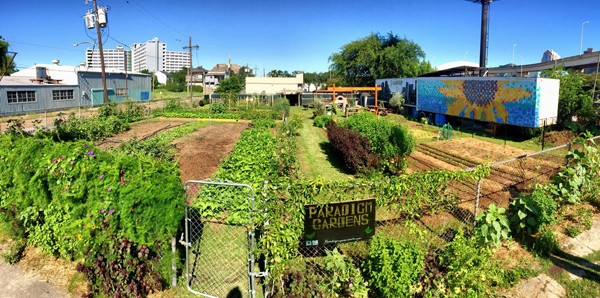
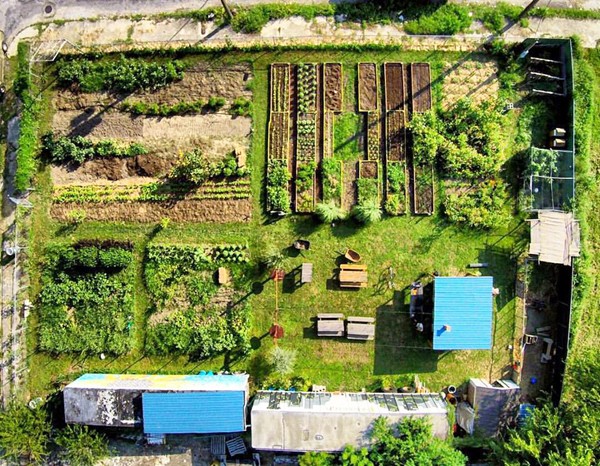
There were definite strategic advantages to this lot: proximity to downtown, relatively large space (¼ acre), close to but not on a major thoroughfare, two large storage containers that came with the property that we could paint murals on and situate to use as sight and sound barriers for the highway immediately next to us, and the abandoned properties on every side of us for blocks – like a secret garden in the middle of the wilderness.
But by far the best thing that the site had going for it was that the real estate company that owned it, Felicity Redevelopment, knew about our work with our past community garden. They had seen that we were committed, had skills, and weren’t going anywhere. They weren’t doing anything with the land and liked our proposal, so they gave us a very favorable lease for the first four years, and this was absolutely crucial to us getting Paradigm Gardens off the ground.
What assets in experience or people made you feel ready to take this on?
Jim, my friend and business partner, is a great resource. He grew up on a very productive organic CSA farm and so he knew a lot about horticulture, but also carpentry, irrigation, etc. My big brother Sam, a farmer from Wisconsin, was a tremendous source of knowledge and inspiration but also hands-on help as he came down to help us build our brick wood-fired oven/grill as well as other infrastructure projects. My parents, both being great examples of hard-workers and working for themselves, always gave me a sense of possibility.
My own experience and connections from many years of living in New Orleans and DJ-ing, promoting and organizing concerts and events helped immensely in our ability to do everything in-house and cut costs. My skill set and Jim’s skill set meshed together beautifully and has allowed us to be very efficient and effective with our multifaceted endeavor.
More than anything though, our relationships with Chef/Owner Mike Stoltzfus of Coquette restaurant and Chef/Owner Aaron Burgau of Patois restaurant have been absolutely instrumental in our success. The potential they saw in us and the risk they took with us by buying memberships loomed large over our head and pushed us not to let them down.
Looking back, how were you unprepared?
Of course looking back there’s always things that we could have done better. Both Jim and I were very naive in terms of business, instead we focused on building positive relationships and always gave people the benefit of the doubt (and mostly still do). Fortunately, this really bit us in the butt only twice. It could have happened more often and more severely but luckily our partner chefs have been phenomenal mentors.
Talk about the site, paint a picture of how it was when you started and your vision for it.
It’s actually pretty easy to paint a picture: Imagine a 300 year-old city with buildings and roads built and razed on top of each other over centuries. Then, 250 years in, someone builds a neighborhood baseball field. Now imagine the field was left alone for nine years after hurricane Katrina, along with much of the surrounding neighborhood, and voila, that’s what we were working with – an overgrown lot with countless bricks buried in the soil. Our garden is just outside of downtown New Orleans, separated by a giant freeway overpass that looms over us.
Alright Joel, you’ve given the people some background – but just like you know my favorite food is crunchy kale stalks, let’s give the readers something to bite into. You know I don’t get out much, but I do like my horticulture magazines, and it seems like every farmer and their sister want to sell to restaurants, but it ain’t easy. New Orleans has one of the best culinary scenes in the country – how did you start and build relationships with chefs?
So, of course you need delicious produce for chefs to try, but every grower worth their composted horse manure has that. So the question isn’t necessarily how to have your produce be memorable, because the reality is – it’s not; as soon as a chef tastes a succulent, flavor-busting heirloom cucumber from another grower she’s already forgotten about the scrumptious cuke you brought her last week. The question is how to form a connection and present a compelling story.
Because, just like a chef will forget about your delicious cuke, so will a foodie forget about a chef’s delicious dish if there’s no connection and no compelling story. Our chefs have numerous paintings of Paradigm Gardens hanging in their restaurants, they host their Christmas parties at the garden and their staff will occasionally take a date to one of our events. So there is a real connection. We have a real story that we can tell, in turn the restaurants can pass that on to their diners in a genuine way.
Jim and I have the benefit of being in the city, a luxury that most growers do not have. Though even for a farmer that is an hour outside of the city, I’d recommend hosting a chef’s dinner as a sort of financial and relationship investment. Pick a Monday or Tuesday evening during the slow restaurant season and personally invite a group of chefs you’d like to target. It definitely helps if you have at least one good chef connection already because they can help facilitate the invite process, calling ahead and vouching for you to their chef friends.
Chefs love to cook, so make it a fun and interactive event where the chefs get to use your produce, and maybe eggs, milk, meat, or honey (depending on your operation) so that they learn more about you and your operation at the same time.
Joel, not much of Paradigm Gardens’ income comes from selling veggies, yet I observe you spending most of your time weeding and planting and harvesting – now I’m not complaining as I get to eat the scrumptious scraps – but how does the produce enterprise relate to the event enterprise?
Very observant Oatmeal, who would have known that hiding in your corner pen you have developed such a shrewd business sense? The three aspects of Paradigm Gardens’ operations are – produce sales, restaurant memberships, and events. From the outside looking in these enterprises may appear a bit lopsided in terms of the time commitment/revenue ratio, because we do spend a great deal of our time maintaining the garden and growing produce, even though that is by far our smallest revenue generator.
But we don’t look at the three enterprises as separate, but rather complementary aspects of one smoothly functioning operation. It is true that the maintenance of the garden is time consuming, because we need the garden looking like a Martha Stewart Magazine shoot at all times. We have systems to increase efficiency in this respect but regardless, a good amount of time is still spent weeding, seeding, transplanting, harvesting, etc.
We grow very efficiently and are proud of the quantity and quality of produce that we squeeze out of a quarter acre. However, we do more “landscaping” and intentional beautification than most growers might, which does admittedly slow down some operations, like harvesting. For example, we intercrop very heavily for all the normal horticultural reasons but we also do so with the goal of optimal optical and olfactory enjoyment. This is more time consuming, slows growth, and reduces our yields a bit, but it more than makes up for it in the “holy moley, what a beautiful garden!” impression that it gives our guests. The events are our primary revenue stream, but wouldn’t be the same without being situated inside a productive, lush, calming space.
It sure is a calming space – I’ve seen little babies playing with my own kids, and stuffy executives easing up after a few drinks and enjoying the music.
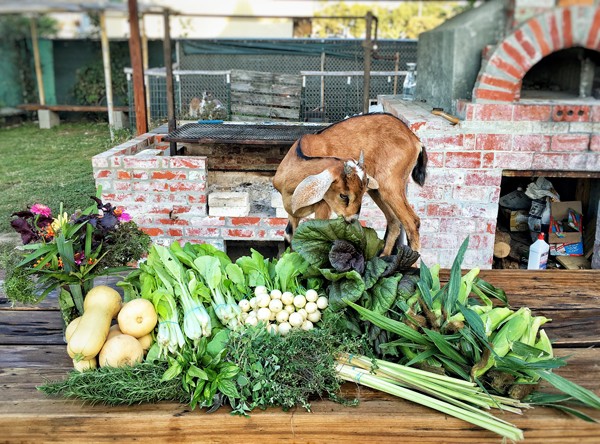
That’s right Oatmeal, we host many kinds of public and private events. For our public events the garden functions like a night club, and us as the club owners – we book food vendors and musicians, we promote the event, we have employees to help staff the event, and anyone can show up and pay at the door (though we always sell out weeks in advance). These public events often feature chefs from our member restaurants cooking our produce in our wood-fired oven and grill. Their presence promotes their restaurants, which in turn promotes us and our events.
Our public events make some money but also serve as great promotional tool for private events, where our margins are better. Private events are things like wedding receptions or company parties, where people essentially rent out our garden. Part of the reason our margins are great for private events is that unlike renting a hall we do everything in-house: the music, catering, staffing. We have invested a lot of thought and time into our website and social media presence in order to connect with our clientele. At this point we are a big fan of digital event platforms to organize ticket sales, we like Eventbrite (poke around our website if you’d like to see more).
We’ve tried various events throughout the years; like wine-tastings and work-out classes, but the ones best are our Pizza & Pie Nights and our Concert Series nights. We have worked out all of the details for these events so that we do everything in-house – the sound equipment, booking the bands and DJs, booking the chefs, the set-up, event facilitation, and clean-up. Most venues hosting events of our size and with so many moving parts would probably have eight to ten employees, but we have a very lean two to three talented and efficient staff (plus us) for each event, which allows us to pay them all $25/hour, and that feels good.
Joel, what advice do you have for farmers considering or just starting events on their farm?
Use social media as much as possible. It is a free resource and a great way to reach a specific audience and to keep them engaged. Put a lot of time and thought into creating the most unique and authentic experience that showcases your farm and your produce. Don’t be discouraged if you lose money on your first few events. It takes a while to really build your events to a point where people are excited to come. Our concert series started by merely asking for donations in order to draw people in. Over time as our reputation grew we could charge more. Now we charge $80 per person and make good money on each event.
And what advice could you give for those already doing events, like a weekly or monthly pizza night, to bring them to a higher level?
Network with chefs and try to get them out to do the cooking. Chefs love cooking in a different environment, and their presence will add legitimacy to your event. They will also promote you to their network of friends, colleagues and followers. Before adding bells and whistles to an event, the most important aspect is that it’s well-run and organized with kind, courteous and knowledgeable staff. It sounds basic but the basics go a long way.
Sam Hitchcock Tilton is a former and aspiring vegetable grower who has visited with farmers around the world. He completed his master’s degree in horticulture at Michigan State University and now helps farmers improve their mechanical weed control as the Midwest rep for the KULT-Kress company. He has a passion for developing the finest popcorn strain and enjoys learning and sharing his experience.
Copyright Growing For Market Magazine.
All rights reserved. No portion of this article may be copied
in any manner for use other than by the subscriber without
permission from the publisher.