










By Doug Trott
It’s that time of year when we’re eagerly starting a new season, re-connecting with our markets and customers, and anticipating increased production and sales. Sadly though, some of us are going to find some unwelcome news – perhaps a major customer is no longer in business, or a market has closed, putting our hopes for a successful season in jeopardy.
What do you do when that happens? How can you be prepared? Where are your next customers (or markets) coming from? The answer is in the funnel.
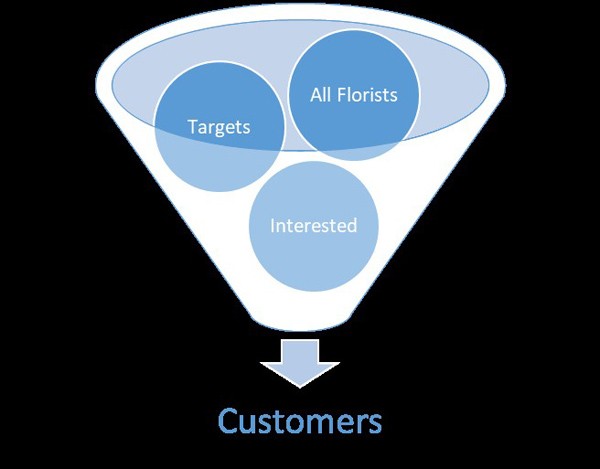
The sales funnel, that is. Every sales organization has a process known as the funnel – a sort of conceptual funnel that has their broader market entering the wide open top, and then customers popping out at the narrow end on the bottom. In between, what’s going on? And more to the point – how does this apply to your farm business? The answer is in how you identify, qualify and sell to potential customers. I’ll start with our experience, and then suggest variations for different business models. It does not have to be complicated.
A number of years ago, as our second year of flower farming grew to a close, we knew we’d have to start making the long drive to the Minneapolis/St. Paul metro area, and sell to florists there, but to whom? We started out with some research, building an enormous spreadsheet of twin cities florists (it has about 250 florists now).
Is it 100% accurate? No, of course not. Florists are constantly closing up or starting up, and while we do make some effort to keep it up to date, for sure we’re not aware of all of the closings and openings. It takes some ongoing maintenance, but really only a little in order to keep it sufficiently accurate.
Next, we looked at the florists’ web sites, looking for custom sites (not the templates from Teleflora, FTD, etc.), especially if they mentioned “local”, “organic”, “natural” – any key words that made them sound like a potentially good fit. We also looked at their neighborhoods, focusing on the wealthier neighborhoods around the twin cities. These florists became our targets.
Our customer spreadsheet has columns for the business name, address and contact info, as you’d expect, and it also has a column for “Status.” The Status column is empty to begin with, but once a florist becomes a target, we enter a 3 into that column. That gives us a list of florists to approach.
We would visit them and ask if they were interested either in our stopping by regularly, or at least in receiving our weekly availability email. If they said yes to either of those, that 3 in the Status column was changed to a 2, indicating that they had expressed interest. On another tab we combine the email addresses of all of the 2s to form our mailing list for our weekly availability.
We also have columns for each delivery day, so if they wanted to be on our route we just add a “Y” to the appropriate column(s). By the way, if you’ve been around for a while, you’ll have people contact you out of the blue – these folks jump to a 2, perhaps without ever being on your list in the first place. Of course, you still need to qualify them – you might decide not to pursue their business if it appears that it will be very minor.
If, like us, you can only visit with so many customers during the day, you have to spend your time with those purchasing the most – or who you think have potential. You can’t let super-small customers take up your time without it impacting your revenue. That being said, it’s not all about the money, and we certainly have a few smaller customers that we continue to see just because we like ‘em. We’re cognizant of the impact, though.
You have to take the bad with the good, and so if they weren’t interested, we’d change that 3 to a -3. They were no longer a target, and so we’d know not to bother them or waste our time. That’s not to say you can’t check back in every year. Similarly, someone that’s marked as a 2 might never place an order or otherwise purchase from us. We give them a year or so, and then change to a -2, and drop them from our emails.
When a florist purchases for the first time, the Status becomes a 1. That status is important – it tells us we need to have a sales tax certificate of exemption on file from them, in order not to have to charge them sales tax. In the unlikely event that the florist (or we) decide we don’t want to do business together any longer, we’ll change that 1 to a -1. We’ve done that just a time or two for habitual late-payers, or ongoing tiny purchases.
Finally, every once in a while a florist who’s a 1, 2 or 3 just disappears – moves, closes up shop, changes email and phone number – we’re just unable to contact them. In that case, we make their status a 0. Since it’s not a negative number, we’ll remember that there isn’t any negative history between us. We could just delete the record, but then if they re-open in the future, we’ll lose the history.
So that’s our simple funnel – it starts out will all possible florists, then narrows (significantly) to Targets, then to Interested, and finally to Customers.
At all times, besides our current customers, we have a number of Interested, and several Targets. Whenever we need to add a new customer, we just work on promoting someone – either following up with someone who’s already expressed interest, or by connecting with a few Targets.
And it works! One spring, a florist who had been our top customer 2 out of the previous 3 years just disappeared. It took us a couple months to confirm that she closed up. We miss her, but it had hardly any effect on our business – we had several others in the queue.
When your sales funnel is running well, its uses go beyond replacing that “irreplaceable” customer. When you’re ready to expand, your next batch of customers is right there. You can even decide to drop your worst customers, because you’ve identified replacements that are potentially much more worthwhile. It’s hard to do that, but if you want to keep your head above water, you gotta do what you gotta do.
Let’s look at some variations. Depending on your business model, you might think of your sales funnel working on opportunities or markets, rather than individual customers.
What if you sell at a farmers market? In that case it probably doesn’t make sense to track your individual customers through a funnel, as you likely don’t know them until they walk up and become a customer. Of course, it would probably be great to know who they are at that point for sending notifications, converting to CSA if you go that route, etc., so you’d still have a customer list.
But I would definitely have a funnel for farmers markets themselves. I would start out listing every market within a reasonable driving range. I’d then add to that list and include every market within a range I’d drive if I were really desperate – because it’s when we’re desperate that it helps most to be prepared.
In order to qualify them (i.e. identify targets) I’d try to collect data regarding the size of the market – number of customers, vendors, vendors selling what I sell, gross market sales (if available), start and end dates, day of the week, and contact info for the market manager. I’d like to know something about customer demographics in order to extrapolate sales potential. And I’d want to make notes on the application process and timeline.
I’d have different statuses for target markets (in both the reasonable and desperate range categories), and another status if we were applying to be members, and a final status when we become members. I’d also have some negative statuses, to indicate if a market no longer appeared to be worthwhile. I’m just speculating – I don’t sell at farmers markets – but you get the idea.
Do you sell per a subscription model, such as a CSA or bouquet subscription? If the former, you might want to have CSA members in a funnel, tracking those who have expressed interest and those who are current or former customers, depending on how aggressively you approach people. Perhaps you’d like a funnel for drop-off locations – losing one at the last minute could be a big deal, so knowing the next customer or business willing to host would be invaluable.
For subscriptions, it may or may not make sense to track people that way, but if you approach businesses about a subscription, so that they can have fresh flowers in their lobby every week or two, I would definitely use a funnel to keep track. I’d make a list of businesses in the area, decide who to approach (perhaps based purely on distance), and then track if you’re in conversation with them about it, and of course if they become a customer.
Do you sell to restaurants or other wholesale accounts? I think that case would be very much like mine, with similar statuses. Perhaps you’d also want to track if they’re interested only in specific products. That’s not really an issue with me and flowers, but if you’re growing a variety of vegetables or meat animals, it might be important.
Just remember, the point of the funnel is not just to work potential customers through it in an organized manner. The point is also to have each stage populated, so that you don’t have to start from scratch when you suddenly need a new customer or market.
Doug with his wife Robin started growing flowers on their farm in 2010, making bouquets on their kitchen table for the local grocery store. Flower farming became Doug’s full-time job in 2014. Robin also breeds registered Katahdin sheep.
Copyright Growing For Market Magazine.
All rights reserved. No portion of this article may be copied
in any manner for use other than by the subscriber without
permission from the publisher.