











By Chris McGuire
The first part of this article appeared in the March 2019 GFM.
Insects and diseases
It is challenging to manage apple pests with organic methods. Fortunately, this is one part of orcharding where it’s possible to improve over time. It’s hard to change varieties or tree spacing in an established orchard, but you can fine tune your pest management practices from year to year and learn as you go.
Despite insects and diseases, it is possible to grow beautiful organic apples. We’re not highly proficient apple growers, but with care and attention we’re able to keep 60-80% of our fruit unblemished and suitable for sale to local grocery stores. However, in an article of this size I cannot tell you how to control all the pests you will encounter.
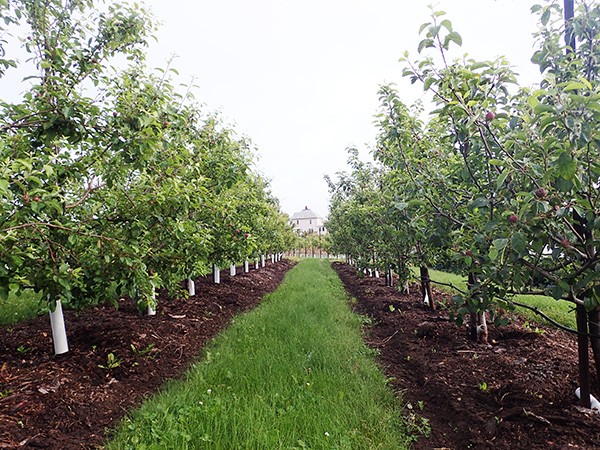
Read the references I mentioned earlier, get a printed guide to common pests, and talk to other growers in your area. You will need to learn to identify specific insects and diseases, because they each have different life cycles and different approaches for reducing their damage. Plan to visit your orchard regularly during the spring and summer to scout for damage and decide how to control pests. If you don’t enjoy learning about pests and monitoring them, then apples are probably not a good fit for your farm.
If your goal is to profitably grow organic apples for fresh eating, you will need to spray. There are particular pests which you can control using other methods: for example, apple maggot flies can be trapped with sticky red traps, mating disruption with pheromones can keep codling moth at bay, and scab-immune varieties will escape apple scab. Learn how to provide beneficial insect habitat, graze livestock in the orchard, maintain healthy trees, and use good pruning practices to reduce pest damage.
But still, you will need to spray some combination of compost tea, neem, sulfur, copper, Bacillus thuringiensis (Bt), kaolin clay, granulosis virus, spinosad, pyrethrum, and other organic options. At some times of year, you will probably need to spray frequently and during very precise time windows determined by the weather. There are issues of compatibility (some spray products cannot be mixed and applied together) and some products can be phytotoxic under certain conditions. Pest management will be much more complicated in your orchard than in your vegetable fields.
Scouting for pests and spraying can be stressful and time-consuming, especially on a farm where you already have plenty to do. On a diverse farm, it’s probably best to focus on a few key pests that can destroy your apple crop – in many areas of the country these will be plum curculio, codling moth, apple maggot, apple scab, fire blight, rusts, and/or summer fruit rots. When feasible, focus on practices like trapping pests, providing habitat for beneficial insects, and grazing chickens or pigs under your trees, because all of these practices can be implemented ahead of time, on your schedule, unlike time-critical sprays.
Match your pest control methods and quality standards to your customers. What types of blemishes are acceptable in your market? Sooty blotch and flyspeck are superficial fungal diseases which make the surface of the fruit unsightly but don’t affect flavor or storage life. These disorders are unacceptable in grocery stores but may be acceptable in a CSA box. Apples with live codling moth larvae burrowing inside are probably unacceptable everywhere in our society.
In our orchard, we have gradually come to manage pests intensively. In other words, I spray a lot – approximately twice a week for much of the growing season. We do sell many of our apples to local grocery stores, and although the buyers there don’t hold us to the perfect standards of uniformity and quality which are applied to Washington apples, they do expect nice looking fruit. We’ve invested heavily in establishing our orchard, and that provides a psychological and financial incentive to prevent pest damage and secure a good yield. I enjoy scouting for pests and learning about the creatures that live in our orchard. I don’t actually enjoy spraying, but I tolerate it. Other growers will have to find a balance that suits their personality and farm.
Equipment
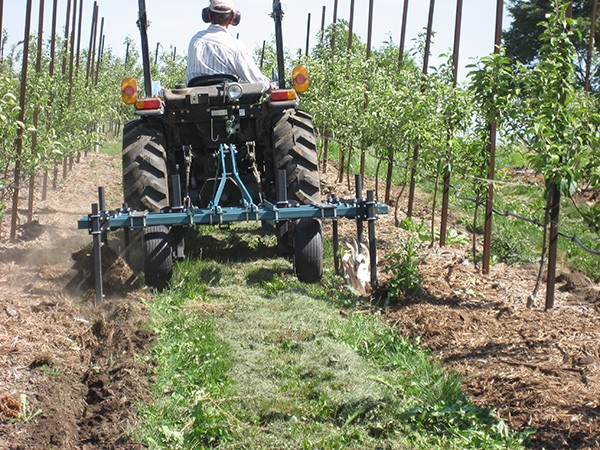
When possible, it’s best to use your existing vegetable growing equipment, such as a tractor, mower, and wagon, in your orchard. However, you’ll probably need to buy a sprayer for your apples. We’ve always used a backpack sprayer for the minimal spraying needs we had in our four to five acres of vegetables. But the backpack sprayer is not practical on more than a few apple trees. For tractor-powered sprayers, your two main choices are a simple handgun sprayer or an airblast (mist) sprayer that will blow a fog of spray through your tree canopies. I highly recommend the airblast sprayer because it’s much quicker and less tiring to use.
Be sure to buy an airblast sprayer which can spray high enough in the air! We purchased a somewhat undersized sprayer that was intended for vineyards more than orchards, and we struggle with mediocre spray coverage at the tops of our trees. Whichever sprayer you select, make sure that it has a vigorous agitation system. One of the most common sprays in organic orchards is kaolin clay, which requires constant agitation to remain dissolved.
It’s important that your orchard layout accommodates your tractor! Our first orchard of dwarf trees had rows spaced 10.5 feet apart. Our 66-inch-wide tractor could not drive between the rows when the trees were fully grown. We changed to a 52-inch-wide tractor and even with the narrower tractor, we’ve increased our row spacing to 12 feet in newer plantings to give the trees more room.
In the packing shed, we’ve found that our AZS brand vegetable brush washer does a great job of washing our apples and helps to scrub any unsightly sooty blotch or flyspeck from the fruit. Apples will require a walk-in cooler close to 32 degrees for storage, but be aware that you should not mix apples and vegetables in the same cooler – apples emit ethylene gas, which will shorten the storage life of your vegetables.
Labor and management
At our farm, apples require fewer labor hours per acre than vegetables. It takes us about 1,300 labor hours per acre to grow, harvest and wash the apples (we can expect to harvest about 30,000 lbs of apples per acre when trees are mature). On the vegetable side of our farm, each acre requires about 2,200 hours of labor per year and produces $50,000-$60,000 worth of vegetables.
Although apples may require less overall labor than vegetables, apples do require close management, attention to tree training, scouting, and pest control. A grower must be prepared for this extra burden. During the early years of our orchard, we had a long-term skilled employee who managed many aspects of the vegetable operation: the packing shed and greenhouse, direct seeding, and CSA box delivery. When she eventually left the farm, we were unable to hire another employee with similar skills, and we felt a huge strain on our management time. In retrospect, she was invaluable in allowing us to establish the orchard alongside our vegetable operation.
Apples require large inputs of hand labor for two tasks. One is harvest, which will not surprise any seasoned vegetable grower – harvest and post-harvest handling are generally the most time-consuming aspects of growing any fresh produce. In an apple orchard, fruit thinning also requires much time. Apple trees regularly set too many fruits, and if some of these fruits are not thinned off, fruit size and quality can be seriously reduced. An excess crop can also deplete the tree’s resources and reduce bloom and fruit set the following year, which can cause trees to descend into a biennial “boom and bust” cycle of alternating large and small crops.
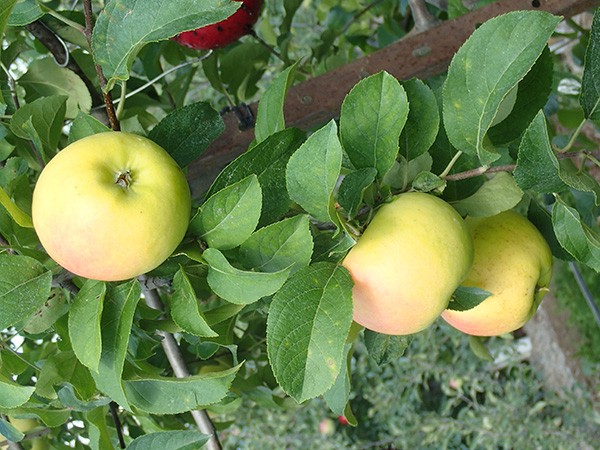
On non-organic orchards, growers spray synthetic growth regulators to thin fruit. Organic growers have fewer options for thinning with sprays and most small organic orchards rely at least partially on thinning by hand. This is a daunting job, and for best results it needs to be completed within a short time window in June – already a very busy time for vegetable growers! Even on our small sized trees, thinning can take over 20 minutes per tree.
If you add an additional vegetable crop to your farm, most of the tasks performed for that crop will be similar or identical to the work you’re already doing for other vegetables (sowing seeds in the greenhouse, transplanting, weeding, etc.). Some of the tasks in an apple orchard, such as pruning, training young trees, and thinning fruit, are different from anything you do on a vegetable farm, which means you’ll spend time training farmworkers on new tasks.
Profitability and quality of life
When I told my wife Juli that I was writing an article about incorporating apples on a diverse vegetable farm, she replied, “Tell them not to do it.” She has a point! Apples are a fascinating and challenging crop to raise, and I love growing them. I’ve spoken with many other vegetable growers who are interested in starting an orchard. Although I share their enthusiasm and interest, I must recommend caution. It is possible to grow high quality organic apples, there is strong demand in the marketplace for local organic fruit, and you can make money with this crop. However, the upfront costs, horticultural learning curve, and attention that apples require are all significant.
Be clear and honest with yourself about your goals for an apple enterprise. If you are seeking increased profits, perhaps you should just expand your current enterprises. As farmers we don’t make money figuring out how to do new things, but rather by doing the things we’ve already figured out. You may well have valid reasons for planting apple trees: to fill a niche in the marketplace, diversify your farm, or simply satisfy personal interest. If so, I hope this article will guide you around potential pitfalls and help you think about how an orchard will impact your farm and lifestyle.
Chris McGuire and his wife Juli have farmed at Two Onion Farm in Belmont, WI since 2003. They currently raise organic apples for a CSA program and local grocery stores.
Copyright Growing For Market Magazine.
All rights reserved. No portion of this article may be copied
in any manner for use other than by the subscriber without
permission from the publisher.