






Farmer to Farmer Profile
By Ellen Polishuk
In case you don’t remember the genesis of this column, I wanted an excuse to get myself onto as many farms across the land as I could manage. I had retired from my own farm, and wanted/needed to stay up to date on what’s happening on real farms in real time. Thus, the Farmer to Farmer Profile column! Sometimes I travel for a conference, and then find a cool farm nearby to visit. And other times, I just need to get on the road.
So it went this March, as I returned from weeks and weeks of farm conference travel, but hadn’t visited more than one farm (47th Avenue Farm, profiled in last month’s GFM) along the way. Right off the top of my head, I thought of asking Radical Roots Farm if they would host my visit, and they agreed right away. I’d met Lee and Dave O’Neill a few times over the years, mostly at the Virginia Biological Farming Conference. I knew a couple of folks that had worked there, and I’d consistently heard great things about the farm. So, off I drove 125 miles from my home in Maryland, down the Shenandoah Valley on a beautifully clear March morning.
Radical Roots is known around these parts as a permaculture farm. I must confess here, that for me the term “permaculture” sets off some alarm bells. Why you ask? Because basically I’m a production snob – I’m most interested in and excited about farms that grow food for a living, where the stakes are high because the farms produce is the main source of income for the farm stewards. It’s just my personal fascination.
And in my prior experience, places that are labelled as permaculture farms have always been more hobby farms, homesteads or educational sites, not “real” working production farms. So, I figured that permaculture and profitable production just weren’t meant to happen on the same property! Well, once I read Restoration Agriculture, I started to understand that I was under informed. There really are farms that employ the design aspects of permaculture, AND engage in for-profit agriculture. Radical Roots Farm is just such an example.
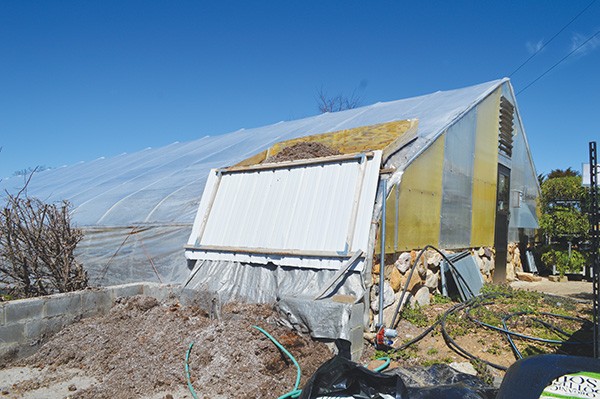
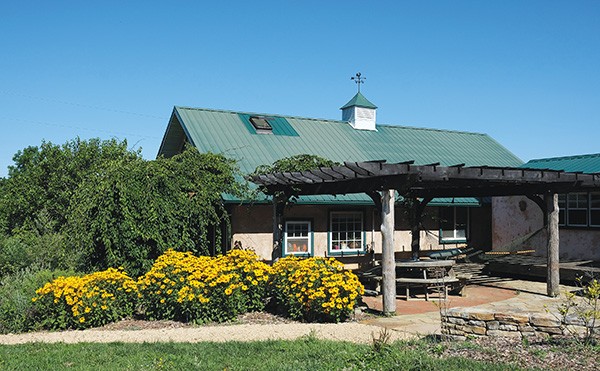
When I arrived, I found my way past the greenhouse and intern house to the main house with the help of a very friendly farm apprentice. Immediately, I was impressed with the layout of the buildings, barns, and surrounding landscape. I must say, most farms I’ve seen do not have much in the way of landscaping around the housing (I’m a huge fan and practitioner of growing flowers, shrubs, and trees at home!). And so, what a pleasure it was to see mature vines, pergolas, flower beds, courtyards, rock walls, and winding pathways all around me! This farm has a strong sense of place, and a high regard for aesthetics.
Into this fine earth-colored handmade house I went, with Lee there smiling and offering hot tea. Right off the dining room, through the now open sliding glass doors, was a raised bed garden inside a bright sun room/greenhouse. Four-foot-tall kale, massive chard plants, tangles of flowering basil were all growing beautifully within feet of the dining room table. Darn, these folks are plant/food nerds! (Dave was the director of the James Madison University arboretum for a few years it turns out.)
Lee O’Neill grew up on Virginia’s Eastern Shore, her father a conventional corn and soybean farmer. Though they lived in town and not on the farm, Lee still learned a lot about what farming is all about—working hard, being passionate, and maintaining forward momentum. Lee’s Dad grew five acres of melons “on the side,” and Lee sold them on the side of the road to help fund her college education.
Lee pursued a social work degree at James Madison University in Harrisonburg, VA, where she met Dave. Dave, a suburban DC kid like me, earned his degree in Geography. (Yet another example of the highly and diversely educated farmers in our movement.)
Post-college, as a couple they went west, where Dave spent a year working at Horton Road Organics in Oregon, which permanently altered their lives – he caught the farming bug real bad. Then Lee caught the bug from Dave. And so ensued a few years of travel and research, all around this country, and then in Australia and New Zealand. They put tons of miles on their bicycles, and got to see many examples of how different farms organized themselves and made a living. They were collecting information so that they could begin their own farm journey.
Along the way, each became educated in permaculture, with both earning a Permaculture Design Certificate, and Dave his Permaculture Teacher’s Certificate. After all this exposure to beautiful places world-wide, they kept coming back to the Shenandoah Valley of Virginia. So, they started farming near Harrisonburg on rented ground. Lee and Dave married in 2000, and Radical Roots was born.
The O’Neill’s searched for land that they could both afford, and that met their criteria for production and beauty. After two years, they found and purchased their current site, which is five acres. It is a sloping south-facing property, and Lee called it a “clean slate.” They bought a camper trailer to live in while they built their first home, by hand, themselves. Their first farm investments were a well, a BCS and a propagation greenhouse. They maintained part-time town jobs to keep the cash flowing.
Over the next five years, so many things happened and changed that even Lee has a hard time keeping the timeline exact in her mind. Suffice to say that they worked incredibly hard and managed to: have two children, quit their town jobs and rely solely on farm income, develop a robust apprenticeship program, become trained in herbal medicine, teach multiple permaculture design classes on site, install a swale system and plant perennial fruits, build a barn/shop, build yet another house so that the first one could become an intern house, etc.
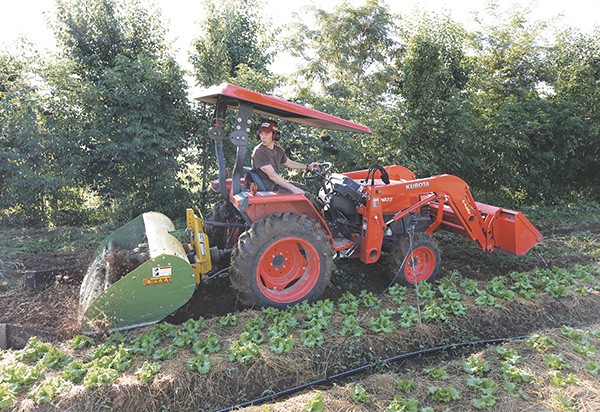
My mind is boggled trying to fathom how much they accomplished in a short time frame. And they homeschooled their kids until just a year ago. Oh, and they cash-flowed all the capital improvements without taking out loans. These are some industrious folks.
Radical Roots market channels have evolved over time. Whereas at the beginning, they were 100% retail with CSA and farmers markets, they are now at 50% wholesale. Lee maintains that this shift happened gradually. A local food hub opened, and another aggregator, which first opened the door to wholesaling.
Then they made the bold move to become certified organic in 2012. That was key to getting into Whole Foods, and obtaining better price points with the food hub. Lee feels it’s important to have more than one big account (the old not having all your eggs in one basket idea), so this year they plan to become GAP certified so they can go after another big grocery account. They also service a few smaller local grocery chains.
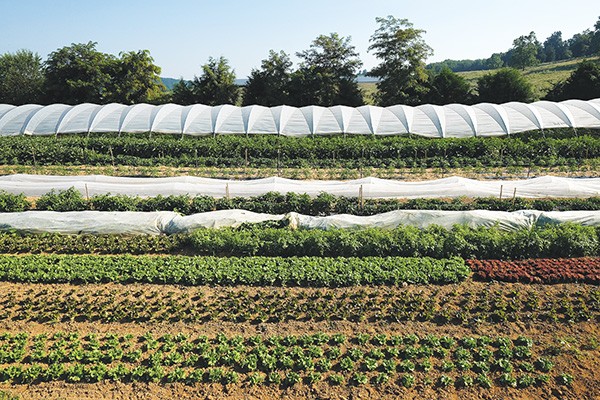
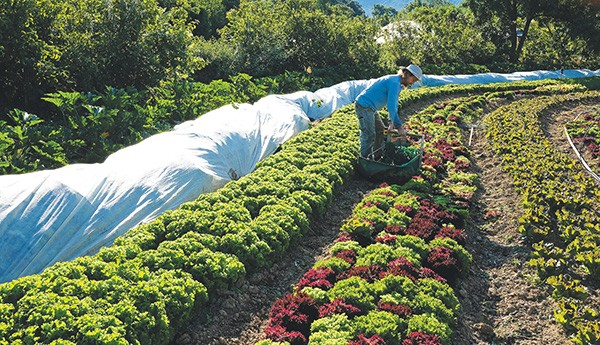
For all these wholesale accounts, Radical Roots offers a concise group of crops: head lettuce, cherry tomatoes, heirloom tomatoes, swiss chard, salad mix, and kale. Lee points out that instead of dwelling on the lower prices that came with wholesaling, they accepted the challenge to lean their production systems so that they could make it profitable. They’re still refining their tomato growing, still improving yields with tunnels and grafted plants. They are figuring out how to do a better job of the simple task of tomato harvest, where field packing = less touches = lower production cost.
Other lean methods that help improve efficiency include lessening physical strain through the use of wheeled racks to move things around – from harvests to germinating flats to plants. They are constantly re-evaluating how well the pack out area functions. They continue to streamline how the harvests come in and flow through to the walk in cooler and then into the delivery vehicle.
Lee excitedly reported that the greens harvester was a game changer in terms of efficiency. All in all, the wholesale side of the business is poised for growth. This is good news as they have allowed the CSA to slowly decline, and they dropped all but their best farmers market in Charlottesville. Even two hours from Washington, D.C., the competition in the retail space has become stiffer.
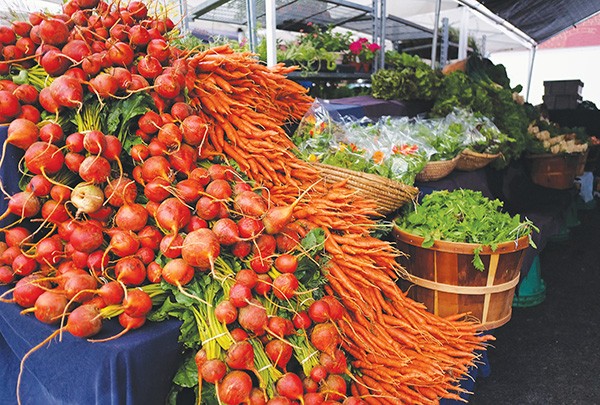
Throughout their farming tenure, the O’Neill’s have maintained a small but profitable greenhouse transplant and nursery business. Lee is the manager of this part of the business, which entails taking a van full of plants to eight different spring garden festivals around Virginia and North Carolina. I can tell that this part of Radical Roots continues to be a source of joy for Lee. She told me how proud it makes her to witness her twelve-year-old daughter answering customers’ questions and helping them make gardening decisions.
How did they manage all of this activity, growth and change? Lee tells me that it’s because she and Dave have maintained excellent communication and partnering throughout. They have both completely bought into the plans that they’ve made all along – neither was secretly holding out or wishing for something different. They have both been deeply committed.
They start things small, do their trialing and research and then build on that knowledge. They’ve been very clear about their roles on the farm, with overlap in crew leading and homeschooling, but otherwise each has their special areas of activity and expertise. What I see from my vantage point is that there is some kind of magical result from so much intention, focus and passion. Radical Roots Farm is about as calm and successful a place as I’ve ever visited. The site is gorgeous, the folks are happy, and the business is successful. What an inspiring farm.
Ellen Polishuk just retired from growing 25 acres of ecoganic vegetables and other crops at Potomac Vegetable Farms in northern Virginia. She is now a full-time farm consultant, writer and teacher. For more info go to planttoprofit.com.
Copyright Growing For Market Magazine.
All rights reserved. No portion of this article may be copied
in any manner for use other than by the subscriber without
permission from the publisher.