






By Gretel Adams
Something we often get asked about at conferences is what it’s like to manage a crew. First off, bringing on other people was one of the best decisions we ever made. People are an investment, so it takes time and money to make it work, but all of that is worth it if it helps accomplish your goals for the farm and also helps give you more personal time back.
Think of it as not only an investment in your business, but also a quality of life investment because you aren’t doing it all on your own. Yes, it’s scary, but it forced us to be a lot more organized with our time and efficient in transitions between tasks. You will always be the fastest at everything, but we know that our time is well spent working ON the business instead of IN the business.
And now that our crew has grown, and we have more return employees, it has become really important for us to not only train the employees, but to train the leaders how to be our eyes and ears in the field. Here are some of the things we’ve implemented over the years that have helped us be clear with what it is we are looking for and also how we’ve found to best communicate feedback and build an ideal work culture.
Communicating daily tasks
We use Evernote to communicate with our crew about the day’s tasks. We have our notes organized into lists that belong to certain people (or groups) like: Field Crew, Barn Crew, Angie (office manager), Emily (farm/wedding manager), Steve, and Gretel. Everyone has a separate list divided into Today, This Week, and then the Master List.
We also keep a notebook that is called Future Plans with each month having its own note. This is where things go that we need to do in the future, so if I know something needs to be done in the fall, like replacing plastic on a greenhouse, that information will go onto October’s list instead of sitting on the master list until then. There are always so many things to do on a farm but being able to compartmentalize these things into what is going to happen, and when and who is responsible for it, has made all the difference.
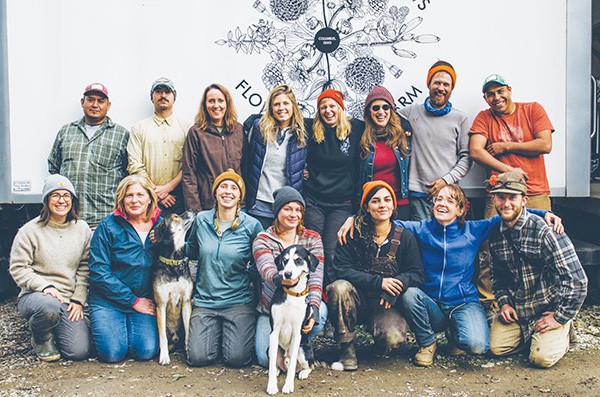
It gives us a place to store all the information that would otherwise just be swirling around in our heads, and we can give the crew members access to the list that is relevant to what they are doing so they can see not only what is happening today, but what the plan is for the week to come. They can also edit the list, so they can cross things off when they are done or add any notes to it if they used the last of the snapdragon seed and we need to order more, or they were harvesting and saw pests or diseases that weren’t there the last time we scouted.
After we have created all the crop plans, it’s easy for me to go through and sort out everything that needs to be done for that week number, and then each morning I will pull from the week’s schedule what needs to be done that day. Planning each day gets easier once we are into the swing of things and each day starts out with harvest, so during the colder months of the year when there are no blooms and there isn’t as much of a routine, the Master List comes in handy for projects that we decided need to be done that month. Evernote can be downloaded onto each team members phone, so they have it at their fingertips throughout the day.
Weekly check-in meetings
Over the years we’ve had some tumultuous seasons as our staff grew faster than our HR skills, but we’ve learned a lot through those hard times. One of the best things that came out of the turmoil was our weekly meeting structure which helps to keep the lines of communication as open as possible. As the team grew, my husband Steve and I weren’t working with them as much as we used to, which made us less accessible despite us always talking about our open door, ask anything policy.

This weekly meeting gave everyone a platform to talk about their experience that week and helped us to see the farm through their perspective. We go around the circle and each person shares these things:
1. What is something you were grateful for, or that you felt went well this week?
2. What is something that didn’t go well or was frustrating in your experience?
The second question can also be expanded on by asking, what does support from me look like? This helps them think about solutions to the problem instead of just wading in emotions of frustration, by redirecting their energy and helping build up their adaptability, which we feel is an essential part of being a farmer.
During this meeting, there is much direct, honest feedback which sometimes is challenging to take at first, but the more you build up this type of culture, the easier it becomes to talk about the difficult things because everyone is open to being vulnerable. And even if it is constructive criticism happening in the meeting, it is guiding us in the right direction, and paving the way through patience and understanding.
With this accountability, there is no judgment for mistakes, and no resentment or humiliation when you ask for help and information. We found that without these check-ins, sometimes issues would be pushed aside and brewed upon, which could lead to resentments building up. Instead we wanted a culture where people just talk about things as they happen, address how we can fix the situation if possible, and then move forward from there.
This has taken a lot of growth on everyone’s part but has been an amazing change. Everyone involved must be open to feedback, learning through mistakes and also building confidence by talking about what went well. It’s led to more ownership of tasks, and more autonomy of the crew as they teach each other about what they’ve learned. It has also continued to build on the culture of growth and community in the group, which has led to more trust and team unity. Trust + respect = confidence.
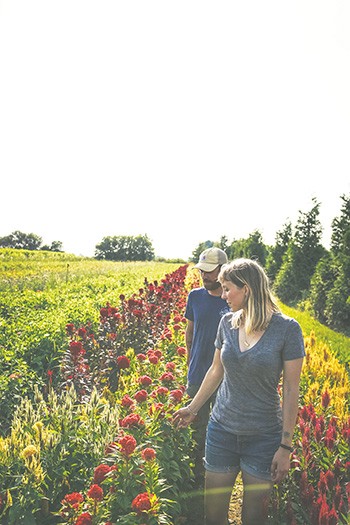
Leadership at SMFF
Clarity is key when you are explaining the task at hand, which means identifying what it is that you do and what your standards are so that it can be learned by others. Talk about what the goal is when you set workers up for a task, and then if you aren’t working directly with them, check in 15 minutes later to be sure they fully understood your instructions. We’ve found that most of the time there is a mistake, it is a reflection of us as managers not being totally clear with our expectations.
“What does finished look like?” is a good question to answer when you are setting somebody up on a task. Take weeding for example; there are times that the goal is to use a hoe and get every tiny white thread of weeds there and to disturb all the soil around the plants (like with lisianthus in the greenhouse). Other times if the crop is out in the field and the bed is further along, finished may mean just going through to get the big weeds out so they don’t go to seed in the field.
Communicating your expectations in the beginning means you can avoid the situation of being upset because the crew took too long in the field hoeing every tiny weed in the celosia patch when you really just wanted them to go through to get all the big lambsquarters that are seeding. Or in our case, sometimes we’ll just throw weeds in the field, but galinsoga we want totally removed and thrown into the woods. You get the point, there are just so many grey areas in farming where the weather or something about a specific crop or time of year changes what finished looks like.
Communication and clarity become even more important once you have middle management as we are communicating to them, and then they are our voice in the field. The more we can create definitive ways that things are done on our farm, the easier it is for someone else in management to make the same decision as you the farmer would make. We want our managers to show others what is required rather than simply telling them. And part of their role is also to have a pulse on the crew, to let us know if something isn’t working out and/or if they need better resources in order to complete the task at hand. We say the solution to confusion is to ask for clarification.
Feedback loop
When we first started having employees, I was afraid to tell them what to do because they were all older than me (we started the farm young). Instead of telling them that something was wrong, I would just follow behind them and fix it myself with the mentality that it was faster to just fix it than to have them stop what they were doing to come back and fix it themselves. What that created was not a learning environment for them to see the way we wanted it done, and also meant the next time they did the same task potentially they would make the same mistake.
What I’ve learned since then is that people want to do well for you, and they want to know whether or not they are accomplishing that. In the book StrengthsFinder, author Tom Rath cites a study that concludes, “having a manager who ignores you is even more detrimental than having a manager who focuses primarily on your weaknesses.” See the chart below:
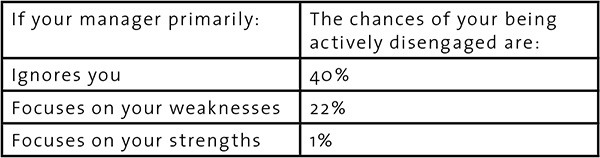
Now obviously the goal is not to just focus on their weaknesses, you want to also give them lots of praise for all the things they are doing right. If it feels hard, it’s because you’re human and it’s a skill that you gain through using it. The more you do it, the more confidence you will have and the more normal it will start to feel.
When times are difficult, know that sometimes even if you are right in the situation, being a boss means being the bigger person and helping others grow. I imagine it is somewhat like being a parent where the child learns best through experiencing the world and learning themselves, with you there to guide them. (Side note: I’m not a mom, so I don’t know this through experience, but I definitely feel like Farm Mama.). It’s my job to train employees to be the best possible farmers they can be. There is a quote from Jim Hollis that I have really enjoyed through this process, “We are here to become more and more ourselves.”
Sometimes there are bad eggs, but the more you learn about yourself and are honest when hiring, the more you hope to weed those folks out before they even get in the door. Chris Blanchard said at one of his workshops, “Be slow to hire, and quick to fire,” by which he meant to cut the ties when it’s needed even if it’s the middle of the season and you feel like you need the person.
If one person on the crew is not engaged but everyone else is, it isn’t fair for the others to have to pick up the slack and team morale will be affected. Now obviously with feedback, you will be talking with these folks and giving them a few chances, but if they don’t kick it into gear or heed your attempts at feedback, don’t be afraid to let them go as they are not the right fit for your team.
Expectations
With more of our team members staying for multiple years, it has led us to create some guidelines of what it means to be a leader in the field. With that has also come policies for how they accumulate specific benefits (less Saturdays worked, overtime pay, paid vacation, etc.). With higher pay and more benefits, we can continue to ask more of them as employers and hold them accountable. We want them to adapt their decision making through observation.
This means learning the crops and our systems, and then learning to trust their instincts for when we leave them in charge. We also expect their head to be in the game. If they make a mistake that was just a mental slip up because they were zoned out, that is much different than them doing their best within their capability and resources and not completing the task. But having a culture of learning takes the pressure off of needing to be perfect, and instead allows them to take pride in improvement. We want them to marry intention with execution.
We have a meeting each morning to review the tasks or projects on the list for the day. When we discuss each task, we ask the employees to think about all the steps that go into the task and all the tools they will need to complete it. We put an emphasis on tidiness so that everything is where it is supposed to be in an organized fashion. This makes it easier to access it the next time you need it. Create checklists if there is something that is often forgotten.
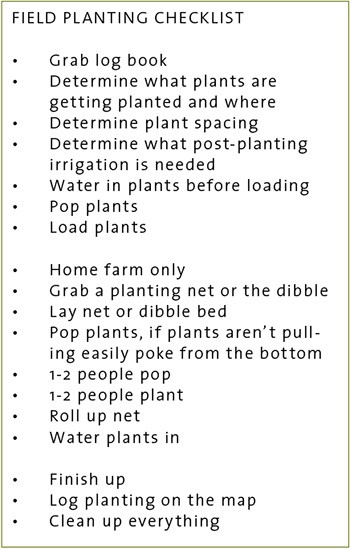
For example, I included our planting checklist, making sure to include cleaning up, watering in, and logging plantings for proper record keeping. As much as you can create protocols, part of farming is knowing that some standards are going to change based on necessities and the variables of weather and the season, but the goal is just to clear up as much of the grey area as possible for each task. We are creating some standard operating procedures that we can use to define the standard for different jobs. The more you can identify it, the better you can train it!
The author Marshall Goldsmith says in his book Triggers, “Skill is the beating heart of high motivation. The more skill we have for the task at hand, the easier it is to do a good job. The easier it is to do a good job, the more we enjoy it. The more we enjoy it, the higher our motivation even if the job is exhausting. Good performance provides good feedback, placing us in a constantly reinforcing feedback loop. Marginal motivation produces marginal outcome.”
So we tell our crew, if they’ve already gained the skill, then move onto mastering it. We want to help them achieve their own goals as well, whether personal or on-farm, so we talk about those. If an employee wants to learn a lot about pests and diseases, then being in charge of scouting and IPM might be the correct route. If they want to have their own farm someday, then maybe something with a broader range like learning about our crop schedule by being on the planting team would work better to get them to their goals.
Ultimately, we know we could not do what we do without the crew and we wouldn’t want to! Success is the sum of small efforts repeated day in and day out. Each year we learn so much about ourselves as leaders and refine our skills as well. And Steve and I have to grow together in this aspect. We used to read books about how to farm in the winter, and now we are learning more about business management and leadership but are in a constant state of discovery and learning about ourselves, about people’s needs, and about how to create the best work culture for folks so they will want to return year after year.
Everyone that works on a farm has to enjoy being vulnerable through the process of learning, feedback, and discovering the answer as we experiment with new systems or take on a new crop. This isn’t the same type of book learning that folks may be used to, so continuing to talk about the learning process helps so that everyone stays engaged and motivated even when tasks get monotonous. They are learning not only technical skills, but also soft skills like coaching, communication, intention, and purpose. In all of this communication is key!
Further reading:
The Culture Code by Daniel Coyle
The One Minute Manager by Blanchard and Johnson
Good to Great by Jim Collins
Dare to Lead by Brene Brown
Strengthsfinder by Tom Rath
Small Giants by Bo Burlingham
The Hard Thing About Hard Things by Ben Horowitz
Gretel & Steve Adams own Sunny Meadows Flower Farm in Columbus, Ohio. Follow on Instagram for more color and variety details: @sunnymeadowsflowerfarm, @flowerfarmette, and @flowerfarmer.
Copyright Growing For Market Magazine.
All rights reserved. No portion of this article may be copied
in any manner for use other than by the subscriber without
permission from the publisher.