











Pivoting from weddings to a floral CSA, and building community
On a cloudy spring day in rural New Hampshire, I crossed a bridge over the winding Ashuelot River and drove up a long gravel road. A little flower farm sits atop a big hill, surrounded by forests and New England’s characteristic stone walls. I was greeted by smiling Sarah Barkhouse, farmer-florist of Vera Flora Farm on three-quarters of an acre in Gilsum, New Hampshire.
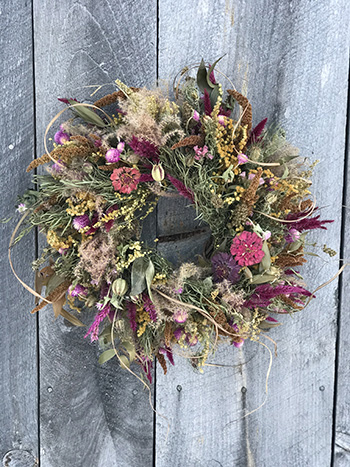
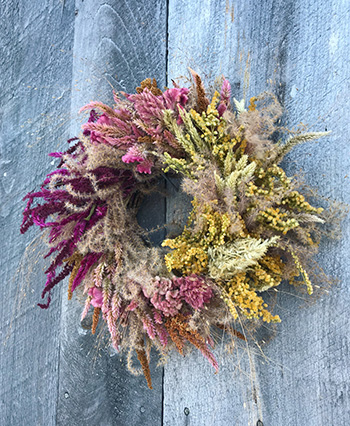 A couple of Vera Flora Farm’s seasonal wreaths.
Sarah and her wife, Vanessa Helgerson, have been managing their cut flower market garden for nearly ten years. They use organic no-till growing techniques to grow over 100 varieties of cut flowers for a CSA, weddings, and a small amount of wholesale. The three of us wandered around the spring gardens and talked about their experiences and expertise as flower farmers in the Northeast.
Vera Flora Farm was founded in 2012 on rocky, sloped, acidic soils. Starting with only $1,000, leased land, and no cooler or greenhouses, Sarah and Vanessa bootstrapped their way into flower farming. “You really have to love it,” Vanessa laughed, reminiscing about how difficult it was to start their market farm in the middle of a forest. Challenges like high winds, ever-hotter summers, and extremely rocky soil led them to transition to more hardy species like peonies and Baptisia for spring/summer and sedum, perennial grasses, and Japanese anemones for autumn. They have since added two tunnels, winter wreaths and dried bouquets to diversify their seasonal offerings.
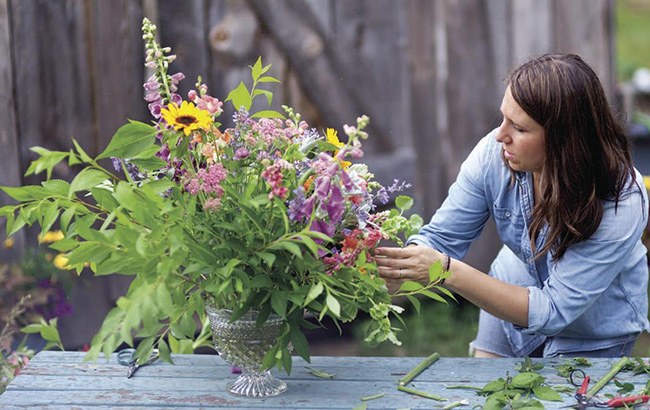 Sarah Barkhouse working on a wedding centerpiece. All images courtesy of Vera Flora Farm.
Expanding floral CSA
In fall of 2019, Sarah quit her job to go full-time on the farm, only to have the rug swept out from under her by COVID and dozens of cancelled weddings. Without skipping a beat, Sarah quickly transitioned to a floral CSA model that has since grown to over 60 members. She relied on social media or word of mouth to double her membership from 25 to 50 CSA members in 2020. “People were really craving something joyful last year, so it made an easy sell,” Sarah told me, adding that most of the sign-ups were referrals from customers’ friends and family.
In spite of the stress and surprise of losing all their 2020 weddings, Vanessa and Sarah embraced this shift as a blessing in disguise. “Suddenly we had our weekends together on the farm with our kids and honestly, we loved it,” said Sarah. The CSA has become the backbone of Vera Flora, capping at 60 members for the 2021 season.
Logistically, Sarah has created a simple Google spreadsheet and email list to manage the orders. They charge $250 for a 12-week summer share, or $125 for a six-week share at the beginning or end of the summer. They offer free group deliveries for four or more shares (typically to workplaces), a Monday pickup in the nearest major town, or home delivery for a $6 fee per delivery.
So it’s an additional $36 to deliver a six-week share or an extra $72 for a twelve-week share. Last year they did not charge for delivery and used a small grant to offset the costs of gas and time. This year they are experimenting with this delivery fee for nearby cities and seeking to re-evaluate at the end of the season to make sure it properly accounts for mileage and fuel without overcharging their clients.
“Community is at the heart of our business,” Sarah emphasized. The CSA has quickly become her favorite market for flowers because it allows their family to spend most of their time together on the farm while still being part of the community. An online shop and on-farm pickups also has offered more opportunities for directly reaching customers.
Working with brides
But that’s not to say that Vera Flora has abandoned their brides altogether. Weddings still have a very close place in Sarah’s heart and they will continue catering to “locavore” brides in the region.
Sarah connects with most of her wedding clients via venue managers and recommendations from wedding planners. “Building relationships with these people has been absolutely key to filling up my wedding calendar.” Keeping in mind that Sarah has been growing and arranging flowers for nearly a decade, this may seem daunting for a farmer-florist who is just starting out.
She suggests starting small and forging connections with as many people in the industry as possible. Don’t get overwhelmed by all the veteran florists out there, and remember that most of them are buying in their flowers from far away places. Locally grown flowers are Vera Flora’s biggest selling point.
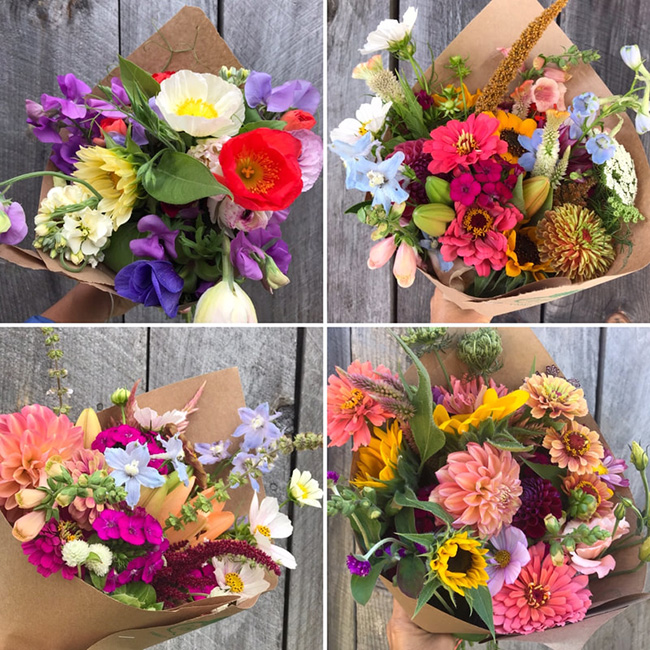 Some of Vera Flora’s offerings for their bouquet CSA.
When Sarah took on her first wedding client, she was an inexperienced intern at a local non-profit, Stonewall Farm. One spring, her boss tossed some seed catalogs on her desk and told her to pick out some flowers to grow in a few extra beds. She chose an array of cosmos, rudbeckia, snapdragons, and others to experiment with.
This was back in 2007 before the explosion of small local flower farms had reached rural New Hampshire. Sarah didn’t have any mentors or books available, so she just flowed with what felt right and taught herself along the way.
Soon, Sarah had a few brides asking if she could design their floral arrangements with flowers from the farm (Stonewall Farm is also a popular rustic wedding venue). Drawing on nothing more than a childhood pastime of harvesting flower bouquets in her backyard, Sarah used trial and error to design her first arrangements. The brides were ecstatic and the farm expanded their floral offerings the following year with Sarah taking charge of the enterprise.
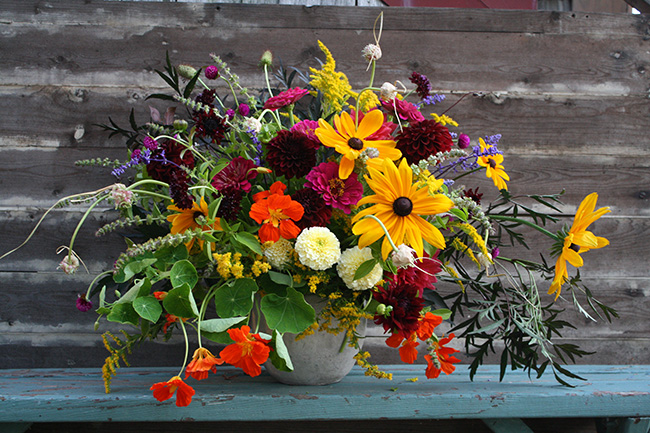 A centerpiece for a September wedding.
One thing led to another and Sarah eventually went back to school at University of Massachusetts Amherst for Horticulture and worked on a few local vegetable farms that dabbled in flowers. She also briefly worked in landscaping, where she met Vanessa. Soon after, Sarah realized she had found her dream niche. She could work with flowers and be a farmer.
The realization was monumental. We all chuckled when Sarah recalled, “I honestly had no idea that being a farmer-florist was even a thing. When I found Lynn Byczynski’s The Flower Farmer, I literally thought I had found the Bible.”
Vera Flora continues to focus on rustic barn, farm, or estate venues in the region because they fit her flowing, nature-inspired design style. This demographic of brides tends to value and understand the importance of local, in-season flowers. She ensures that her clients recognize the unique design elements of each season in New Hampshire, from spring’s daffodils, flowering apples, peonies and ferns, to summer’s bunches of zinnias, dahlias, sunflowers and amaranth, or autumn’s grasses, strawflowers, and dried seed-pods.
In terms of communicating with brides, Sarah has developed her own system to streamline operations. I asked her if she had any tips she’s learned along the way. She responded,“I feel like I’m supposed to say ‘put up boundaries’ and ‘my time is valuable’ but honestly, I just try to be human and generous with everyone.”
Over the years, Sarah has crafted template responses to cut down on response times for initial inquiries. She also has worked to standardize some floral offerings to make estimates quicker and easier. Farming is challenging enough as is, but wearing multiple hats as a wedding florist, designer, and office manager complicates it even more.
Sarah said, “most of my wedding clients are looking for designs that are loose, natural, garden-inspired, and organic…which is my wheelhouse. Therefore I’ve been comfortable standardizing my pricing for items such as a bridal bouquet, bridesmaid bouquet, 6” centerpiece, boutonniere, and 18” urn. I know I’ll use approximately X number of focal flowers, X number of foliage stems, and X number of accent flowers. Unless the client wants something really particular, I can use my ‘menu’ pricing to help me create estimates more quickly rather than pricing out each potential stem.”
She added, “the downside is that, when you’re essentially running two separate businesses (a flower farm and a floral design company), pricing can get tricky. Unlike a mainstream florist, the wonderful thing is I have my own flowers to pull from for weddings and events- I can wander the fields and my woods looking for what I’m inspired by. I have a general sense about what I’ll use for a wedding at a given time of year, but I don’t have my designs planned to a T.” The menu-style pricing helps Sarah bridge this gap.
Thankfully, Vanessa really enjoys taking on farm work when Sarah is busy designing and coordinating with brides. The pair’s skillsets complement each other perfectly.
Working with brides can be time-consuming and challenging, but it is extremely rewarding. “At the end of the day, a florist is a key partner in a couple’s wedding vision and you are building a relationship and there aren’t too many shortcuts you can take to do that,” Sarah said.
Building a flower community
Being a vegetable farmer, I used to wonder why people would grow flowers when they could grow food. But 2020 completely changed my perception. After months of being stuck indoors and separated from community, seeing someone’s face light up at the sight of a fresh seasonal bouquet made me realize how important flowers are to our lives.
Floral aromas, textures, and colors catapult us into the present moment. Whether as a table decoration, a wedding bouquet, or a thoughtful gift, flowers bring people together. Vera Flora is founded on this principle of building community around flowers. They agree that, all clichés aside, “flowers really are food for the soul” and they bring joy and connection to the community. There is even an abundance of scientific literature indicating how flowers in homes, offices, and hospitals leads to reduced stress and greater overall wellbeing.
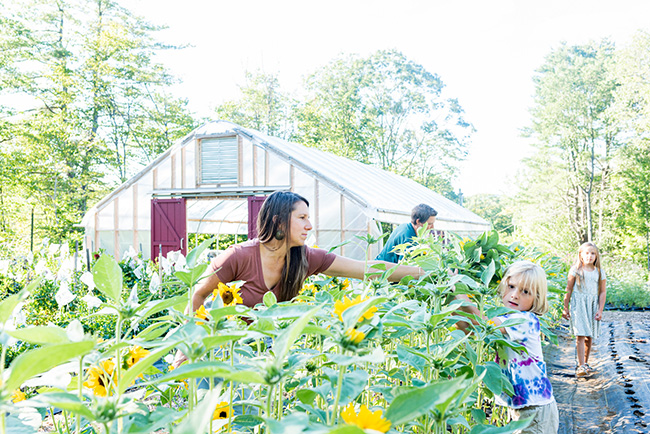 Sarah and kids harvesting sunflowers.
For Vera Flora Farm, flowers are a community and family endeavor. The farm is named after Sarah’s paternal grandmother, Vera Mae, who enchanted young Sarah with her floral homestead paradise. Vera Flora is also Latin for “true flowers,” which embodies the farm’s ethos of growing organically and arranging with the seasons at the special place they call home.
“Vanessa and I both really like being rooted to a place, a placed-based life, and making something that we feel we can contribute to our community. Earning a living off our land while being home with our family is the informal ‘why’ of our business.” Sarah, Vanessa, and their two children Willa (9) and Heath (6) are living this dream every day, with smiles on their faces and clippers in their hands.
Logan Hailey is a farmer, writer, and co-owner of Ramblin Farmers LLC, a mobile freelance farmhand service. She travels to farms and forests around the country in her off-grid school bus tiny home with her partner and three dogs. As they ramble and farm, they’re searching for a place to put down roots and start a farm of their own. Keep up with their adventures at www.ramblinfarmers.com.
Copyright Growing For Market Magazine.
All rights reserved. No portion of this article may be copied
in any manner for use other than by the subscriber without
permission from the publisher.