











Post your farm-made tool with #ToolsForGrowingForMarket. If author Josh Volk picks your tool, you win a $50 tool gift certificate and a Full Access subscription to GFM.
Eleven years ago, I wrote an article in Growing for Market titled “Water Greenhouse Plants Automatically,” that ran in the January 2010 issue. Reading back through that article in the archives it’s still good stuff. Since it’s the beginning of the year I’m sure lots of you are just about to start filling your greenhouses back up with seedlings in flats, plug trays, soil blocks and nursery pots, just as I am. If you’re not already using automatic water in your greenhouse, I’d encourage you to go check the archives for that article, and I’ll give an update here on the evolution of my greenhouse sprinkler system, and what I’ve ultimately been using for at least the last eight years with good success and next to no problems.
My current system uses Ein Dor mini-sprinklers supported by 18” metal rods. If you haven’t seen Ein Dor mini-sprinklers before they are extremely small. And unlike many other mini-sprinklers I’ve used, they throw a full 360 degrees with no restrictions at all. The droplet size is larger than misters, which I like because it helps the water resist floating on air currents and the larger droplets tend to penetrate the canopies of tightly packed, more mature seedlings better than mist. I use a 30psi regulator, which helps keep the droplet size larger. If you run them at higher pressure they tend to create more of a mist and to put out water faster. I use the blue size, which is rated for 7’ as the diameter of the throw and 0.3gpm of water at 30psi.

Ein Dor sprinklers put out larger droplets than misters which do a better job of getting through thick canopies
in mature seedlings and resisting breezes. Note: if you can use a timer to turn off any fans for the few minutes
your sprinklers are running you’ll get much more even watering.
To get even watering I started out by spacing the heads every 4’ down the centers of my 42” wide seedling tables. I use wooden benches covered in lath strips and the rods just sit in drilled holes in the wooden cross supports that are holding up the lath. The 4’ spacing works, but four years ago I set up a new space, forgot how I had done it before and ended up putting the heads every 2’. It turns out this does give more even watering.
The number of heads I can run at one time is limited by the size of my distribution line, but also by the water I have available. I use 3/4” poly tubing which will easily carry 8 gpm (about all I have available anyway). Do the math and this works out to mean I can run up to 26 of these heads at a time, in other words 52’ of table space, which happens to be more than my entire current propagation house. The poly tubing just sits on top of the tables between the rows of plug trays. Short lengths of spaghetti tubing carry water from the distribution tube to the mini-sprinklers
I run all of these on the same timer, but I have a valve essentially every 8’ so I can shut down sections of the tables that aren’t used early or late in the season. It’s also possible to get little tiny shut off valves that sit right under each mini-sprinkler, or plugs to replace the press fit sprinkler heads when they’re not needed if you want more control.
The greenhouse where I first set these up was quite a bit larger. For that set up I used solenoid valves to control 4 separate zones which allowed different watering programs for different sized propagation containers or plants at different maturity stages.
Most of the programmable timers run more or less the same logic, letting you set just one duration for your irrigation, but to turn it on up to four times per day. I like to give an extra long watering first thing in the morning to really soak my trays, and then one or two shorter waterings in the afternoon to cool things off, but long enough before it gets dark that the leaves have time to dry.
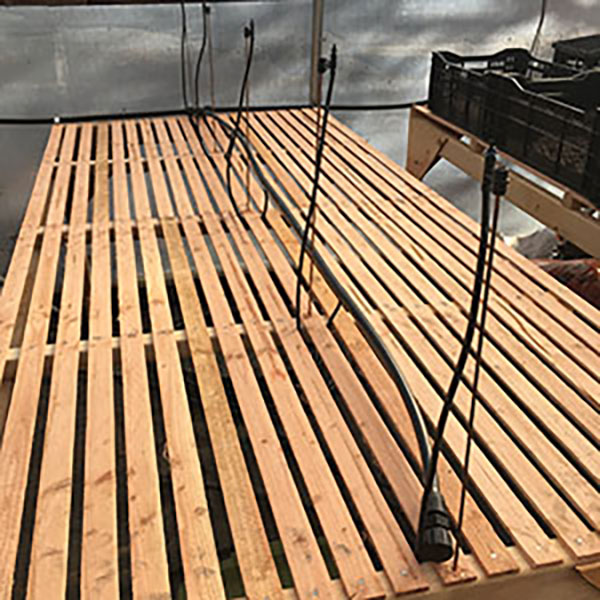
The seedling tables I use are 8’ long and fit two rows of 1020 trays.
The wooden cross supports are perfect locations for drilling a hole to stand the metal rods in for supporting the sprinklers.
I just run the distribution tubing down the center of the table top, between rows of trays.
There’s a valve at the start of every table to allow the entire table to be shut off when it doesn’t have trays on it.
Tables can easily be connected together end to end, and even with two side by side it’s relatively easy to reach all of the trays.
All photos courtesy of the author.
To get the extra watering in the morning I set two separate waterings about 10-15 minutes apart, letting the first one soak in before the second one tops off the trays. Depending on the time of year I end up running the water for 2-4 minutes per set.
Even though the water is automatic someone checks in pretty much every day just to make sure nothing has exploded, or that the timers haven’t malfunctioned and left everything completely dry. This is really quick. About twice a week I reset the timers if the weather is changing. Once or twice a week I’ll either flip trays around so the outside edge, which tends to dry out more than the center of the table, will get more water, or I’ll just do a quick touchup with a watering wand.
You can also use these heads in a hanging configuration and get anti-drip nozzles for them. I ran them this way when I first started using them but always still had a bit of trouble with occasional drips, and getting the heads to hang straight. It turns out that with my particular table set up it’s really easy just to have the distribution lines and sprinklers on the table tops and they never actually get in my way. It’s also much easier to install and to drain for winterizing.
I do miss hand watering and getting to spend more time with the seedlings that way, but a quick calculation shows that by letting the sprinklers do most of the work they’re paying for themselves in very short order. If we didn’t have them we’d spend at least 5-10 minutes a day hand watering even our very small greenhouse, which would probably add up to an hour or more a week.
The system cost me less than $200 in materials and maybe a few hours to set up. At $15 per hour (our loaded hourly rate), the system pays for itself in about four months of use, saves labor during peak field prep and planting times, reduces stress, and, in my experience, does a better job at watering evenly than inexperienced help.
Josh Volk farms in Portland, Oregon, and does consulting and education under the name Slow Hand Farm. He is the author of the book Compact Farms: 15 Proven Plans for Market Farms on 5 Acres or Less, available from Growing for Market. He can be found at SlowHandFarm.com.
Copyright Growing For Market Magazine.
All rights reserved. No portion of this article may be copied
in any manner for use other than by the subscriber without
permission from the publisher.