











By Bo Dennis
By passion and necessity, farmers are natural innovators. The consolidation in agriculture has led to manufacturers focusing on larger scale tools and equipment, leaving smaller and mid-scale farmers to tinker and “farm hack” old tools to make things work for new systems. Sometimes these projects come together perfectly; as we use welders, carpentry, and possibly too much duct tape (or used greenhouse plastic, used drip tape, etc.) to create the odd looking but highly functional tool.
Other times we are left with this mentality of “if only” as we long for more specific design tools to build exactly what we need. 3D printing presents the opportunity to do that. In addition to making tools themselves, 3D printing software can be used to design and construct prototypes to be sent off for fabrication in another more appropriate material.
Much of the software, as well as existing 3D files you can edit, are free and open source. Open source technology allows for the equitable access to information and encourages cumulative innovation amongst communities. Creativity shared between farmers- the actual users of the tools- expedites invention through collaborative industry growth. As more farmers start to fiddle with 3D printing software to design farm applications and share them with their peers, the faster this innovation will occur.
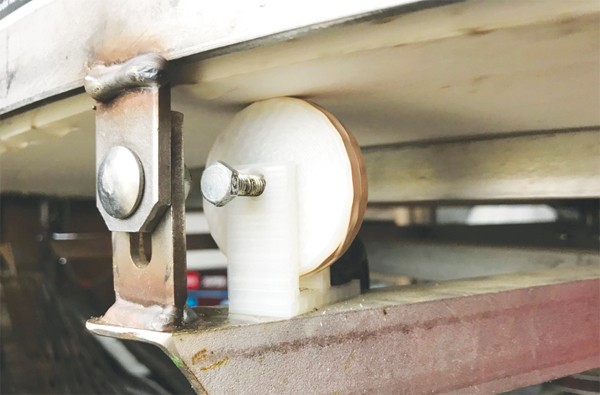
In addition to the possibility of building something specific, there is also the frustration that small pieces, such as the correct coupling or seed wheel, are pricey for what seems like such a simple farm tool. What might be a $20 off-the-shelf seed wheel that does a so-so job with pelleted seed, for example, can be customized to work exactly for your farm’s seeds and printed for under $1 with an entry level 3D printer.
If small to mid-scale farmers are to strive towards long term viable businesses and overall sustainability, we need tools that keep us nimble, adaptive, and efficient so we are both profitable and resilient. The experimenting to get there should also be affordable.
The following article will overview the nuts and bolts of 3D printing and its applications on the farm.
Farm applications
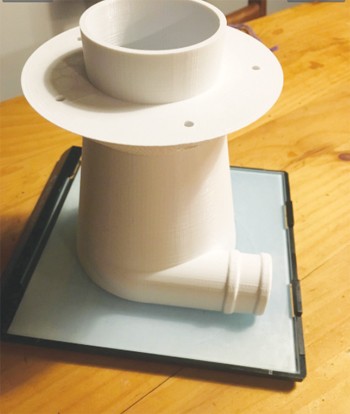
As a farmer based at an educational institution, I have had the privilege of connecting with a foundation to fund the beginnings of this work within the sustainable agriculture community. This has included providing pilot groups of farm businesses and tool share libraries with 3D printers as well as educational workshops around using the printer and the software. As we’ve been able to get this technology into more hands that are actively using them to design tools directly applicable to their businesses, the creativity of the projects has spanned wide uses. Some of these projects from the pilot group included:
custom seed processing equipment to work with shop vacs
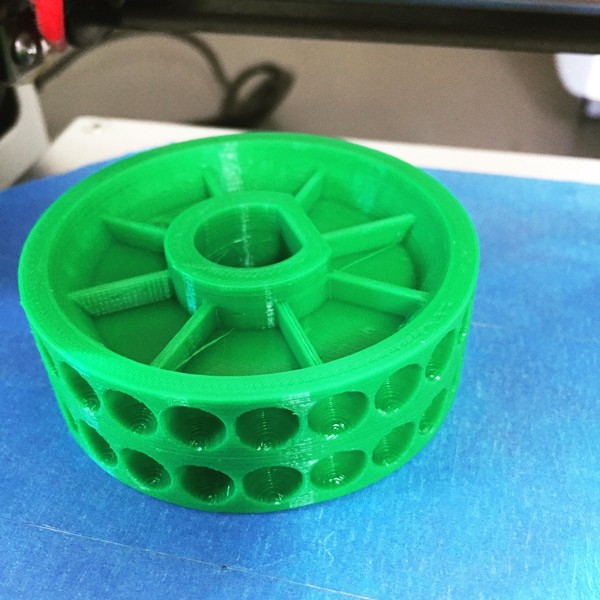
custom seed wheels to work better with pelleted seeds
large soil block makers
holders for sensor units in walk-in coolers
mason bee houses
threaded adapters for irrigation lines
landscape fabric cutters
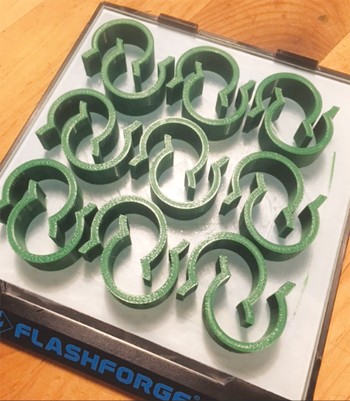
clips to hold row cover and plastic onto EMT conduit
seed counting plates for germination tests
root washer replacement parts
fence insulators for pipe gates
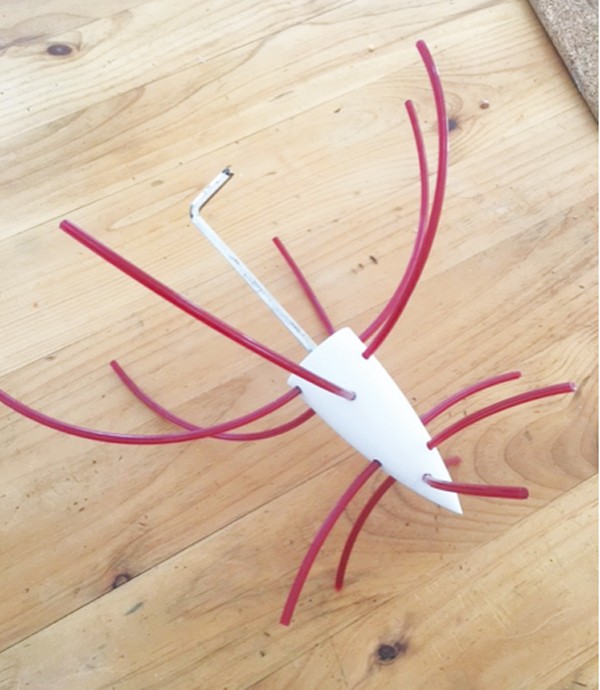
Some of these projects involved taking existing files from sites like Thingiverse (thingiverse.com) and Farm Hack (farmhack.org) and altering them, while some involved designing a file from scratch on web-based platforms.
The two leading incentives for these projects within this pilot group have been to design the right tool for the job and to save money. Seed farmer Daniel MacPhee at Blackbird Rise in Palermo, Maine, has built a suite of seed processing tools that increase the efficiency of his processing. He shares, “Despite some pretty awesome equipment out there for the large-scale and deep-pocketed seed operations, they are totally out of reach for us. In order to compete in the wholesale market as a small-scale farm, we produce relatively small lots of highly diversified specialty seeds which means we’re always on the hunt for old tools and creative techniques to make it economically viable.”
“I love existing in this space of constantly ‘reinventing the wheel’ to come up with processing efficiencies, and 3D printing has exponentially increased my ability to quickly turn pipedreams into reality. The best part is that I am rarely actually reinventing anything because there is such a strong community of sharing online that makes it easy to find and combine bits and pieces of solutions from disparate sources into exactly what I need. If I can’t quickly find a model to adapt to my specific need, I can just as easily build the entire model from scratch on my own,” said MacPhee.
“We’ve designed a number of simple and adaptable tools that have increased our seed cleaning efficiency greatly as well as replacement parts for salvaged antique seed cleaning equipment we’ve adopted from forgotten corners of old barns. Currently, I am most excited about creating simple very small-scale seed processing tools to distribute to new seed growers to increase their capacity to clean farm-produced seed.”
Diversified grower Anson Biller from Full Fork Farm in South China, Maine, states: “It’s been a different sort of lens to identify this or that particular thing, and to be able to say, ‘I can fix or improve that.’ It promises to be a great new tool to put to use on the farm.”
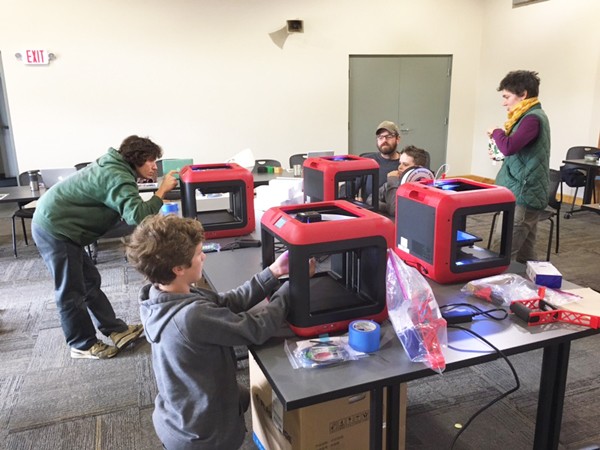
The next hope for this project here in Maine is to gain more interest from farming communities across the state, train more folks in the software to allow for printing “hubs” in these communities, and to create an online depository for all the files farmers are designing and working with. As Daniel explains, the more widespread use of these 3D printed tools on farms has the potential to spur economic efficiencies for small scale, diversified growers. To follow along with the work happening here, please see our website at https://farm3d.weebly.com.
This site also has links to more information about 3D printing uses in sustainable agriculture and more pictures not included in this article.
Printing materials
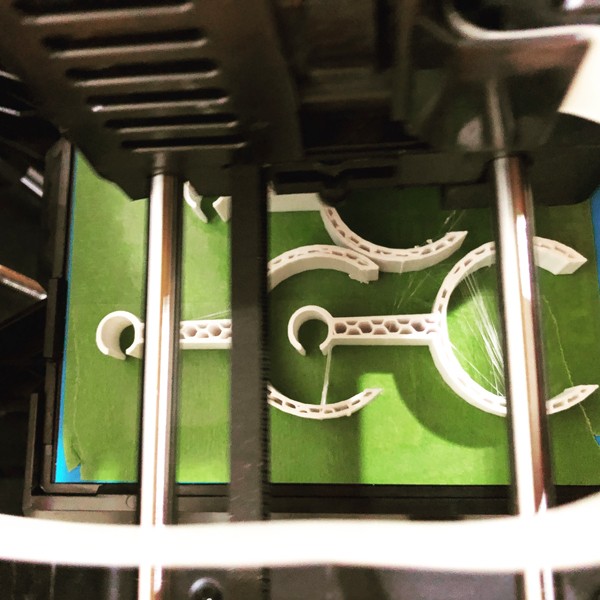
3D printing uses electronic files (called “STL” files) pulled from the cloud or a USB, similar to your average desk printer. These files can be built from scratch to fill your needs or printed from existing files online. Filament is extruded through a heated nozzle onto a platform which then fuses together in layers, creating the 3D rendering of your object. The designer can control variables such as the infill density of that object (which affects object strength as well as printing time), numerous structural elements, as well as the type and color of the filament. Once a file is uploaded and you hit “print” you can go back to work in the field or barn. For example, right now our printer is whirring away while I write this, making maple spiles to fit various tubing sizes. Some prints you can also leave overnight depending on printing length.
Printers
Printers range in tremendous size and capability. Our educational farm started with a Monoprice select mini ($180) and quickly switched to a FlashForge Finder ($300) due to its less clunky build and more user-friendly software. Our current greatest restriction with these printers is their build plate size, which is a six-inch square space. Many projects can be accomplished in this space, but it can be limiting if you are hoping to build bigger prototypes. The size limitation itself can lead to further innovation as you develop practical workarounds like model-slicing and printable snap-in connections. The farmer who built the large soil block maker printed multiple components of the project and then stuck them together.
Filament
The filament extruded from the printer comes on reels and are most commonly “PLA” or “ABS.” PLA, standing for Polylactic Acid, is a vegetable-based plastic material often made from cornstarch. PLA is less durable and more sensitive to heat than ABS but has proved to work for most projects we have made on the farm, including fence insulators and seed wheels, though the test of time may prove otherwise.
ABS, Acrylonitrile Butadiene Styrene, may be better for farm applications as it is stronger and equally affordable (a reel of ABS or PLA is around $20). Two of the major downsides of ABS, however, is it is not biodegradable so the fear of just creating more plastics in the world is certainly there and ABS prints best with a heated printing platform, so a different printer may be necessary.
That said, the composition of filament is limited only by what can be melted and extruded as well as the printer model and temperature range of the extruder. Filament doesn’t have to be plastic as it is also possible to print metals, ceramic, glass, concrete, and filament with wood that can be sanded similar to natural wood. Materials vary in their user-friendliness, fume release, temperature and other factors as well as their wear on printer components. Material shrinkage must also be considered when designing parts or tools for very specific farm projects. For example, PLA has a tendency to shrink with temperature fluctuation, so you have to adjust your printing specifications for the model accordingly.
Design software
As someone who doesn’t consider himself particularly “techy,” I hesitated before jumping into 3D printing and plastics. I didn’t know how to code and I was afraid of creating more useless plastic destined for a landfill. It took a few eager sustainable agriculture students and passionate coworkers to encourage me to explore adding one of these to our tool library at the college farm.
Working with this tool has certainly changed my perspective about the endless possibilities of integrating technology into sustainable agriculture and the ways in which we as farmers can use tech to facilitate innovation and efficient problem solving on-farm. All the design software is intuitive and navigable; and though it might seem daunting there are thousands of YouTube videos there to guide you. Some of the basic (and free) software you can use include:
Tinkercad
A basic online platform for altering existing STL files or building new designs from scratch. This allows you to scale, build shapes, measure and design what you want.
Thingiverse
Not software but a depository for endless 3D printing files. While it is hard to sift through and many don’t pertain to farming, with any good hacking comes recognizing what can be slightly altered to fit your needs.
OpenSCAD
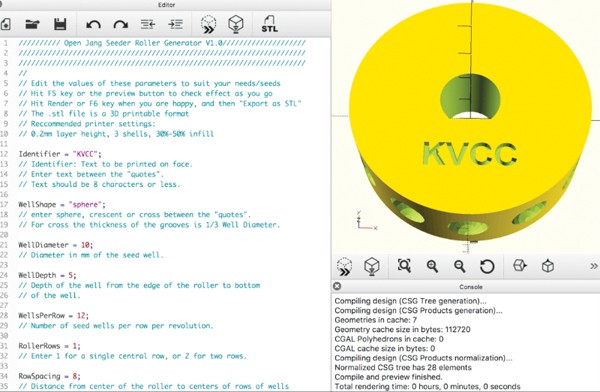
A gentle introduction into coding which allows you to alter the printing code and details of a file. The “seed roller generator” on FarmHack is a great example of using this program. Through parametric customization in this case, it allows you to customize aspects of a file given a set of a parameters. You can simultaneously adjust all seed holes to change shape, depth, alignment and number of holes.
Flashprint
Each type of printer works with a certain type of printing software. Flashprint works with our FlashForge Finders. In the printing file you can alter density and resolution. Since the filament is printed as a flexible fluid that deflects with gravity until it hardens, any temporary printing supports your print might need for a significant overhang or internally hollow spaces can be identified by the program or else added manually.
Learning curves and limits
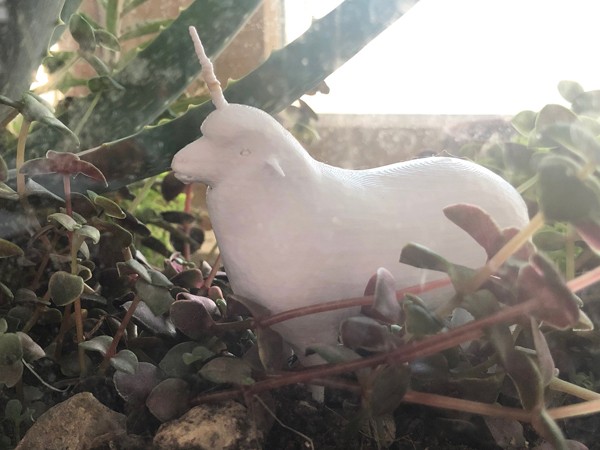
As with any new farm equipment or system, it takes time to learn this software and trouble shoot printing to maximize 3D printing’s potential. While starting off by making a few small random pieces such as guitar picks and my ever-favorite unicorn sheep might seem pretty useless, these beginning projects of taking a file, slightly altering it, and then trouble shooting printing help you practice the programs needed to start designing more useful tools. Assuming that you are like me and in the summer months you find yourself with no extra time and resort to eating “lunches” of corn chips while on the tractor, this dream and design space of working with 3D printing is definitely a great winter months project. That said, printing can happen at any time without waiting and watching (though that is very satisfying too).
Once you are familiar with the software it can take a matter of minutes to design and start printing something that will be ready that same day (even the same hour) to potentially permanently replace and customize a so-so part. In addition to the learning curve there are limits to the outlined software and tools. These include restricted build plate size and detailed design. For example, this tool is much more suited to geometric shapes than natural forms.
As many of us are hopefully still in winter mode and scheming up what this coming season will look like, I hope this info has inspired you to consider how as farming communities we may use modern technology to sustainably innovate our farm systems. While I am not advocating for robots replacing farmers, there is some potential labor and money saving that can happen from behind a screen.
Bo is a diversified farmer and agricultural educator based in rural Maine entering his 11th farming season. He currently farm manages at a local college where he teaches in the sustainable agriculture degree program. He is passionate about Katahdin sheep but has yet to perfect breeding a unicorn sheep.
Copyright Growing For Market Magazine.
All rights reserved. No portion of this article may be copied
in any manner for use other than by the subscriber without
permission from the publisher.