











By Bruce Hoskins
High tunnel production systems offer several obvious advantages over open-field production. They also present unique nutrient management challenges. Primary advantages include greater control of nutrients and water, enhanced heat gain, additional growing degree days, and extension of the growing season both earlier and later in the year.
With the advent of holding and harvesting late-planted crops through the winter, many houses are being double or even triple-cropped each year. With no natural precipitation, all water must be supplied by irrigation. Control over water inputs allows for better control of some foliar diseases on susceptible crops such as tomatoes. Higher soil temperatures can result in faster nitrogen (N) and phosphorus (P) release rates from both chemical and non-chemical amendments.
There are also potential problems with this system. Higher temperatures in an enclosed environment – often in monoculture – can worsen insect pest problems. Faster growth rates and higher yields create greater nutrient demand from the soil. Soil nutrient levels that may have been adequate or only marginally deficient in an open-field system may result in a major deficiency in a high tunnel system. For example, tomato fruit yields alone can result in equivalent nutrient removal on a per acre basis in excess of 200 lb (N), 80 lb (P) and 500 lb potassium (K) – demonstrating the very high nutrient demand on high tunnel soils. Efforts are ongoing to verify and/or modify existing soil testing guidelines for these very high nutrient demand high tunnel systems.
Our Northeast High Tunnel research group is working to develop new soil fertility, pest control, and cultural guidelines for high tunnel production. The group is composed of research, Extension, and laboratory personnel from UNH, UVM, UMaine, and Penn State. This article is an overview of some of our findings.
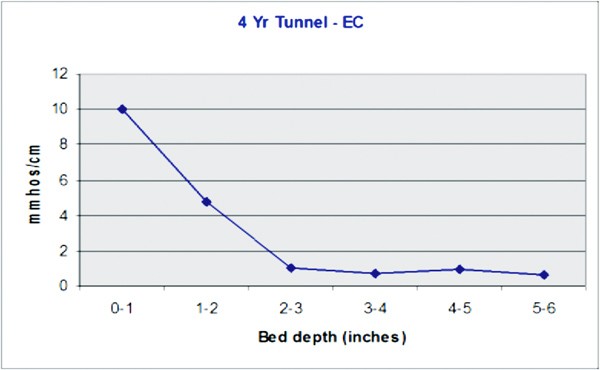
One of the most common problems in a continuously-covered high tunnel system is the buildup of nutrient salts over time. Water is typically applied through drip irrigation only to satisfy the immediate needs of the crop being grown. Transpiration of the crop plants plus evaporation from the soil surface cause a net upward wicking movement of soil water and dissolved nutrient salts. In this aspect, high tunnel soil management is very similar to irrigated desert production in the west and southwest. Unlike open-field production systems, occasional remediation of salt buildup is necessary, typically by uncovering to natural rainfall or otherwise flushing with high volumes of water.
To document this salt buildup, several beds in research tunnels were excavated in one-inch increments and measured for total salt content. We found that, regardless of the nutrient source (chemical fertilizers, natural fertilizers, or compost), all beds showed the same pattern of salt accumulation in the top two inches (figure 1). The top inch typically has ten times the salt level and the second inch has five times the salt level of the remainder of the bed. This huge stratification of nutrients is best addressed by remixing the beds before each planting cycle or at least once each year.
Soil testing systems
As requests for soil testing services for high tunnels increased at the University of Maine, it became apparent that routine field soil testing was inadequate to address many of the potential problems inherent in these production systems. Since high tunnel growers employ a wide range of soil amendments and management intensities, it became necessary to offer a range of testing options.
For the first crop year, the soil nutrient capacity should be enhanced to support high yield production demands. The potential for nutrient salt buildup and nitrate carryover should be addressed following the first crop. With virtually no nitrate loss from excess water or saturated soil, nitrate carryover from one crop cycle to the next is another major difference compared to open-field production systems.
Our first enhanced testing package, called the Basic High Tunnel Test, is a traditional field soil test plus total water-soluble salts (measured by electrical conductivity or EC) plus a direct measurement of available nitrogen (primarily nitrate). Recommendations for N-P-K are enhanced to compensate for the double and triple yields attainable in tunnels. Recommendations target 150 parts per million nitrate-N (300 lb/A), 40 ppm available P (80 lb/A), and 300 ppm K (600 lb/A), based on our routine field soil test.
This package has worked very well for the majority of our high tunnel growers. As with any traditional soil test, it monitors the season-long capacity of the soil to supply available nutrients. It also alerts the grower to potential salt buildup problems in a covered system. Since there is little or no loss of available nitrogen to factors other than plant uptake, ongoing nitrogen management can be adjusted based on residual nitrate levels in the soil.
All field soil test interpretations are based on the capacity of the soil to retain and supply nutrients over one or more full seasons. When a soil test shows levels near to or in excess of this inherent capacity, it is possible to start monitoring “free-salt” nutrient levels – those in excess of the soil’s retention capacity. This is done using the Saturated Media Extraction (SME) method.
For decades the SME has been the routine method used for greenhouse bench crops grown in soilless mixes and also in irrigated soils in arid production systems in the West and Southwest. This became our second testing system for high tunnels, dubbed the Long-Term High Tunnel Test. It was developed in collaboration with Dr. Vern Grubinger at the University of Vermont, who has been a strong advocate of the SME test for high tunnel systems.
The SME-based package is most appropriate for those houses that have been continuously covered and/or aggressively amended, have a relatively high EC level (> 2.5 mmhos/cm or dS/m), and very high reserve nutrient levels. Nutrients are monitored and managed at the water-soluble level. The SME monitors the pool of immediately-available nutrients (often called “nutrient intensity”), rather than total available nutrients held in reserve (nutrient quantity) measured in a typical field soil test.
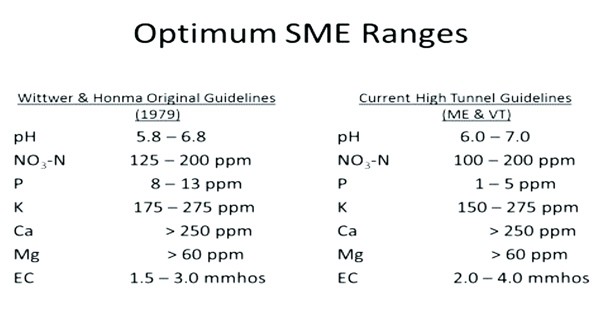
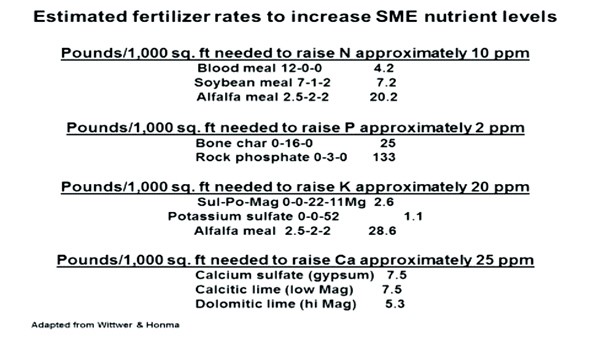
Organic matter level is also monitored to address soil moisture retention capacity. Interpretation and recommendation guidelines are based on the work of Wittwer and Honma at Michigan State (1979) (figure 2). Recommendation guidelines were modified from the original chemical sources to non-chemical sources required by organic production standards (figure 3) See tinyurl.com/yy9kvskk for more information on this. These guidelines are used to calculate quantities of N-P-K amendments needed to increase soil water concentrations.
The SME test package has worked well for highly-amended systems with high demand crops, such as tomato. In either testing system, very high soluble salt levels (> 4 or 5 dS/m) must still be addressed to avoid dessication damage to crop plants. Salt levels can be reduced, either by uncovering to natural rainfall, flushing with several inches of water, or by physical dilution with peat moss or additional field soil.
Unexpected findings
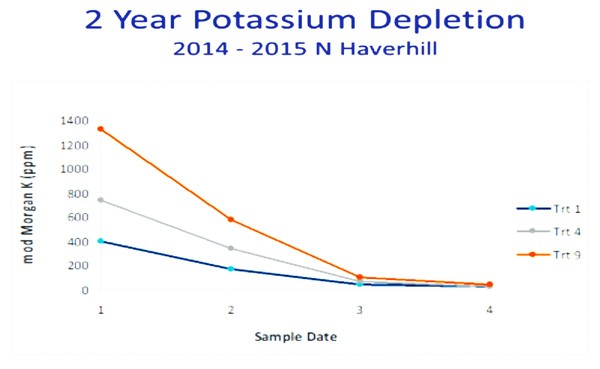
In a preliminary research project K was applied the first year as natural potassium sulfate. Two successive tomato crops were grown with no further K application. Initial application rates ranged from 100 to over 900 lb/A of K. At all locations, soil K levels were “cropped down” by plant uptake to low test levels, regardless of initial treatment level. In some cases, this was an astounding amount of soil depletion in just 2 years (figure 4). Tomatoes and other solanaceous crops have a strong tendency to “luxury consume” K, whether or not it is needed for normal growth and yield. This explains the high incidence of very low soil test K levels in tomato production tunnels.
The proportion of the total quantity of a nutrient present in the soil water at any given time is termed “buffering capacity”. It is controlled mostly by the clay and organic matter content of the soil. The 3 locations in our initial study had a range of soil textures: silt loam (higher clay), sandy loam (moderate clay), and loamy sand (low clay). On average, the proportion of total K which was immediately available in the soil water was 10 % in the silt loam, 20 % in the sandy loam, and 33 % in the loamy sand.
The higher proportion of immediately available K in coarse textured sandy soils leads to faster plant uptake earlier in the season and faster depletion of the total available K reserves. Faster K depletion in sandier soils can be compensated for by applying one or two additional applications through the drip later in the season. Front-loading all K at planting time is more compatible with loamy soils, which release K to the soil water more gradually through the season.
Another fundamental problem with high tunnel production is the incomplete wetting of beds in the hot dry environment. This can slow or prevent the release of applied nutrients. In open field production the soil is thoroughly wet to field capacity several times during the season. In a tunnel, there are often dry soil zones between drip lines. Even though both chemical and natural K sources (including potassium sulfate and K-Mag) easily dissolve in water, we were finding undissolved granules at the end of one or even two years after application in our research tunnels.
This is also a potential problem with natural nitrogen sources, which require sufficient soil moisture for full breakdown and release of nitrogen in plant-available form. Our current recommendation is to maintain three or four lines of drip in a typical 30-inch bed to minimize dry soil zones and incomplete nutrient release, especially in sandy soils. We also recommend using fine granulation fertilizers, where possible, to aid in more complete release of nutrients. Completely saturating beds right after applying fertilizer and again at two or three intervals through the growing season will also aid in completely releasing applied nutrients.
We are attempting to find critical K test levels corresponding to maximum yield and quality, for both types of soil testing methods: field soil tests (modified Morgan and Mehlich 3) and the soil water test (SME). In our potassium fertility research with tomatoes, we have found some very significant responses in marketable yield and fruit quality. Fruit quality issues of concern are yellow shoulder and internal white tissue, which are both physiological symptoms of potassium deficiency. We are continuing to accumulate and analyze uptake, yield, and quality data in our ongoing efforts to refine soil fertility and cultural guidelines in high tunnel production.
High Tunnel Soil Testing Packages are currently provided by the University of Maine, University of New Hampshire, and University of Massachusetts soil testing programs.
Bruce Hoskins has managed the University of Maine Soil Testing Lab for over 30 years. His wife Mary Lou and he operate Cedar Mill Farm, a small market garden operation growing cut flowers and mixed vegetables. It includes two high tunnels.
Copyright Growing For Market Magazine.
All rights reserved. No portion of this article may be copied
in any manner for use other than by the subscriber without
permission from the publisher.