











By Andrew Ashbrook
Rounding is a pricing strategy whereby smaller denominations are excluded from the grand total at checkout. That means pennies, nickels and dimes. The principal incentive for rounding at the farmers market is to expedite the checkout process.
Handling fewer denominations simplifies transactions and reduces the wait time for customers in line. Secondary incentives include uncomplicated cash drawer management, easy deposits and straightforward change requests from the bank. In addition, quickening checkout procedures helps to diffuse the stress associated with long, bustling lines of customers.
To determine whether rounding is the right decision for your business, you must consider the benefits and contrast them with the costs. Some of the benefits described are based on assumptions, others on objective truths. For example, the checkout process is simpler when you’re not handling pennies, nickels, and dimes. This is uncontestable. But you need a more compelling analysis if you are to understand the total relationship between the benefits and costs involved.
The fundamental assumption of rounding is that by simplifying the checkout process by eliminating smaller denominations, you are receiving benefits that exceed the financial costs accrued by dispensing with fractions of individual transactions. My intent is to elucidate the outcomes associated with this trade-off and to provide a verifiable method of measuring the financial costs therein.
To begin exploring this assumption, quantify how much faster a transaction occurs when you eliminate small denominations and contrast that with a complete transaction. Do this a few times and find the mean value. Bear in mind that tools like calculators and sophisticated point-of-sale (POS) systems naturally speed up our calculations. In fact, most POS systems can determine the customer’s change without any basic math required from a cashier.
Factoring in these innovations, it should only take a cashier a few extra seconds to procure small denominations. Multiply the number of transactions per market by the average number of seconds saved per transaction and you’ll get an idea of how much faster the line is moving. For example, let’s say that you’re saving four seconds per transaction and your farm averages 150 transactions per market, you would have eliminated ten minutes of checkout time per market span.
Note that the expedited checkout time is diffused over the market span. The ratio between time saved at checkout and market length helps determine how valuable the time saved truly is. A line that moves ten minutes faster over a two-hour period is more efficient than a line that moves ten minutes faster over a four-hour period. Similarly, 150 transactions occurring within a two-hour period is naturally busier than had they occurred over a four-hour period. Knowing the rate at which transactions occur will help you decide if rounding is an effective strategy.
The million-dollar question is whether rounding prevents the loss of business. The supposed benefit of retaining neglected business incentivizes rounding more than any other claim. However, this potential gain is difficult to assess without conducting thorough customer reconnaissance. Would a patron really exit a checkout line if it were moving ten minutes slower, diffused over a period of two or more hours?
Without clear data demystifying this uncertainty, the financial benefits of rounding, if any, remain unknown. But if you identify the average rate of an expedited checkout, you can then associate that time with a clear financial cost. This cost is verifiable and will allow you to accurately measure the inherent risk of rounding.
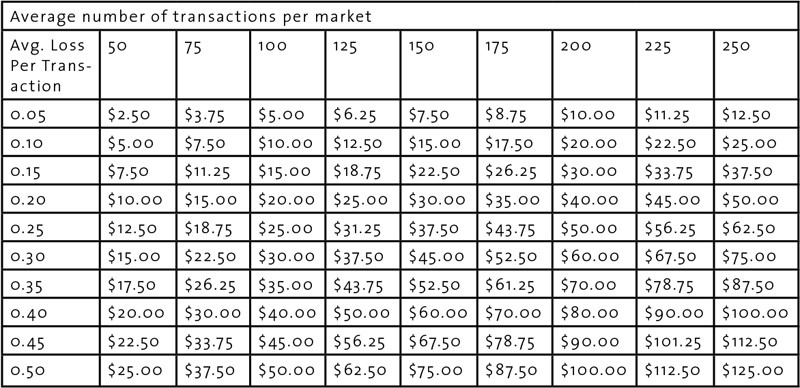
Determining the financial cost of rounding is an intricate process and largely dependent on the system of rounding practiced by your farm. The different systems have exponentially different outcomes but can be simplified into the following metrics: to what denomination do you round; how many items are priced per weight; how many markets do you attend throughout the year; do you round per item per transaction or at the end of a transaction; and do you round up.
First, I would caution against rounding up without clearly delineating when to round up and I would not round up more than five cents per transaction. It’s true that rounding up somewhat mitigates the effects of rounding down. Nonetheless, the mathematical probability favors rounding down, especially if you are using a reasonable delineation for rounding up. Don’t justify the losses inherent to rounding by occasionally rounding up.
Furthermore, customers are most likely going to be unaware of your rounding system. When you’re giving them a break by rounding down, they are probably unappreciative but only because they believe they are paying the full price you’ve advertised. However, if you are caught rounding up, regardless of whether you have rounded down at some point during the transaction, you could be accused of dishonest dealing.
The number of markets you attend, the number of transactions conducted per market, the amount of produce sold per weight and other determining factors amplify your maximum loss potential when rounding. For example, if you round to the nearest nickel you won’t lose as much as rounding to the nearest quarter. Let’s say there are 2.16 lbs. of potatoes on your scale and your advertised price is $2.50 per pound, the total price will read $5.40.
If you’re dealing in smaller denominations like nickels and dimes, you won’t lose anything on this transaction. If you are rounding down to the nearest quarter increment, you will lose 15 cents. You may be tempted to round up, but again I caution against this practice. A mindful customer attentive to the scale will question why they are being charged extra for their potatoes.
By complicating the bill, we can see the full extent of how rounding can cause unnecessary losses. In addition to the potatoes, a customer purchases 1.53 lbs. of celeriac at $3.00 per pound, and 3.49 lbs. of loose beets at $2.75 per pound. The celeriac totals $4.59 and the loose beets are $9.59. If you are rounding per item to the nearest quarter, you would lose an additional 18 cents on this transaction, bringing your total loss to 33 cents.
33 cents lost on a few vegetables may not seem like something worth writing an article about, but it’s only part of the picture. Let’s say that on average you are losing 16 cents a transaction, roughly half of the example given, and you conduct an average of 150 transactions per market. You would lose $24 a market, simply by conducting business.
Factor in the number of markets per year and you realize the true cost of rounding. If you attend one farmers market per week, for 35 weeks of the year, you would lose $840.00. If you attend three markets per week for the same amount of time, you lose $2,250.00. Over five years that totals $11,250. Over ten years, $22,500. That’s capital lost that could’ve been used to purchase a new greenhouse, a new delivery van, a new well, an upgraded washing station, etc. If you’re a busier farm conducting more transactions and attending more markets, the losses will be of a greater magnitude.
Once the costs have been accurately measured, you can clearly value the risk associated with rounding. Using the metrics established in the previous examples, saving ten minutes at checkout per market costs the farmer $24. If attending one market per week over 35 weeks, the farmer loses $840.00 for about six hours of expedited checkout. If attending three weekly markets over a 35-week period, the annual loss is $2,250.00 for 17.5 hours of expedited checkout.
Over ten years, that’s $22,500 for 175 hours of expedited checkout. 175 hours may seem like a lot but remember that it is diffused over a greater period. Consistent with the example given, if your markets were four hours long and you attended three markets per week over a 35-week period for ten years, you would amass 12,600 market hours. 175 hours amounts to 1% of that total. Put another way, 1% of your market time were exchanged for $22,500.
The only way to know for sure how much you’re losing is to do the math. If you choose to round, remember that there are ways to mitigate your financial losses. For example, rounding at the very end of a transaction rather than per item on the bill will substantially reduce the money lost per transaction. The potatoes, celeriac and loose beets mentioned earlier would total $19.58 if tallied correctly.
By rounding to quarter increments at the end, you’ll only lose 8 cents, 25 cents less than if you had rounded per item on the bill like the original example. There is enough variance within each individual transaction to radically affect how much you lose per transaction. These small details will make a surprising impact.
Andrew Ashbrook is a semi-nomadic prospective farmer presently growing in Maine.
Copyright Growing For Market Magazine.
All rights reserved. No portion of this article may be copied
in any manner for use other than by the subscriber without
permission from the publisher.