










By Kai Hoffman-Krull
Business planning can sound like a migraine. Excel sheets, graphs, historical records, receipt after receipt, and a ton of time in front of the computer. Ok, maybe it doesn’t just sound like a migraine, maybe it becomes a migraine.
Most of us chose farming because we like to be outside, not in front of the screen trying to be an accountant. But what if business planning wasn’t so much about creating an epic document you never want to look at again, but more like ongoing research? What if business planning wasn’t creating a grand vision, but a small vision that leads to another small vision?
It wasn’t until a morning before my second year of grad school that I realized farming is also a business. I had no idea how to run a business. I enrolled at the school’s entrepreneurial institute, and the first day I walked in I could hear that I didn’t fit in. My boots, with the soles mostly worn smooth, were silent among the sound of clicking hard, fancy shoes on the polished cement floor.
The course focused on The Lean Startup, a book written by the Harvard business professor Eric Ries, which presents a model for business planning that flies in the face of traditional business planning that expects you to create a long and methodical document that sets out your plan for the next five years.
The Lean Startup argues that traditional business plans place the majority of the analysis in the planning stages rather than integrating analysis into how the business is run. Decisions are more effective when made from actuality rather than theory or opinion. The Lean Startup methodology presents business as a research project, one where the business is continually examining what is working and what is not.
This theory of business planning is not how traditional agriculture operates. Big ag runs with large numbers and large debts. To make changes at the scale of hundreds or thousands of acres is a massive financial risk when the majority of farmers are operating with significant debts from banks.
Whereas the traditional wisdom is that scale is more efficient, The Lean Startup argues that it is a business’s ability to adapt based on progressive data analysis that drives efficiency. When a business takes a research and analysis framework, the systems and products sold receive continual inquiry, which promotes innovation in practice and attunement in the marketplace based on real experience rather than theory.
There is no time in history where the ability to adapt will be more important than in our presently changing climate. We are moving into a time of greater and greater uncertainty. In essence, none of us know what’s coming because uncertainty is what we are promised. Sustainable agriculture will require a collaborative framework to understand problems and solutions as they arise because they won’t necessarily have arisen before. Data can be a language for farmers to communicate about problems and solutions if we can figure out how to be asking the same questions.
I must stress before I begin that I am actively trying to figure out how to collect data. I’m atrocious at writing anything down. And a lot of that just happens in a little notebook in my back pocket that I misplace all the time. But the data I collect is worth collecting. And a part of this collection is recognizing failures as much as success, as that is the foundation of The Lean Startup methodology—we should fail. If businesses aren’t failing, they aren’t innovating. If failure is seen as something to be worked with rather than rejected, then failure is only a part of the larger solution.
Farming as research
There is a strange distinction made between scientists and farmers. Aren’t farmers also scientists? A farmer’s job description is based on science—the ability to understand the intersection of soil health and fertility needs, climate, hydrology, sun and water. The fact that farmers interact with these topics directly and not in a classroom shouldn’t be seen as less valid, but perhaps more. University research is a powerful tool to understand specific issues with detail that we cannot do outside of a lab. But so too are the observations made from the field.
Farmers are researchers. Every observation on the farm is data. Good farmers throughout history have paid attention, recognized changes, and generated hypotheses for what wasn’t working or could be working better, and then tested them out.
It doesn’t need to be data in an excel sheet to be research. And, obviously, farmers today don’t have enough time to be tracking every piece of data on a computer (I sure can’t, nor do I want to). While I do believe some data is worth collecting and writing down, the most common method of data collection is the foundation of the scientific method, test plots and control plots.
If you have a hypothesis of any kind, try it out in a small way on at least three different plots. These plots could be full-sized beds or just a square meter section of a bed. This could be things like trying different fertilizers, trying different cover crops, trying different varieties of a specific crop, or a no-tillage system. It is important to do at least three plots so you can get a sense of an average difference. With only one test plot you can have any number of elements influence your test without you knowing it, such as extra fertilizer getting applied in one spot, soil type, etc. Test plots are the simplest form of science—comparison. Your eyes can tell a lot.
Tracking data by writing it down does allow for a different type of insight than we can get through our memory or immediate observation. Whether it’s using a spreadsheet, any of the many technological planning tools available to farmers, or just writing things down in a field journal, tracking data allows us to understand trends and how these trends evolve over time. Since we can’t nor shouldn’t track everything, finding the right questions uses a very non-science-based word—intuition (gasp)—to select the topics you want to examine.
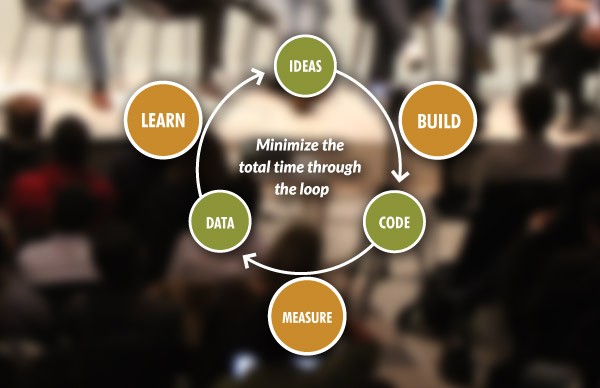
You probably see in the picture above that the word “code” is used, which indicates that The Lean Startup has been used in large part with tech companies in Silicon Valley and not farms. But the basic understanding of The Lean Startup has been used now across the globe for product development. And I am trying to limit screen time, so it’s about finding the right questions to ask. If there are specific crops or methods you are interested in researching, here are some general categories to consider:
Time
The largest expense on a farm is usually time. Joel Salatin, the son of an accountant, advises farmers to walk around with a watch and track the amount of time you spend doing certain tasks. Choose the crops or varieties you are researching, and organize them by a garden bed, such as one bed of carrots. The goal would be to track and tally every bit of time you spend on that bed from planting through harvesting.
Material inputs
Try and calculate expenses on that bed of crops, such as lime, fertilizer, row cover, fuel used, irrigation, water, etc. The expense of water is obviously a variable unique to your individual situation. But your goal is to once again come up with an aggregate number for all your inputs into that bed.
Sales
One of my favorite tools is using Quickbooks for invoicing, which means that all my sales records are automatically stored and organized for me. The records are data I only enter once but can ask questions of later. It allows me to then look back and see how much I sold over the growing season of different crops, and how much money that made me. These dollar amounts can be very enlightening when then merged with the data from time and material inputs. The intersection between the data of these categories holds the potential to tell you what crops are making you the most money.
Core principle—MVP
The practice of breaking down a specific crop or set of crops into the individual inputs then provides a framework for how you might start a new element of your business—either a new production method, a new product for sale, or a new vision for your business entirely. The foundation of The Lean Startup is the concept of the Minimum Viable Product (MVP), a product that offers the quickest transition from theory to implementation.
Within the context of farming, the MVP has just enough core elements to effectively test the effectiveness of the growing method or the food produced. It is the smallest and simplest way to test your hypothesis. The concept of the MVP assumes this simple model will be inherently inefficient. But efficiency increases come from real market and production data rather than abstract numbers and concepts. And, most importantly, you will fail small.
Whereas the traditional business plan creates a significant investment in the “idea” before implementation to avoid risk, the MVP concept assumes failure. The goal is to fail when it matters less and when you can learn from it. The model emphasizes that if you are not failing, you are missing out on opportunities you cannot find another way.
Most farmers are already using the notion of an MVP in some form. It’s not different than trying something with what’s around, like parts you find in the junk pile. For example, if you’re thinking of switching to overhead water instead of drip, maybe you find a few sprinklers you have around from garage sales. But your crops are grown too tall for the arc of the sprinklers so you cut a piece of PVC, take a piece of wire and tie the sprinkler head on the top. You stick it in the middle of a row, hook a hose up, and turn it on.
Is this an elegant, long-term solution? Not at all. But it’s a low-cost way of seeing if this is a method you want to invest in. The MVP, while not the end goal, gives you a way of understanding levels of success from actuality and not concepts.
This is an art as much as it is a science. Understanding what steps are unnecessary and what are necessary for the MVP is no simple question. The MVP concept is as much a thought experiment as it is a system, one that continually tries to take parts away to get to what is most efficient while still the essence of what you want to offer.
Once this product is established you get to analyze how it interacts with the marketplace, which becomes the data from which the rest of your data is compared. As Eric Ries says, “A core component of Lean Startup methodology is the build-measure-learn feedback loop…Once the MVP is established, a startup can work on tuning the engine. This will involve measurement and learning and must include actionable metrics that can demonstrate cause and effect questions.”
Field sample
At the start of this past market garden year I shifted to a greens business instead of a mixed vegetable garden, shifted my market to all wholesale accounts, and shifted to an all no-tillage system using occultation. I had done some back of the envelope calculations and had the sense that greens paid out more than the other crops grown in the past. The garden was forest six years ago, set at the base of a long hillside that sheds organics downhill and water from springs above. This high carbon, sub irrigated soil is still low in pH, and greens illustrated the greatest vigor without showing many signs of nutrient deficiency from the acidic soil.
At the beginning of the season I started with as wide an array of greens as I could—kales, collards, gai lon, lettuce, arugula, mustards, and a bunch of fancy sorrels, amaranths, and radicchios to make mixes look attractive. As the season went along, I found that while the arugula only had 2-3 weeks of harvest for young greens, the more mature greens were excellent wilted.
I piloted a “wilt mix” which was basically just the arugula salad mix materials that were too big for salad anymore. And the financial numbers for the wilt mix were amazing, as there were no additional planting, fertilizing, or seeding expenses. Once these greens started getting too large for the wilt mix, I would add them to mixes with varieties of small kale, beet leaves, and collards for a braising mix. In essence I was getting two and a half crops for one. I did some sampling of the wilt mix with restaurants and the Orcas Coop and San Juan Coop, talked it up to chefs, and within a month it was selling as my best product.
The transition to using the no-till occultation method was a bit of a leap of faith, and didn’t follow the Lean Startup methodology, as I should have tested it out and expanded once I saw it working. But…it worked. Really well. Not only did it provide the soil benefits of no-till farming, but it also eradicated the majority of the weed seed when I let it stay on the beds long enough.
Using old billboard tarps, the material traps moisture and heat under the tarps and germinates the weed seed, which then dies from lack of light. From my calculations, weeding was nearly 75% of my non-harvest time investment, which reduced to something closer to 10% with the occultation method. The billboard tarps are also a low-cost investment ($29 for a 12 x 24) which can be used for 5 years or more due to the UV protection they coat on the advertisement. The tarps are also 11 mil and withstand a good amount of wear and tear. If you think you can’t afford to do no-till farming, from my experience you can’t afford not to.
The power of learning
For being a business model that is used by big business in Silicon Valley, the Lean Startup methodology actually focuses on the economic benefit of being small—namely your business’s ability to adapt. In an age where we are told we need to scale to be profitable, the Lean Startup methodology says that every business—in this case farming—is likely doing too much. How a business then asks questions of what makes it successful, what areas show the greatest promise for expansion, and what areas should be narrowed or eliminated, is a continual, ongoing process.
Whereas large companies require one bureaucratic hoop after bureaucratic hoop to jump through to make a decision, small businesses with good communication and flexibility can change at a moment’s notice when presented with new and promising data. Just as in nature with plants and animals, resiliency is created through evolution. The question then becomes how we bring this concept of evolution to our business. How are we seeing our farm as evolving, as continuing to learn and respond to what we want to do, what our land can best produce, and what the market desires? How are we asking the questions on both sides of the business equation—production and sales—to really know what we should be putting our energy into?
Even if you think this is all a bunch of baloney, the piece that’s hard to argue with is that it pays to build time for reflection and analysis into your work schedule. It is so easy, I know personally, to feel like examining the farm businesses is taking time away from real work. But if we aren’t asking questions how can we assume our practices and products are right?
Does this sound familiar? It’s January and you are working on your planting schedule for the next season, getting your seeds organized by crop type, variety, and a planting map that shows the progression of plantings through the upcoming growing season. Maybe you have historical records of what you’ve planted in those beds from years past so you can plan the best crop rotations. Maybe you have some different questions you are interested in, like trying some green mulches, a few beds of no-till farming, biochar in some test plots, interplanting trap crops for wire-worms, or different mixes of cover crops.
And then once spring starts the tractor breaks, the sheep keep finding new holes in the fence, the chicken feed is getting eaten by rats, and you’re behind in your planting schedule. Suddenly you’re not looking at your planting schedule, you’re throwing seeds in the ground as fast as you can, and whatever research questions you wanted to ask are out the window, if the window didn’t also break in a spring windstorm.
Adaption is the competitive advantage for small-scale agriculture. It’s what large farms can’t do. For starters, they can’t afford it because of their debt. And, as the saying goes, big ships are harder to turn around. We are going to need to be turning agriculture around. As we move further into a changing climate, we are going to need more and more ingenuity among farmers, more creativity and experimentation, and more sharing of the successes. And we are going to need to learn to talk and share our failures. It is not a tragedy to fail. Failure is a part of future success. In truth, if we see our farms as evolving as nature does, failure and success do not exist, only the ever-present journey of learning.
Kai Hoffman-Krull runs a market garden with his wife Sarah on Waldron Island, located in the San Juans off the coast of Washington State. Starting with raw forested land five years ago, they integrate vegetable and fruit cultivation with wild foraging to supply their farmers market stand and restaurant accounts on neighboring islands.
Copyright Growing For Market Magazine.
All rights reserved. No portion of this article may be copied
in any manner for use other than by the subscriber without
permission from the publisher.