











By Sam Hitchcock Tilton
Like Indiana Jones tenaciously searching for the Holy Grail, similarly I, for years, have questioned farmers, searching for the one true row-spacing. With so many possible configurations for tractor-tire spacing, bed-top size, number of rows in a bed, and inches between rows – I felt there had to be one configuration to rule them all.
Until one day I posed the question to a grower in Massachusetts, who replied, “Well, it depends on what you are growing.” And this opened my eyes to the many factors that should play a role in choosing a configuration and made clear that there is no one true row-spacing, just ones that best fit each farmer’s situation at a given time.
In the years since, I have tried out many configurations and made observations in university research plots and my own plantings. I have visited with farmers around the world observing myriad spacings and row configurations. In addition I have designed weeding machines for growers of various crops and seen the implications of row configuration on weeding tools and harvest.
In Europe they would call this term of row configuration – one’s culture. As in, “this tool is suitable for carrot cultures on beds with 45 cm rows.” Such a broad term of cultures I think accurately reflects that the spacing and row configuration on which you grow has a large effect on your growing style – more than determining your culture – it is your culture.
Semantics aside, your bed size, rows per bed, and spacing between rows determines many aspects of your cultivation – seeding, weeding, applying plant protectants, and harvest. Your row configuration dictates the type of equipment you need. And choosing correctly from the beginning has high stakes when realizing the amount of money that you will invest in machinery suited specifically to your spacing. Switching configuration often means re-tooling your machinery, at significant expense.
So I thought it worth an article to share my reflections on choosing a culture, as well as sharing the perspectives of some experienced growers. Won’t you come along? As my training in the Classics has taught me – I thought we could start with some first principles, and from there look at examples.
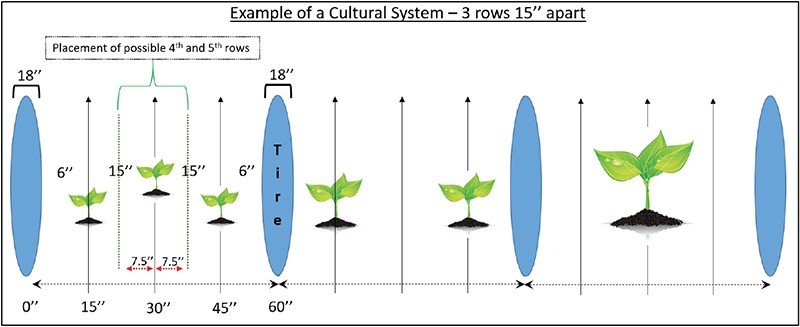
1. I highly suggest using 3 rows with the middle row centered on your bed. On a smaller hand-scale this is less important, but for mechanizing the growing of diverse crops it can make all the difference by reducing the needed equipment to a minimum. Here’s what I mean – 3 rows allows you to plant all three rows (for smaller crops like beets, lettuce, and carrots), just plant the outer rows (for medium-sized crops like brassicas), or just plant a single middle row for larger crops like tomatoes and zucchini (see Figure 1).
Realize that with this 3-row configuration you can plant all configurations (1,2, or 3 rows) with the same planter or transplanter without adjusting it, and you can cultivate with the same cultivator – the only adjustment being dropping or raising a sweep in the unplanted row(s).
2. Choose a configuration that leaves enough shoulder space between your outer rows and the edge of the bed. What looks right on paper may not work in the field – over repeated tractor (and foot) passes, the edges of your beds will be worn down. By harvest, what started the season as a 48” bed top will likely be reduced by 4 inches on either side, so that your two outside rows will be near your compacted tire-tracks. Account for this reduction of shoulder space when choosing your configuration.
Of course we all want to fit more plants on our land and give those plants as much space as we can – but if your outer rows are too close to the edge of your bed two problems will arise – your tractor tires and implements will be contacting and breaking the foliage of these outer rows, and your weeding tools will have less loose soil to work on the shoulders of your beds and be less effective. For this reason you’ll notice in Table 1 that most common cultures have beds that are 1 foot wider than the outer rows (giving 6” of shoulder space on either side).
3. In choosing a configuration think about the big picture of your farm and identify your limiting factors. The spacing that is right for you may change over time as your farm changes. If enough land is your limiting factor you’ll likely want a tighter spacing that produces the most yield in the smallest space. Whereas if labor cost for weeding is your limiting factor, you’ll likely want wider spacings that are conducive to mechanical weeding. There are many farm attributes to inform which configuration is most appropriate (and we’ll discuss them further on).
As my Amish employer used to tell me, “learn what other people are doing, and then do as you darn-well please.” To see what others are doing I listed the prevalent cultures on Table 1. There is a reason these configurations are the most common. Also there is equipment ready-made to fit them. Please allow me to say a few words about each.
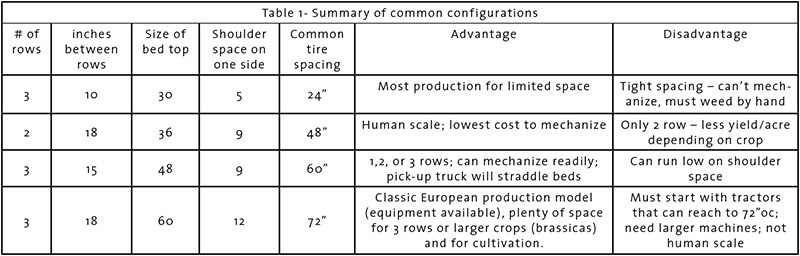
Let’s start with the hand-labor model suited growers up to 2 acres and popularized by Eliot Coleman and J.M. Fortier (who both have great books explaining this spacing). This is the tightest configuration, and has beds 30” wide and walking paths about 18” wide between beds. Generally we have three rows, 10” apart for transplanted veggies, and direct-seeded smaller crops can fit in five or more rows per bed.
What does this, the tightest of all configurations, do well? It fits the most production into the smallest land-base. As Paul Huber, a grower in Wisconsin describes it, “When we started, our limiting factor was irrigation (we could only irrigate a small area), so this model gave us the most production for the small area that we could irrigate. Now over the years I see that this model maximizes the use of all resources.” Paul is saying that in these intense beds where most tasks are done by hand, plants, fertilizers, and water can all be put exactly where they need to go.
Paul also likes that this configuration is designed for the human scale; he and his harvest carts can straddle the beds and there is less stretching and reaching. With this culture Paul finds that hand-tools and walking tractors work best. For him 4-wheel tractors and their implements are generally inefficient in this system because the varied crop blocks and small spaces would make for a lot of tight tractor turns, and it would not be worth the time to switch tractor implements often. Paul believes that Planet Jr. walking tractors could fit this model well and could see these maneuverable little tools with quick-change implements being a great fit for this tight culture.
But, as a melon can look ripe and glowing from afar, yet when picked it disintegrates in your hand into a putrid clump of stench, leaving you smelly for the rest of the day – so too each configuration has its own problems to consider. The biggest drawback of tight row spacings and small beds is the difficulty in mechanizing tasks; it has been hard for Paul to incorporate mechanical transplanters and cultivators into these tight rows. We need space between rows to fit pieces of steel and room to move soil. If weeds are an issue for you, this tight configuration can cost you money in hand labor.
Or as Paul says, “In terms of conserving resources, I like this model. But economically, I’m not sold on [it], because my labor costs have always been so high. One advantage has been, however, that capital expenses for equipment have been very manageable. I think this model is best-suited to those who are growing on less than two acres.”
Another factor to consider with tight plant configurations is disease pressure – most diseases favor moist conditions with low air-flow and touching plants that make it easier for disease to spread. These closely spaced rows can engender disease, especially if your climate already has higher humidity. Chris Blanchard often shared his experience of growing on 4 rows spaced 12” apart: when he switched to 3 rows spaced 15” apart he noticed that disease was reduced because of the increased airflow.
As we move on to the next configuration, I am about to break my own rule of thumb from earlier This next configuration is 2 rows spaced 18” apart on a 36” bed top. “But Sam, you said we should stick with 3-row configurations?” Well, hear me out (and feel free to again refer to Table 1).
This configuration is suggested by Michael Smith, the notorious KULT-Kress salesmen who travels the country slinging weeding machines, and has had more cause to reflect on these configurations than anyone else. Here’s why you should consider this spacing – it is the cheapest way to begin vegetable growing at a mechanized scale. This is what I mean: tractor tires on 48” centers is common for sub-compact and even lawn-type tractors – with their small size and lower horse-power these tractors are cheaper than their bigger cousins. Then implements: you could get by with just a 4’ tiller as your only tillage implement. And again, smaller implements are cheaper.
With 18” between rows and 9” of shoulder space, this culture offers enough room to run a mechanical transplanter, a multi-row seeder, and all manner of tractor-mounted cultivation tools. The smaller beds keep this configuration on a human-scale, so that you can step over beds and reach into them to harvest (and with no middle row you don’t have to reach into the middle of the bed).
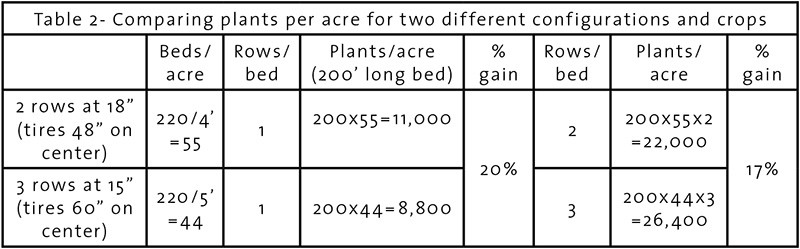
Here’s another consideration that farmer Eileen Droescher pointed out – depending on what you are growing, this configuration can be the most space-efficient, and here’s what I mean: In a metaphorical acre we’ve got an area about 200’ long by 215’ wide. Regardless of our configuration, a one-row crop like zucchini will often be grown in a single row in all configurations. We can see from Table 2 that for a single-row crop, when comparing the 2-row configuration to the 3-row, because both contain only 1 row/bed and because the 2-row configuration fits-in more beds/acre: the 2-row configuration gives us 20% more zucchini plants/acre. That is a significant difference.
However, if we are talking about a crop that can be spaced more closely, say head-lettuce, we can see that the 3-row configuration fits in 17% more plants/acre. So while this point about plants/acre may be mute for farmers with diverse crops planted in both 1,2, and 3 rows, those farmers growing a small range of crops can maximize their production/acre by choosing a configuration that suits their particular crop. Although, as we have seen, plants/acre is just one of many considerations to balance when choosing a configuration.
From 2 rows 18” apart, we journey on to another ancient culture – 3 rows 15” apart on a 48” bed top. This is a popular spacing for growers with diverse crops; it is large enough for machine-work and the 3 rows give the flexibility to choose an ideal culture for an array of vegetables – growing plants in 1, 2, or 3 rows (see Figure 1). Richard Wiswall describes this configuration in his book, The Organic Farmer’s Business Handbook.
In farming there are few hard and fast rules, so I’ll mention that all of these configurations are somewhat fudge-able; I know plenty of growers who are on 3 rows at 16” or 2 rows at 20”. If conditions dictate, these cultures have similar attributes when their size is nudged up or down; the chief concern is that whatever your precise spacing – EVERY SINGLE ONE of your tools is set to that precise spacing.
Speaking of precise spacing, I’d like to point out an important detail that is often missed regarding bed-size, or the width of the growing area between the tractor tires. Many focus on tire spacing – the distance between the centers of each tractor tire – with the idea that your tire spacing determines your bed size. BUT THIS IS NOT TRUE.
This is because the size of tires varies – so that if you have narrow 11” wide tires spaced 60” apart your bed-top will be wider than if you have fat 18” wide tires also spaced 60” apart. For example, my ‘ol buddy farmer Hans Bishop has beds 48” wide, but he also has big fat row-crop tires. To achieve his 48” beds he sets his tractor tires to 65” apart on center to compensate for their girth.
Take a look at Figure 1 below, where you can see in diagrammatic form the configuration of 3 rows at 15” with tires leaving a track 18” wide set 60” apart center to center of tire. Though the tires are set 60” apart, because of the wider path they tread, the resultant bed-top is 42” wide. Even with 48” wide beds Hans finds that, “after a few cultivations the outside rows are on the outside of the bed, and the shoulders have worn away.”
Getting the bed-size we want means being able to set our tractor tires where we want them. Generally utility and compact tractors cannot be set to a wheel spacing greater than 60”, sometimes even less, and often they can only be set in 6” increments. I have learned this to my own disappointment since purchasing my own tractor when I had much less experience.
In contrast, row-crop tractors (generally those above 55hp) have long axles allowing wheels to be set out to wider widths. Hans appreciates that many of his tractors are row-crop models that permit him latitude in choosing and changing the tire-width. A big reason he chose his culture of 3 15” rows is that his family’s farm already had row-crop tractors set for 30” rows (same tire-spacing as 3 rows at 15”).
A good attribute about this configuration of 3 rows at 15” is that it is possible to fit in 2 more rows to achieve 5 total rows in the bed (see Figure 1). These 5 rows are helpful for smaller and quicker-growing crops which can prosper within a tighter culture.
For these “30-day crops” Hans plants 5 rows 10”apart. Even though spreading out his rows puts this 5-row configuration right on the shoulders of the 48” bed, Hans finds that a 10” row spacing is the minimum for good mechanical weed control. Although, a neighbor of his sets his five rows tight at 7.5” apart to better fit them on the 48” bed-top. But as a result the grower can only fit narrow 4” wide baskets on a basket weeder for cultivation.
One must always observe how one’s crops are enjoying their culture. For example, Hans noticed that the middle rows of his 3-row carrots were consistently smaller than the outside rows, and in response he now plants carrots in a 2 row culture (30” apart). Another grower noticed the same issue in 3-row carrots and in response they now seed the middle row at a lower density than the outer rows.
I’ll leave 15” rows back in that furrow and take us on down along the road apiece to our final culture – 3 rows at 18”, on 60” beds. This configuration is the European vegetable standard (with wheels set 2 meters apart) and is also common in the US. Because potatoes are most commonly planted in 36” rows, a lot of machinery is sized and available for this configuration. In areas of specialized open-field vegetable growing, especially in the Western and Southern US, tires are set even wider at 7 or even 8 feet apart.
I spoke with my former employer Peter Seely at Springdale Farm about his experience with cultures. His is an interesting perspective to get on this subject, and not just for his 30 years of experience growing; Peter’s wife, the incomparable Bernadette Seely, is a native of The Netherlands, and so after twelve years of CSA farming the Seelys put the farm on hold and lived in The Netherlands for a year. Peter worked at various farms and greenhouses and at the end of his stay sent back several shipping containers of vegetable machinery. In the last twenty years he has been trying out all manner of configurations using this European machinery along with American equipment.
I thought that I could pigeonhole Peter as my poster child for the culture of 3 rows 18” apart, but he explained that he has changed his configurations over time to fit whatever was the limiting factor on his farm. Early on when weed control was the biggest challenge Peter wanted to maximize the use of a Buddingh finger weeder. This was a very effective tool but it required widely-spaced rows. As they added more CSA members, producing more on the same land has become the limiting factor, so Peter added more rows per bed to increase yields.
As a result, Peter now grows crops on 1,2,3,4,5, and 7 rows! He also plants 19 rows for dense salad crops. Having several configurations requires a lot of different cultivation rigs, and to save time most cultivation tools have their own mated tractor – a big investment. Carrots grown in 7 rows per bed instead of 3 yield much more, but at the same time that tight spacing means that other than a basket weeder, expensive human hands must assure a weed-free crop.
At other periods, and for certain crops, harvest-time was the limiting factor, and so Peter would widen row spacing to accommodate machine-harvest. What is your limiting factor? How has your limiting factor changed over time? For which step in your production system do you want to maximize efficiency?
In choosing your culture, yield versus weeding-time is not the only tension. Peter raised another consideration – “I also use my spacing to mold the crop – what aspects of each crop do you want your culture to maximize?” For example, if Peter wants large single heads of broccoli he will give the rows more space or give the plants more space within the row. On the other hand, if he wants to produce single-serving cabbages or smaller heads of lettuce he will reduce the in-row spacing and in effect the plants will prune themselves.
Well, what started as a search for the one true spacing turned into a tour of several exotic and foreign cultures, where we’ve seen myriad options, the consideration of which may lead us to a culture appropriate to ourselves. Here, as is the case with many honest searches, what I meant to find at the beginning is not what I found at the end. But I hope, dear reader, that you found something useful.
Sam Hitchcock Tilton is a horticulture instructor at Lakeshore Technical College, just north of Sheboygan, Wisconsin. He has a background in vegetable farming and earned a master’s degree in horticulture from Michigan State University, where he studied weeding tools and techniques. Sam was the Midwest Sales Representative for KULT-Kress precision cultivation tools. He enjoys jokes and popcorn.
Copyright Growing For Market Magazine.
All rights reserved. No portion of this article may be copied
in any manner for use other than by the subscriber without
permission from the publisher.