











By Andrew Mefferd
In the first part of this article in the August GFM I shared how we came to plant a quarter acre of hemp this spring after getting a contract with a local processor. They want to make it into salves, tinctures and other products. Since we haven’t grown hemp before, we planted extra just to be safe. Now the crop is looking good and I anticipate having more than we need to satisfy our contract.
At the end of the previous article I was describing how we hope to get a better price for the portion of our crop that may be sold on the open market by getting it Certified Clean Cannabis. This is the equivalent of organic certification offered by our certifier, MOFGA Certification Services, until hemp is officially added to the list of crops that can be certified organic. That will probably happen this fall or winter, so hemp grown nationwide next year will probably be able to be certified organic like any other crop.
Our other strategy is to add value. One way for a farm to add value to their crop would be to sell their own hemp products. As processors come on line to handle hemp, growers will have the option to either process their own or have it done by someone else. For a farm already selling soaps, lotions, tinctures, dried herbs or other value-added goods, it would not be much of a stretch to add hemp products to what they are already selling.
Another option that I could see helping small growers compete is to band together in cooperatives. Some of these are already forming, and we will cover them in a future issue of GFM.
However, in our case we decided to add value to our hemp crop by venturing into the hemp seed business. As we did our research, we found that hemp seeds are expensive, around a dollar a seed at the quantities we were buying. Several suppliers we contacted were out of seed at planting time, and some of the seeds we were able to buy did not have great germination rates.
The hemp seed market right now is like any other market where demand exceeds supply; lower quality products will come on the market to meet demand. Though I’m sure given the interest that the hemp seed market will mature quickly and the quality will eventually be on par with flower and vegetable seeds.
Adapting no-till to hemp and my needs
Having just interviewed almost 20 growers about their no-till systems for my book The Organic No-Till Farming Revolution (ONTFR), of course I wanted to figure out how to grow our hemp no-till. I ended up doing for myself what I hope the book will do for others: I adapted and changed the ideas in it to suit my circumstances. Nobody interviewed for the book was growing hemp, and none of them grew exactly the way that I ended up growing. Here’s what I did.
As our planting plan took shape through the month of April, I realized that we would need to plant about a quarter acre of hemp in order to satisfy our contract and leave some plants for seed production. I had a well-drained quarter-acre field that had grown vegetables a few years ago, and been fallow since. That seemed like the logical place to put a quarter acre of hemp. I just had to figure out how to reclaim an overgrown weedy not-quite-gone-back-to-sod field without tilling in just over a month. We were hoping to plant the first week of June.
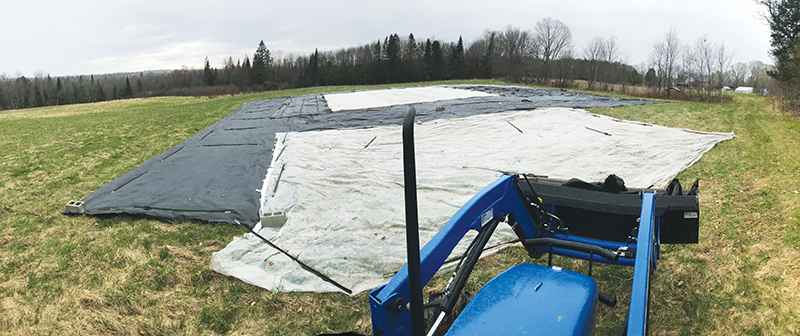
I thought the first step to killing the vegetation would be to do occultation (smothering) with opaque tarps, or solarization with clear tarps. In the end, I did some of both. When I scraped together every last piece of old landscape fabric and used greenhouse plastic I had, it covered about a quarter acre.
Before tarping in early May, we put down 500# of lime with a drop spreader. That gave us about a month between tarping and planting, and I knew from researching the book that was the bare minimum amount of time to allow for occultation to smother the weeds. Though solarization can work in as little as 24 hours on a hot sunny day, I figured our partially regrown sod would benefit from more than that. I looked at our motley assortment of clear and opaque plastic and thought: this will be a good test of whether the clear or opaque works better.
It really ended up being a test of how good we are at weighing things down. Almost as soon as we put them down, we had windy storms, and the tarps partially blew off. A big part of the problem was that there were a lot of exposed seams between the tarps. Because I was using stuff that I had on hand, I had a lot of individual pieces ranging from the width of a greenhouse cover (40’) to pieces of landscape fabric that were only a few feet wide.
A complicating factor was that much of the landscape fabric had holes in it where a crop had been planted through, which I realized catches the wind a lot more than an intact piece of plastic. As satisfying as it was to only use materials that I already had on hand, my advice to someone who doesn’t have enough ground cover would be to source a large, used piece of silage cover or greenhouse plastic. Seams are where wind gets under plastic, so the fewer seams there are, the less likely the cover it is to blow away.
My solution to the tarps blowing away was to haul more and more stuff out to the plastic to hold it down. Every time it would blow off, I would haul out pallets, tires, oddly sized slab wood that wouldn’t fit in my stove, cinder blocks, T-posts…anything I had on hand that would weigh a tarp down. Finally, I got enough weight to keep the plastic on. I just wondered how much the weed killing job would be compromised by being blown off multiple times.
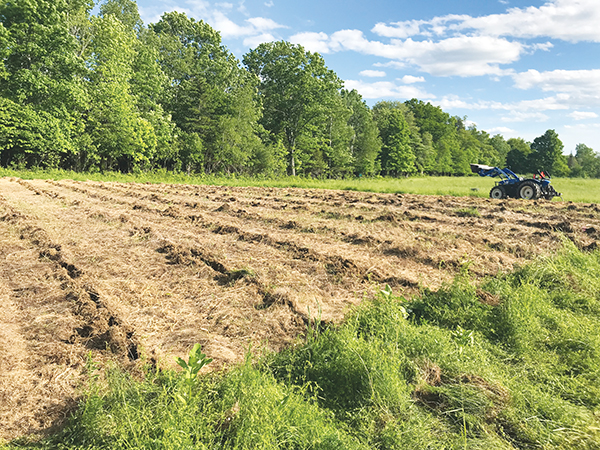
In the intervening month it rained a lot and was very cool. It was terrible solarizing weather and not ideal for occultation either. I didn’t even get the tarps off until the middle of June, though we had been planning on planting the first week of the month.
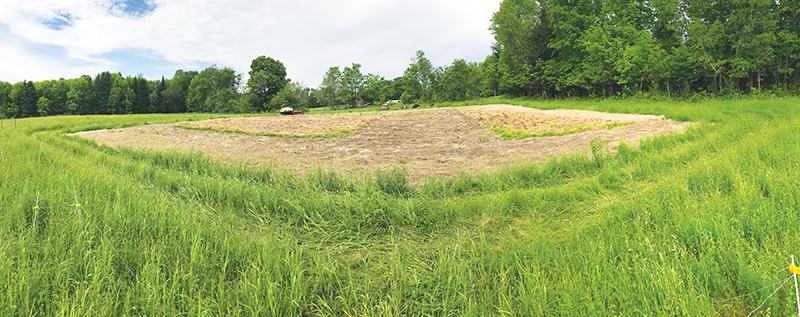
At least I didn’t need to plow, as the soil was way too wet. When I got the tarps off, I was happy with how little vegetation had survived under the tarps. There was some regrowth at the edges of tarps that had blown off, but mostly the vegetation was dead and starting to decompose.
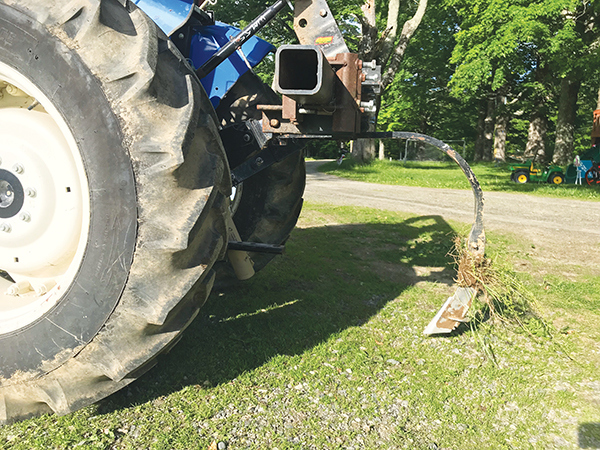
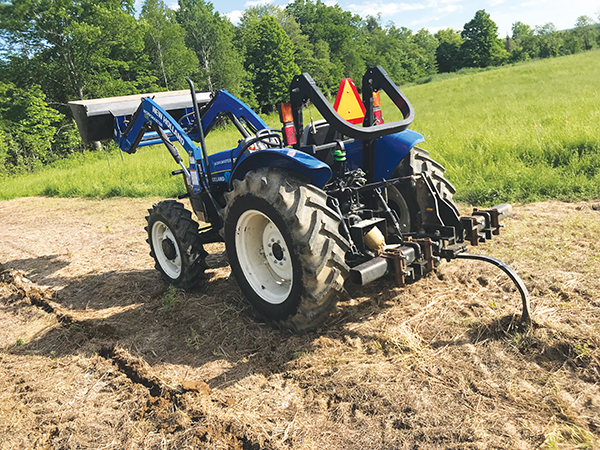
Next, I took a drop spreader out to the field and put down fertilizer based on my soil test, amended along the lines of what was recommended in my interview with Zach Menchini, that you can read here. Then, I took a cultivating shank and ripped a slit a few inches deep, every five feet down the middle of what would become each hemp row.
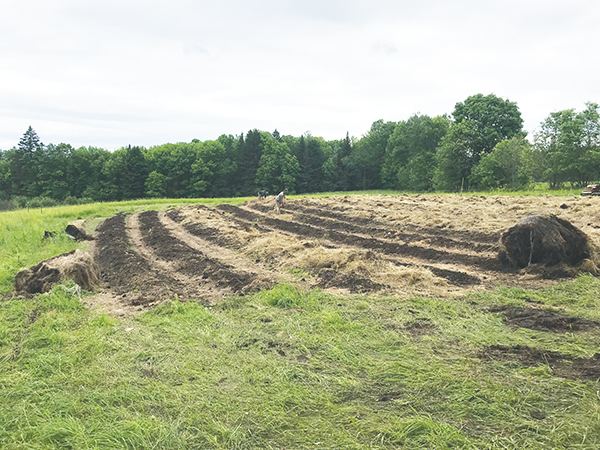
Many of the no-till growers I interviewed for the book used broadforks to loosen no-till soil. Though especially with planting already a couple weeks late, broadforking a quarter acre was not an option. I figured cutting through the residue with a single cultivator shank would open up a furrow for that taproot and shatter any compaction that may have built up over the years, without inverting the soil. I feel like not inverting soil layers is the bare minimum to be considered no-till, though different people have different definitions.
I had purchased 80 yards of compost in hopes of layering it 4-6 inches deep 30 or so inches wide across the bed top. To apply that much compost, I disengaged the beaters on my old John Deere ground-driven manure spreader, so the moving floor would drop the compost without the beaters flinging it all over the place.
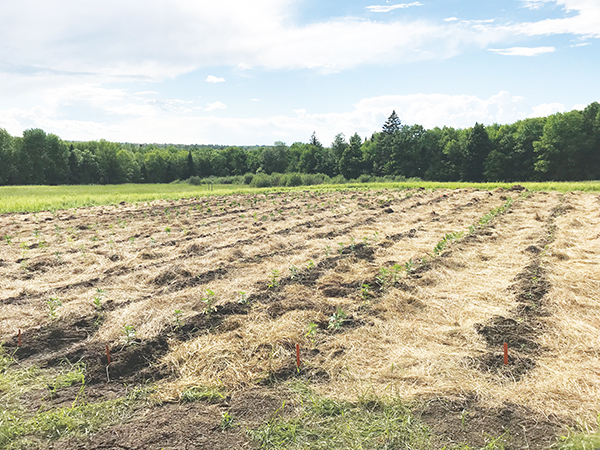
This worked pretty well though it was slow, since the spreader would drop a pile of compost and then nothing for a few feet until the floor moved again. This meant that I had to go over each of the 20 or so beds multiple times until they were covered. Better options for spreading would be a high-volume drop spreader, or a PTO-driven manure spreader with the beaters disengaged, so I could speed up the flow of compost with the PTO without increasing ground speed. Partially because of how slow it was, I didn’t get around to spreading all 80 yards of compost that I had, so instead of being a layer of compost 4-6 inches deep, it was more like four inches deep.
Once the compost was down, we quickly evened it out with rakes, then rolled out some old, spoiled round bales of hay in the paths between the plants. Since the round bales were four feet wide, and the rows were planted on five-foot centers, that only left about a foot down the center of each row for weeds to come up. We were hoping that the four inches of compost would suppress in-row weeds.
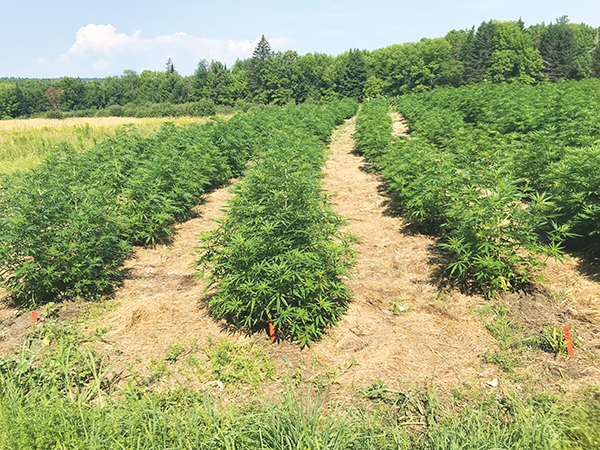
Since I didn’t make the compost, I had no idea how weedy it was. I was rolling the dice, hoping it wasn’t too weedy. This worked pretty well, in that there weren’t many weeds that came out of the ground from under the compost, except for tenacious things like milkweed.
Though some parts of the compost were weedy. Where our smallest roughly four-inch-tall seedlings were planted into the weedy stuff, the weeds were as big as the hemp plants by a month later. I spent about eight hours hand weeding the worst of the weeds out of the smallest of the plants, and another two hours weed whacking the rest of the weeds out from under the bigger plants with a string trimmer. I anticipate that is the last of the weeding I’ll have to do, because the plants have closed canopy and any weeds that grow from now on will not get any sun.
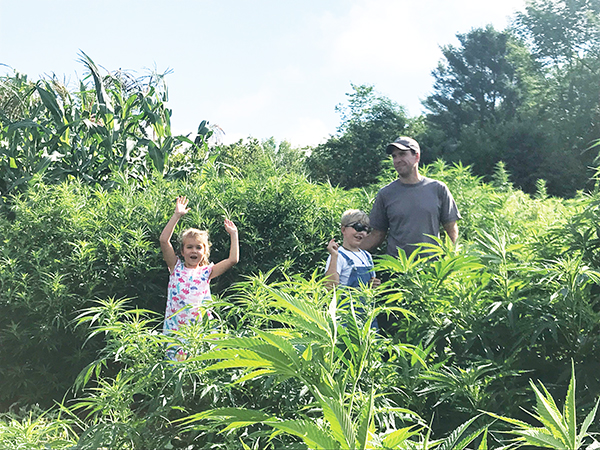
So far, the plants look great and I’m very optimistic about the crop. It is worth noting that field prep like this is still a lot of work! It hard to say what’s quicker between plowing, discing, rototilling, etc. and tarping, re-tarping, removing the tarps, compost spreading and mulching. I guess a lot of it comes down to what you prefer to spend your time doing. I prefer the jobs associated with tarping to those that go with plowing, though I realize not everyone feels that way.
Andrew Mefferd is the editor of Growing for Market magazine. He farms in Maine.
Copyright Growing For Market Magazine.
All rights reserved. No portion of this article may be copied
in any manner for use other than by the subscriber without
permission from the publisher.