











Any farmer that’s been around a season or two knows there isn’t a miracle crop that grows itself, has amazing yields, and will make you rich quick. Crop fads come and go. Likewise, there’s no magic recipe for the perfect farming system or defining success. Over the last several years there has been discussion within the small-scale farming community about strategies for making as much money per acre as possible. While this is a laudable goal, there are many benchmarks for success.
Defining success is personal and depends on location, climate, soils, markets, labor, etc. Money is surely one measure. We all want to make a decent living, and at times that can feel elusive. Farmers should get paid well, but we’re not competing on a level playing field. Nonetheless, most of us don’t get into agriculture because it’s an easy way to earn a dollar. Folks are drawn to farming because it’s both a business and a cause. Each of those pieces is equally important. Without financial stability the farm can’t survive, but it doesn’t all boil down to profits.
Some of the ways to gauge success include quality of life, family time, and personal well-being. Going on a Sunday hike, learning to play an instrument, hanging out with friends, taking your kid to the park, surprising your partner with a night out, luxuriating in a long bath, cooking the delicious food you grow—making time to enjoy life is every bit as important as having a weed-free farm or a record-breaking season. Success can be viewed through any number of lenses, including:
- Meaningful off-time, restfulness
- Peace of mind, satisfaction, happiness
- Growing crops for a food bank
- Providing incentives for SNAP customers
- Paying employees well
- Having health insurance
- Taking steps to promote environmental stewardship
- Building community relationships
- Volunteering for your market board or a local-non-profit
There are as many different ways to farm as there are farmers. When we see something that’s working, it can be easy to think it must be the best way to do things. It is a natural reaction to reading or hearing about a farm that seems to have worked out the kinks. Yet most farms, even the most outwardly successful ones, will readily acknowledge that progress in farming involves as many mistakes as achievements.
While some farms might be grossing more an on acre than other farms gross on five, it’s important not to get lost in the numbers. There’s more to the story than gross per acre. Over time, farms generally become more efficient as farmers learn from past missteps, get better and quicker through repetition, have the funds to make capital improvements, hone in on profitable crop mixes and marketing outlets, and generally refine their systems through time and experience.
Some of the push to demonstrate profitability might come from a desire to counter notions that farming is necessarily a low-income business. While it’s true that there are some operations that are making surprisingly good money, those figures might be tied to high value crops in upscale markets. There’s nothing wrong with such a business model, but not all farms have access to or aim to serve those markets.
Farming is as local as it gets. Even a farm that’s just down the road is going to have a totally different experience. Soil, marketing style, personality, goals, and lifestyle choices will all be unique. What a farmer wants to earn is a very individual target. Many micro farms are finding profitability by focusing on a narrow crop mix, contrasted with larger operations that thrive on offering customers a broad spectrum of products– from veggies to meats to small grains. One farm may opt to rely on equipment where another chooses to substitute tillage for labor. Just because something has or hasn’t worked for one farm doesn’t mean the same will be true on another farm.
Although there’s much to be learned from other growers, there isn’t a cookie cutter approach or one-size-fits all answer. Certainly, read books that growers have written sharing their experiences. Visit other operations, and take home inspiration and new ideas. Attend conferences. Read grower magazines like this one! And if you find yourself not meeting your financial, management, or operational goals, hiring a consultant may fine-tune your operation. But comparing your farm to someone else’s can be the quickest route to feeling bad about what you’re doing.
The Farmer to Farmer Podcast is an excellent resource with interviews of over 100 farmers; no two operations are alike, and yet they are all successful. Chris Blanchard, the host of the podcast, said it best himself in a recent interview:
“I think it’s really easy to go, ‘Oh, there’s one model that works.’ There are 100 models that work or 1000 models that work. All of them come with the things that work great and the things that don’t work great and the things that could be better. But I guess that to me has been the most surprising thing, just how many different farms are actually making it work in different ways in different places.”
The comments of small farm extensionist and author Vern Grubinger reflect a similar sentiment:
“That is why I quickly get away from recipes, ‘you should do this.’ I am much more coming from, ‘Here’s some things you can think about. Here’s some things I have seen other people doing.’ I am not equipped to tell you the answer.”
Having a strategic plan for the farm and yourself and updating it every couple of years can pinpoint goals and the steps needed to reach them. Farming is equal parts job and lifestyle, so it makes sense to combine business and personal objectives into one overarching vision. Although the thought can appear daunting if you’ve never done it before, it doesn’t have to be. Take a few hours of retreat time in a peaceful place to think about where you’ve been, and where you want to be in one, three, five, or ten years, and what you can do to get yourself there.
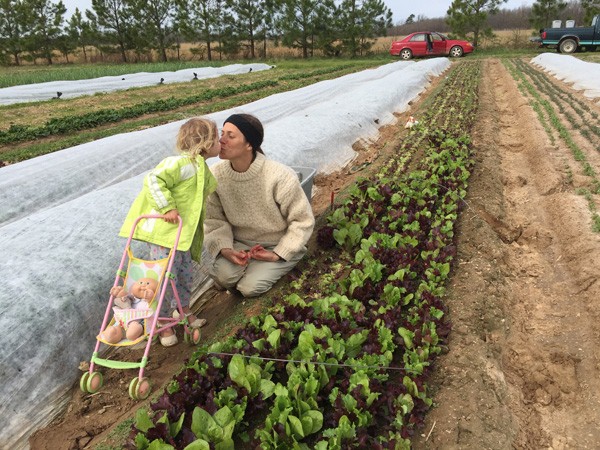
The author and daughter enjoying some quality time in the field. Image courtesy of Emily Oakley.
Successful farming can’t be achieved by following a prescribed formula or looking to one farm as the sole model. The finest advice teaches us how to learn from our mistakes, perform experiments, think critically about our operations, and come up with our own tools rather than apply a standard set of answers. There isn’t a right or a wrong way to farm. No one is an expert about your farm but you. You have the answers for what is best for you and your lifestyle. You know your situation better than anyone else. While we all can and should look regularly to others for new concepts, innovations, and encouragement, feel free to use your own resourcefulness to tweak them to suit your farm. Take advantage of the wide diversity of operations, and choose elements that fit your model. Look at many different farms, select what you like from them, decide what’s replicable for you, and use your own ingenuity, along with trial and error, to figure out what works on your scale.
References:
Blanchard, Chris. January 5, 2017. “Chris Blanchard on Lessons Learned from the Farmer to Farmer Podcast, Consulting, and His Own Farm.” Farmer to Farmer Podcast; Episode 100.
Grubinger, Vern. August 13, 2015. “Vern Grubinger on Finding Solutions that Work on Your Farm.” Farmer to Farmer Podcast; Episode 27.
Emily and Mike own Three Springs Farm in northeastern Oklahoma where they direct-market their crops from 3 acres of vegetables. They are in their 14th season of learning as they grow and growing as they learn.
Copyright Growing For Market Magazine.
All rights reserved. No portion of this article may be copied
in any manner for use other than by the subscriber without
permission from the publisher.