









“What are those?!” If you’ve ever grown husk cherries (Physalis pruinosa – also known as ground cherries) you’ve surely heard that question many times! This cousin of the tomato is a lovely paper-shelled jewel on our market table and charms most customers who try it. The flavor of husk cherries varies as the berry inside the husk ripens from green to yellow to orange. They fall from the plant when they are ripe. When they turn really deep gold they are sweet with a hint of nuttiness. We’ve heard customers describe the tropical flavor with all sorts of combinations including, but not limited to, hazelnut, grape, cherry, and pineapple. When customers ask us to describe the flavor we are always at a loss for words and instead just invite them to peel the husk off and eat one. Most people get hooked right then and there. Green, unripe berries should not be eaten, as they are an emetic.
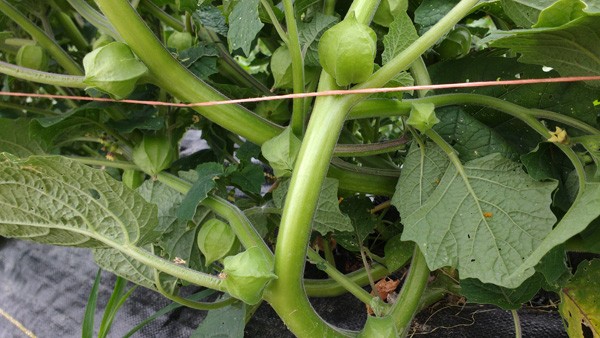
We’ve always loved growing husk cherries, but realized that the tiny fruits aren’t as profitable as larger fruits (like peppers, tomatoes or even cherry tomatoes) due to the time it can take to harvest. We saw that other farmer friends trellised their husk cherry plants with the Florida weave and we started doing the same. As the branches naturally sprawl on the ground, it speeds up harvesting to have them lifted up for a clear view of the base of the plants.
Below, this closeup of a trellised husk cherry plant shows how the branches are held up off the ground by the twine. Fruits develop in the green papery husks that later turn light brown.
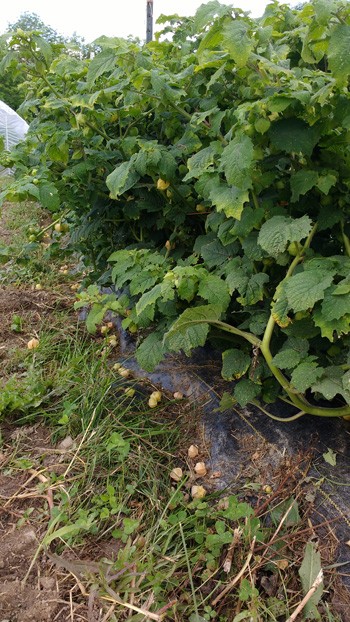
A few years ago, we inadvertantly planted our husk cherries in a bed that had a low spot down the middle. The thing I love about an unhappy accident like that is how instructive it can be! After hearing our volunteer harvesters (my inlaws! Don’t make them unhappy!) complain about having to crawl around and reach under the plants where all the fruits had rolled, we realized we should make use of gravity and hill the bed before planting. This has been an incredible time-saver at our farm! For the last two years, we’ve hilled the bed, fertilized like we would for field tomatoes, laid down drip tape, covered with landscape fabric, and planted in holes 20 in. apart in one row at the peak of the hill. Once the plants start to size up, we drive in the t-posts and trellis with a Florida weave. The plants will get about 3 ft. tall and we trellis them twice.
When it’s time to harvest, we just go along the bottom of the hill and scoop up the fruits by the handful! We can harvest a bucket or crate very quickly with this system. The paper husk keeps the berries clean, and unless they are in standing water, they will wait right there worry-free until picked up.
Below, in this row of husk cherry plants you can see how the fruits drop off on their own and roll to the lowest point. All images courtesy of Liz Martin.
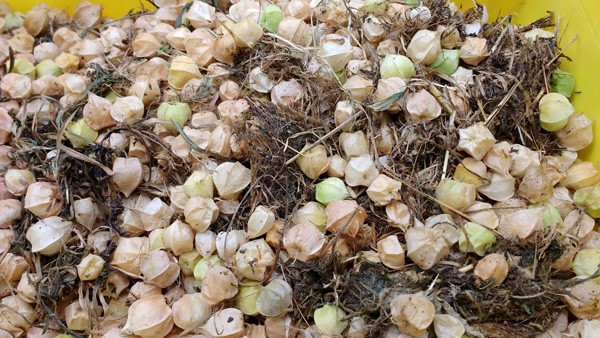
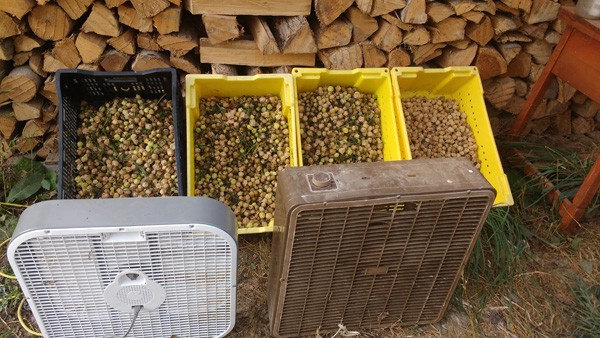
Our farm uses permanent beds and sod paths, and often there are a lot of mower clippings mixed in at the bottom of the hill. We just pick everything up and find that we can winnow the crates of husk cherries in front of a box fan a few times. This way all of the yellowed husk cherry leaves, grass clippings and shrunken fruits that are mixed in blow away, leaving just the husk cherry fruits to go to the market! This system has saved us hours of time harvesting and allows anyone to be able to pick the crop.
Below are husk cherries along with grass clippings after being scooped up off the ground.
Despite how effective the winnowing is, next year we plan to use a wider piece of landscape fabric to eliminate the grass clippings getting mixed with the husk cherries. We think a 6’ piece of landscape fabric, instead of 4’, will make it so that only husk cherries gather at the bottom of the hill.
We tried growing a bed in the hoophouse last year. This was the only time we have ever had any disease or pest problems. Spider mites were a real problem on the plants growing in the hoophouse but non-existent on the outdoor plants. We have decided that we don’t need to fight the spider mites and will grow husk cherries only outside the hoophouse.
Below are the box fans the author uses to winnow her husk cherries.
If you want to try husk cherries this season, the seeds can stand to be planted with the earliest tomatoes as they size up slowly in the trays. The seeds can take a long time to germinate and should be sown very shallowly. Take care not to over-water when they are germinating and very small. We always sow in open trays and then pot them up. Since they are slow to germinate and grow, sometimes it seems like they’ll never amount to anything. Worry not! We have transplanted even tiny plants out in the field and been amazed to see them zoom right up and make lots of fruit.
Some people claim different varieties to be better than others, but I’ve never noticed a major difference between seeds from different companies. It’s really about letting them ripen completely so they are as sweet as possible. We started saving the seed of our largest fruits several years ago and have really seen this selection help our husk cherry fruits tend towards marble-sized and away from pea-sized. Another labor saver!
After winnowing with box fans, the author is left with clean, salable husk cherries (below).
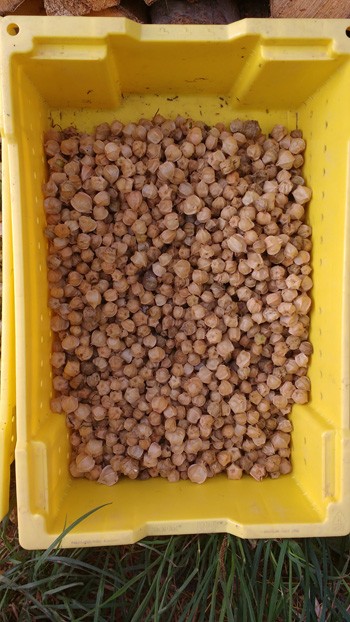
We charge $4/pint but we try not to cram them into the boxes. We fill them to the top but don’t push them down. With all the air in the husks, you could double the weight in the box (and halve your sale price) if you aren’t careful.
The fruits keep an incredibly long time. We tell customers to keep them on the counter, not in the refrigerator, just like tomatoes. Fruits that have ripened and fallen from the plant will keep for up to 2 months. But fruits don’t really ripen off the plant. We recommend only storing fruits that dropped off the plant of their own accord.
Husk cherries are a really fun little fruit to market. Kids love them! And the labor saving tricks of finding or selecting for a larger fruited variety, hilling, Florida weaving, using landscape fabric, and winnowing the fruits have made husk cherries a crop we love even more.
Liz Martin runs Muddy Fingers Farm together with her husband Matthew Glenn. Muddy fingers farm is a 2 acre, 2 person vegetable farm specializing in heirloom and unusual vegetables. Produce is sold through CSA, farmer’s markets and to fine local restaurants. 2017 is the farm’s 15th year.
Copyright Growing For Market Magazine.
All rights reserved. No portion of this article may be copied
in any manner for use other than by the subscriber without
permission from the publisher.