











By Ellen Polishuk
A mile of gravel road crosses the Winooski River over an old covered bridge, leading to Cate Farm. On a beautiful clear bright summer day, the long and lanky Richard Wiswall saunters over to warmly welcome me. Even though it’s a Monday morning in July in Vermont, during what should be the busy season, he’s full of smiles and exudes warmth and ease. Instead of a stressed-out, disheveled grower, there is a composed and relaxed man greeting me.
How can he manage to be so comfortable, especially at this time of year? Because he’s a life-long professional grower who’s got his systems down, his team in place, and his priorities in alignment with his goals. He wants great crops, a healthy lifestyle, and to be a vital member of a vibrant community.
Richard refers to his age repeatedly when explaining why the farm is in its current iteration. He turned 60 in 2017 and his desire to work long long hours has waned. He’s already been there and done that. Now he labors at a more judicious pace, reaping the benefits of all the work and investment he’s made over the last 35 years. He enjoys more free time now to pursue other interests and hobbies, including playing tennis.
On the property, he now has time to undertake projects not directly related to production; renovating ten acres of forestland that was lost to invasive species. This new project gave him the opportunity to buy a huge excavator. He could have paid someone else to do the work with their machine, but Richard wanted to play with a new piece of equipment. To my eye, this is yet another sign of a mature and successful business, having the economic wherewithal to purchase a specialized and costly piece of equipment, which will hold its value for later resale, that ultimately saves the farm money. And, the main motivation was to have fun with a cool new machine!
Richard also enjoys more cerebral non-farm work, teaching and consulting with other farmers. His 2009 book The Organic Farmer’s Business Handbook still sells well and continues to help growers figure out how to farm smarter not harder by determining which crops actually make a profit. In his own business, Richard has continuously assessed which crops really make the money (profit not merely cashflow) and has been repeatedly brave enough to stop growing those that don’t. There is no better advertisement for spending the time to do data gathering and analysis than seeing how doing just that has resulted in a gorgeous farm run by a relaxed and happy farmer.
In spite of many years farming, the spirit of learning and innovation still abound on Cate Farm. Though not raised on a farm, Richard has amassed many tools and skills that “real” farmers have – carpentry, welding and plumbing. He’s always looking for a better (usually easier) way to do each task, to grow better plants. Some of his recent discoveries include:
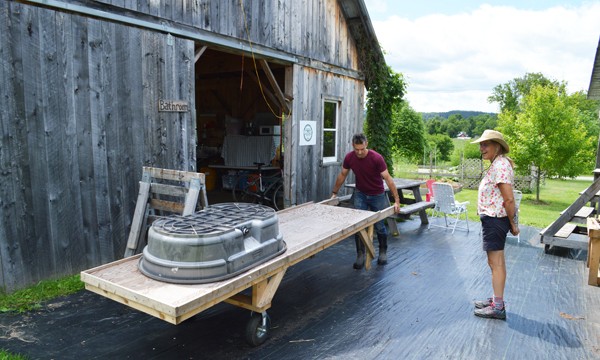
The Mule – a homemade wooden cart to move 25 flats around.
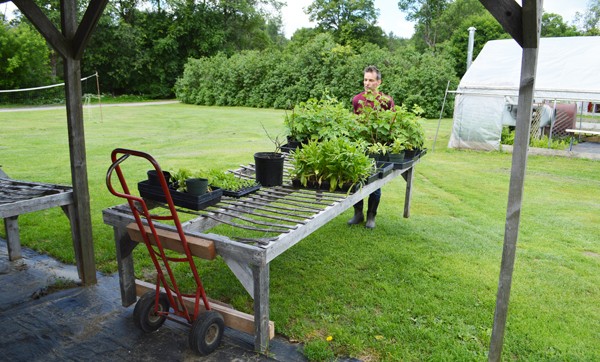
A handcart with two pieces of 2×4 that allow him to move benches under cover solo.
Solarizing the high tunnel for three days to create weed-free beds for winter greens production.
Using grafted tomatoes in the tunnels to grow bigger, more productive plants.
Using techniques learned from Andrew Mefferd’s book The Greenhouse and Hoophouse Grower’s Handbook, like crop steering, to increase tomato production.
Other long-used innovations include:
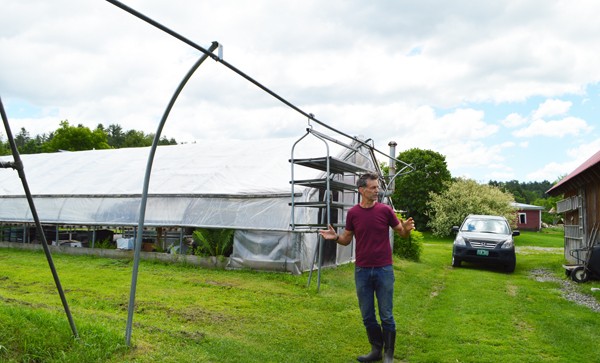
Greenhouse trolley. This is Richards’s favorite tool, as mentioned on the Farmer to Farmer Podcast in March of 2015. This is an overhead metal rod system that creates a track through two transplant greenhouses. From it hangs a four-shelf, eight-foot long trolley. Many flats can be loaded easily and moved either between houses, or outside to get put onto a truck. Richard installed it many years ago and still loves it!
Using Fort Vee transplant mix from Vermont Compost. Why make your own when this stuff works so well?
Bright lights and radiant heated floor in one room of his shop for earliest seed germination.
Loops of underground tubing, carrying heated water, to warm up greenhouse soil.
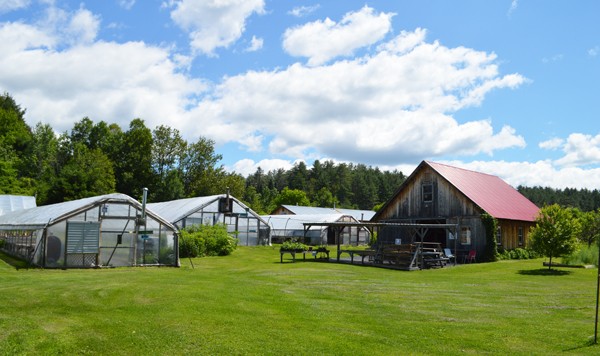
This land was settled and farmed by the Cate family in 1793. Richard became its owner and steward in 1981 and named his business after the founding family. Over its 36 years, Cate Farm has taken many shapes. At peak production in the 1990’s, Richard grew 18 acres of mixed vegetables for a CSA, a farmers market and for wholesale. In 2001, Richard and his wife, Sally Colman, decided to begin scaling down.
In 2017, Cate Farm grows only one acre of root crops in the field, all for the wholesale market. The heated high tunnels grow luscious tomatoes, also for the wholesale market. And the three greenhouses grow thousands of vegetable and flower transplants for wholesale and for on-farm retail sales. While these three crops/enterprises are not the most profitable Richard has ever grown, they help manage peak labor demand nicely, and fit very well with his existing markets.
The genesis story and evolution of Cate Farm offer inspiration and hope for new and wanna-be growers. In 1981, Richard, a Long Island native, invested $10,000 into a partnership with several people to purchase the land. He was the only partner interested in farming. While each partner pursued their own interests, Richard began to build up the Cate Farm business. After 12 years, Richard’s business was successful enough that he could borrow the money from a conventional lender to buy out all the other partners. During that partnership period, he was investing in equipment and infrastructure as well. Cate farm stands as an example of how an unlanded but inspired grower can get onto a farm using unconventional means.
Richard was also an original member of the Deep Root Organic Coop, which has acted as an important avenue to the wholesale market. The coop’s grower members came together in order to access more distant markets. The idea was to give themselves a much bigger market to sell into, relieving pressure on selling to local markets. By banding together, the coop farmers can reach into the lucrative Boston market with the quantity and variety necessary to service larger wholesale accounts.
Cate Farm attended the very successful producer-only Montpelier farmers market for 25 years. It was their sole retail market until 2010. For a number of years, Cate Farm ran a vegetable CSA. It was hard to leave these long standing and successful market channels, but it’s where the business needed to go in order for Richard and Sally to downshift into a smaller more easily managed operation. Luckily, Cate Farms dedicated eaters from the past have become its excellent plant buying customers now.
During the interview on the Farmer to Farmer Podcast, Richard mentions he probably wouldn’t be able to farm so well, so easily or so compactly now if he hadn’t had a bigger operation before. I found this intriguing and followed up with him. Indeed, his previously larger size operation gave him the opportunity to afford and incorporate multiple tractors and implements that would have been too costly for his currently sized operation. He can now farm his one acre field crop with tractor weed cultivation, and multiple tillage tools that are long paid for. This distinction is important for newer growers looking for inspiration on how to farm smaller acreages, and make a good living – it wouldn’t make sense for a new grower to acquire the same equipment Richard has to grow 1-2 acres of field crops.
I attended one of Richards day long workshops held at the SSAWG conference a few years back. It was tremendously informative and invigorating. One of the stories that struck me the most was hearing about Richard’s pay rate for his employees. His model is, and has been, to increase the pay rate by a dollar an hour each year an employee returns. And he didn’t start them at $7.00 either! This generous offering resulted in a number of folks coming back to Cate Farm for several years running. Now, Richard has three employees earning $22.50 an hour – which is disbursed as an $18/hour wage, plus $4.50/hour put into a SEP IRA at the end of each year. Richard describes how with his current team of Sally, son Flint, and three part time seasoned employees, the farm runs smoothly, with tremendous efficiency, and almost no upset.
This model challenges any grower to examine the costs of having a crew of inexperienced folks every season, year after year. Can you imagine what it would be like to have to give very little if any direction to your crew members each day? What would it be like not to have to check up on anyone? Not to teach every little technique of cultivating, harvesting, seeding each crop every month, every year? I really can’t quite fathom it myself. But, seeing how beautifully well-kept Cate Farm is, and how happy and stress-free Richard is, sure does inspire me to think through employee models with a new perspective.
Richard and Sally have achieved another envious milestone – each of their three children is somehow involved in the food movement. Pete Colman runs Vermont Salumi, which converted part of the old barn on Cate Farm into a certified processing kitchen for charcuterie. Flint Wiswall, is a full-time farmer at Cate Farm, now managing the transplant greenhouses. Kuenzi Wiswall has begun her own business, The First Bird Flowers, growing and selling cut flowers.
Cate Farm is a beloved member of its local community. They provide gorgeous organic transplants for home gardeners. They offer gainful employment. And they have incubated a successful new food business. It’s a gorgeous thriving farm that will prosper long into the future.
Ellen Polishuk just retired from growing 25 acres of ecoganic vegetables and other crops at Potomac Vegetable Farms in northern Virginia. She is now a full-time farm consultant, writer and teacher. Ellen is passionate about helping growers around the country improve their soils, labor management practices and their businesses so that they can increase farm profits and achieve a joyful balanced life. For more information go to ellenpolishuk.com.
Copyright Growing For Market Magazine.
All rights reserved. No portion of this article may be copied
in any manner for use other than by the subscriber without
permission from the publisher.