











By Carolina Lees
Hiring your first employee is a rite of passage for many farmers. It’s common for a farm to start with one or two extremely dedicated owners who do all the work. Then as the farm grows, it’s time to bring in some outside help.
I’ve now had employees for 3 summers, and as anybody who’s gone through that transition will agree, it’s a huge change. Whether you want to teach and serve as a mentor to your employees or just find somebody who will pick beans so you don’t have to, bringing other people onto your farm requires adjustment.
Besides helping shoulder the load, employees can keep things fresh and moving on a farm. People just arrived at your operation see things with new eyes. Harvesting beets is exciting! Digging potatoes is a treasure hunt! Who knew all peppers start off green?!
Those new eyes can be a lot of fun to work around and can help you get back to the enthusiasm of your early days of farming. I love sharing my experience with folks eager to learn and watching people live the turn of the seasons for the first time. But with all that newness comes a lot of confusion. Where does that tool go? What size are the peas supposed to be? How many bunches was I supposed to get again?
And that confusion can take a toll on morale. Most people want to feel competent and successful in their work.
I value being a good boss. I am respectful of my employees’ time and give them reliable schedules and varied work. I make sure they get a share of the harvest and I take time to teach them about the big picture of what we do.
But I’ve often noticed my employees expressing frustration with themselves and their learning curve. They get easily discouraged when they make a mistake. Some of that is their personal journey and out of my control. But the way I set things up makes a big difference in how quickly they can learn and become independent on a given task.
I had six years of experience working for other farms when I started Corvus Landing. I was competent with a range of crops and tasks and I was used to working quickly and efficiently. Starting on just ¾ acre, I was able to be nimble and adaptable, scrounging up harvests and trialing varieties that would never have worked on the larger farms I’d trained on.
When I increased the size of my farm, I couldn’t keep up with everything on my own. I was ready to turn over some of the work and to have some backup in case of injury, illness, or even a few days off. But I found that my adaptable, nimble systems were difficult to communicate to new arrivals. Plantings, harvests, and systems were just a little bit different from one week to the next, or one bed to the next. I spent a lot of time explaining all the little changes and adjustments, making them a lot less worthwhile.
I’ve found over the years that setting up streamlined systems for workers to learn on is key to success. And when employees feel successful and competent, they are more motivated and do better work. Training and explanation is a part of it, and the part I was more comfortable with initially. But you can get away with a lot less training if you can make the task easier to learn in the first place. Since bringing on my first employees, I’ve made a lot of simple changes that have made a big difference in their learning curve and confidence. And in the process, I’ve made my own job easier.
Too much variety
Diversity is a major part of my farming strategy, both for growing and marketing success. Zucchini sells better if there are a few yellow ones thrown in. But variety adds complexity, which makes it harder for newcomers to pick up right away. It’s obvious to me that the yellow zucchini are ready at a slightly different size than the green ones, but is it obvious to someone who’s never harvested zucchini before?
As I’ve turned over more of the farm work to my employees, I’ve found myself cutting down on varieties. When ordering seed, sowing, and planting, I ask myself how important it is to have that other variety. Is it significantly earlier? Does it really increase my sales? The zucchini example is pretty simple: they do increase my sales and they’re not that hard to harvest properly. But maybe I don’t need seven kinds of onions.
Besides eliminating varieties, I now group them differently. When possible, I plant just one variety at a time. This works best with crops planted in regular rotations: since I grow a non-heading and a hybrid type of broccoli, I’m now alternating the rotations rather than sowing a few flats of each at a time. This simplifies every step of the process. My employees only need one pack of seeds, they can’t mix up seedlings of distinct but visually identical varieties, and harvest standards are clearer.
For crops with fewer planting dates, I try to group varieties clearly. I have cut down to four varieties of potatoes, and if possible I plant full beds of each. I label each in the field with colorful flags and the variety’s name. These techniques are simple, but they eliminate a lot of error and reduce the need for supervision (read, less work for me).
Clear standards and measurements
When I’m working by myself, I approach harvesting with some level of flexibility. I may know I need exactly 40 bunches of radishes for the CSA, but I could take 20 or 30 to market, depending on their size, quality, and ease of harvest. Maybe I’ll cut into the next rotation, maybe I won’t, I’ll take a look and see.
When I send employees to harvest, though, the more explicit my instructions the better results I get. If I can give a clear number (“Harvest 65 bunches of radishes”), employees are more likely to remember and to come back with results I actually want. It pays to take some time the evening before a harvest to check on any marginal crops or new rotations so I can send employees in the right direction.
Not that I never give a range. But if I am giving a range, it’s helpful to also have an objective quality or size standard. (eg, “take all the beets from this bed that are bigger than a golf ball, up to 40 bunches”). Best is if you can send the same person back to the same crop in the next harvest, because they know where they left off and can continue working with the same standards in mind.
When possible, I give employees objective quality and size standards. If each bag of salad is to be between .50 and .52 pounds, there’s no room for interpretation or misunderstanding. I also like to give time benchmarks where possible, one we use a lot is “a bunch a minute” as a general rule.
And it’s not just in harvesting that consistent, clear measurements come in handy. I like to use hands and fingers as a size standard, especially when thinning. Telling somebody that beets should be 3 fingers apart makes it easy for them to check their spacing and they don’t have to carry an extra tool.
I have simplified my planting spacing to make it easier for my employees. I use C clamps attached to the tiller to mark rows, then a long measuring tape to get the correct spacing. Even better would be a wheeled bed marker that marks a grid on the bed: that’s been on the list for a couple of springs but I haven’t gotten around to making one! I have also cut down on variation in my plant spacing to reduce confusion for my employees. When my farm was smaller and space was my limiting factor, tightening up those plantings where I could made sense. But now that time and training are more of my concerns, standardization is preferable.
Tools and containers
For small, frequently used tools like harvest knives, hoes, and sharpeners, ideally there should be one per employee (plus one or two extra stashed away for when one gets lost). When I was a farm worker, I liked having my own designated knife or hoe because it was easier to sharpen and it gave me a feeling of ownership. As a farm owner, I like that system because it increases my employees’ accountability for the tools, meaning that fewer get lost.
When appropriate, I try to always supply the same kind of tool. For example, I have 2 separate propagation houses and a watering wand for each. It’s much better to have the same kind of watering wand in each house so the flow, pattern, and technique stay the same. On my farm, I’ve found the same to be true of irrigation timers, rubber bands, bags, row cover, trellising supplies, harvest tools, flats, and really anything we have more than one of. Training is much simpler and quicker if, when the employee goes to water in transplants at the other house, they can do exactly the same thing they did the first time.
Having plenty of containers available for harvesting is an obvious need. I like to have certain sizes or types of containers designated for different crops. It makes them easier to pack into the truck for market or to find what we’re looking for in the cooler.
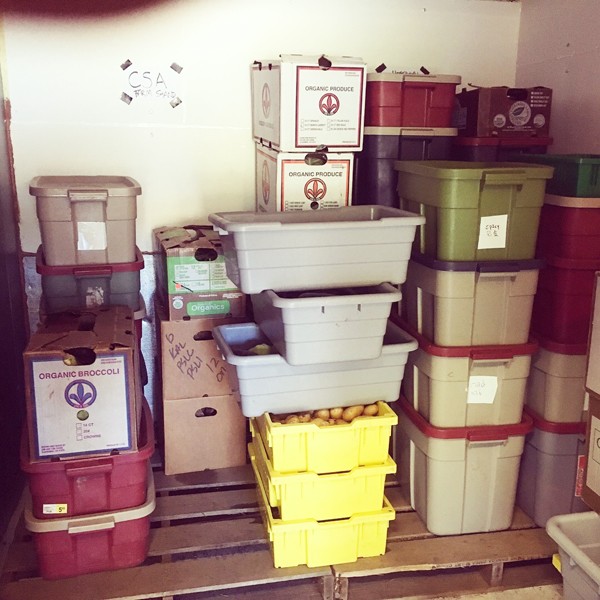
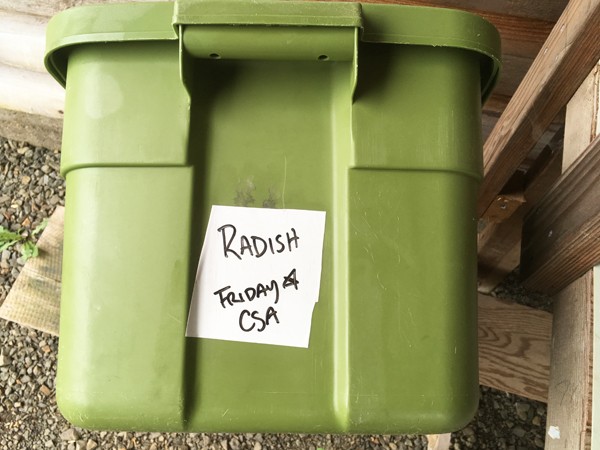
Labeling bins was a challenge until I discovered dry erase contact paper this year. It’s basically a sticker you can put on the outside of your bins, then write on with dry erase markers, like a white board. I bought a roll of it for under $10 at JoAnn Fabrics, and I cut out squares that stick to the outside of my bins. Then my workers or I can label the bins by where they’re going, what’s in them, or with a date. We also organize our cooler with different areas for CSA, market, and crops being held for future use. These areas are labeled inside the cooler and separated by pallets.
Markets, pricing, records
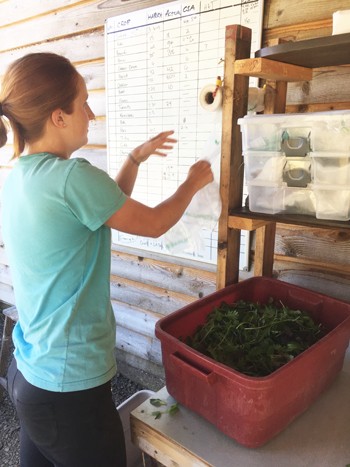
We use a large enameled steel white board to chart our daily harvest. The steel means that it can get wet and not disintegrate like cheaper white boards do, and it’s important for it to be large enough that everyone can read it easily. It hangs just above a scale so it is easy for employees to record weights on crops when they arrive in the packing shed or head to the cooler. I have columns for how much I want harvested, how much was actually harvested, and how many to send to CSA, wholesale, and market. There’s extra room to write in notes or include how much was left from a previous harvest. A second white board displays a clear packing list for the CSA.
Writing the day’s harvest and providing clear spaces for record keeping cuts down on how much I have to explain. It allows the employees more independence in harvest and packing, and I can usually cut out to work on other tasks once the harvest day is underway. At the end of each harvest day, I use my phone to take a picture of both boards so that I can record the harvests on my market take sheets and in my CSA records.
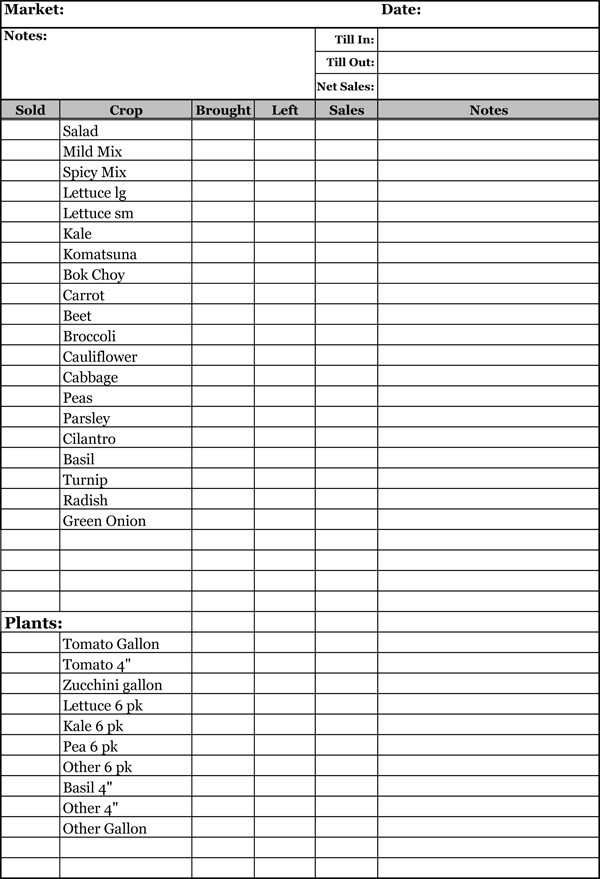
I have a three ring binder that goes to every market with the take sheet for the day. I ask my employees to record what’s left and what’s sold at the end of the day. My employees used to dread this process and always cut corners. So I developed a clear, standardized take sheet and purchased a higher capacity scale that made it easier to weigh large bins. (I’ve also made matching recurring invoices in my accounting program so that the market sales are easy to enter.) The task got quicker and more pleasant so now it actually gets done.
I’ve always tried to keep my pricing consistent and stable for my customers’ sake, but now I also do it for the employees. I keep an alphabetical price list handy at the back of the stand for market workers to refer to. While I can label a changed price for someone shopping, my workers aren’t looking at those labels and often forget to adjust as they add up a purchase. That higher capacity scale? It’s also a price computing scale, which saves a lot of math errors and makes it quicker to wrap up with a customer so we can move on to the next.
A lot of farms use checklists for workers. As an employee, I remember check lists for packing the market truck, for flat sowings, and for weekly tasks. This is another way to foster independence in your employees and reduce mistakes. The more clearly any list is written, the better results I get. It doesn’t take me any more time up front, and it saves me time by cutting how much explaining I have to do and reducing mistakes.
Save time and be happy!
Happy workers help make a happy farm. When I’ve set up a good system and trained my employees well, I can watch them head to the field with confidence. They feel more independent and enjoy their job more, so they have a higher tolerance for less pleasant tasks, days that go unexpectedly long, or unanticipated changes. And often those time-saving systems I set up for my workers benefit me as well. I really like that new market take sheet.
I enjoy having people on my farm who care about it and care about me. I enjoy teaching folks about farming, but there’s only so much time and energy I’m able to devote to that. Better systems means less time training and less follow up supervision, as well as fewer mistakes. When my employees feel more competent, I win!
Carolina Lees started Corvus Landing Farm in 2010 at the Oregon coast. She and her crew farm two acres of vegetables, providing for the small communities surrounding the farm through farmers markets and a 60-member CSA.
Copyright Growing For Market Magazine.
All rights reserved. No portion of this article may be copied
in any manner for use other than by the subscriber without
permission from the publisher.