











Post your farm-made tool on Instagram or Facebook with #toolsforgrowingformarket. If author Josh Volk picks your tool, you win a $50 tool gift certificate and a Full Access subscription to GFM.
Back on January 6, Muddy Fingers Farm posted some photos of their plans for the upcoming season saying, “One of our favorite #ToolsForGrowingForMarket is farming the season once from the couch before we head out to do it in person!” I couldn’t agree more – having a dry run at the farming season with some simple planning tools makes decision-making during the season so much easier, and better.
The “tool” that really caught my eye in their post are what I call, “maps in space and time” but might be better characterized as hybrid calendar-maps. For me, those maps are the number one best planning and record-keeping tool I have. When I talked to Liz Martin, one of owners of Muddy Fingers Farm, it was fun to hear more about how they use the tool a little differently than I do.
The basic idea for the hybrid calendar-map is that rows represent a particular location on the farm – in this case a bed in one of their fields – and columns represent the weeks of the year. This allows them to see what is happening in a particular bed on any week of the year. For planning purposes this allows them to see when beds need to be prepared for planting, when they are occupied by a crop, and when space is free in a bed for a second cash crop or a cover crop.
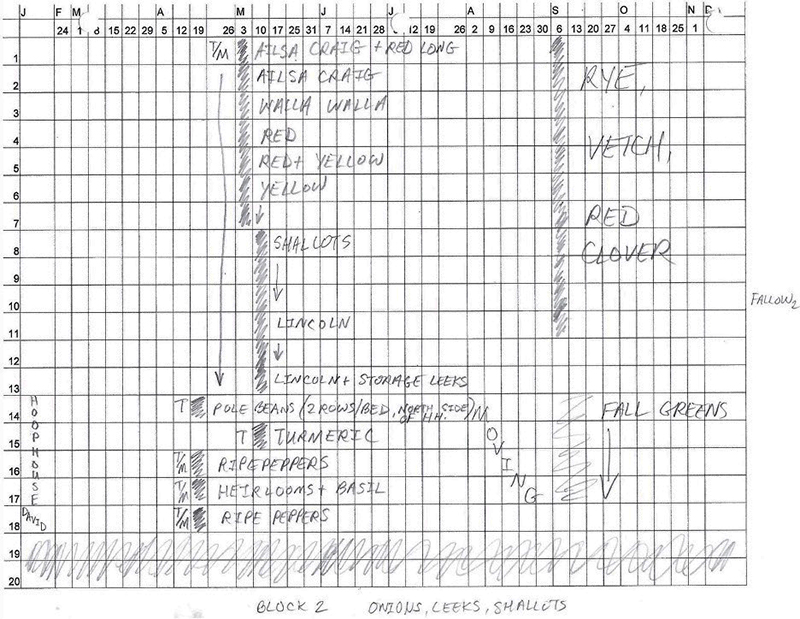 Figure 1.
If you have a rotation plan in place, as they do at Muddy Fingers, you can write the crop that is planned to follow in the right margin of the map as a reminder. This reminder helps when planning, especially when planning overwintered cover crops, but also if you find yourself needing (or just wanting) to make last minute changes during the season – pull out your map and see how that change will impact the rotation the following year, and the planned crops in adjacent beds.
Liz, and her husband Matthew, manage the farm together and are also the main labor on the farm. They update their maps each season, just using a grid they’ve printed out on a spreadsheet that has columns for the weeks of the year, and 20 blank rows, representing the 20 beds in a planting block. They fill in the maps, essentially planning out the entire farm on paper and noting key work that needs to be done on particular weeks. During the season they go through the maps each week, looking down each column for that week and noting the work that was planned for that week: beds to be prepared for planting, specific crops to be planted, cover crops to be seeded.
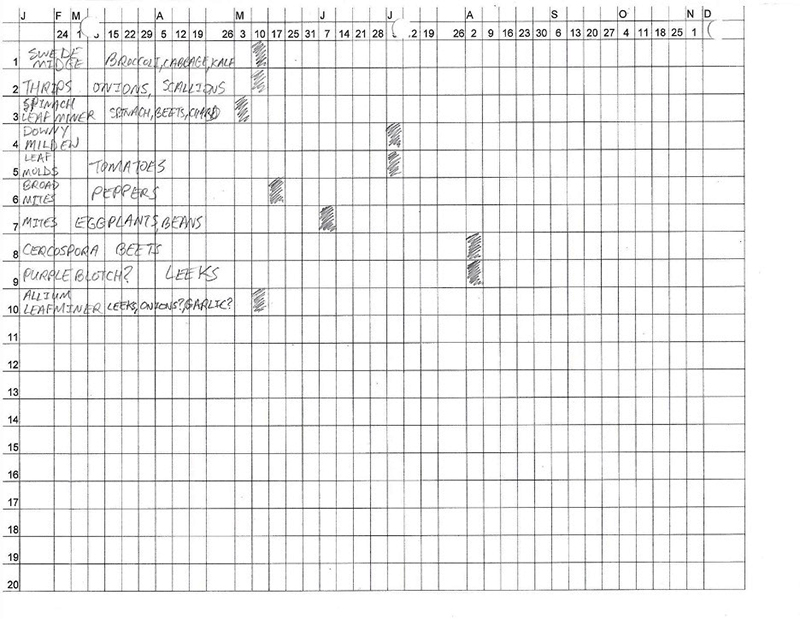 Figure 2.
I wrote a couple of articles here in Growing for Market back in 2010 on Mapping Crops on a Spreadsheet, and Tips on Using Spreadsheets for Crop Planning. In the article on mapping I explained that I create my planning maps similarly, but by typing my notes into the grid and using some formatting of background fill to show when crops are in the ground. I then use a second blank map to keep records during the season on what actually happened in the field. Liz told me that they started out using this same system of keeping records on a second blank sheet but that over time they’ve dropped that step as the actual ends up being very, very close to the plan.
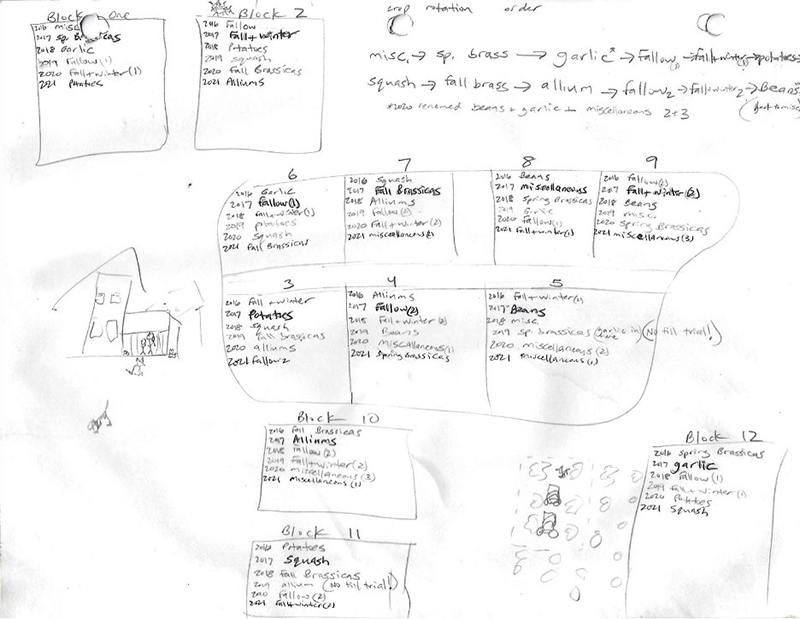 Figure 3.
One clever addition Matthew made to their maps recently was an additional “map” that reminds them when peak pest times are. This pest map goes into the same three ring binder as the other maps and when they’re looking at the week’s column of notes, it points out pests that they should be scouting for and potentially addressing in different crops.
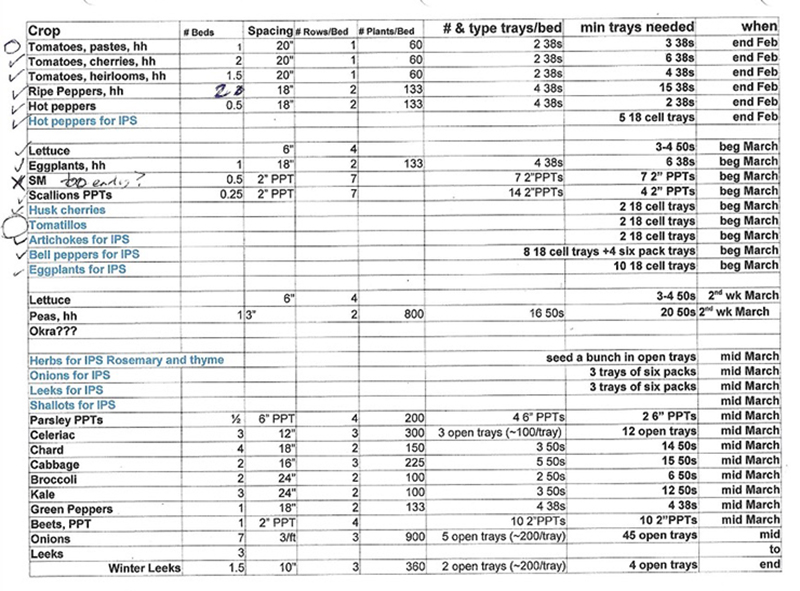 Figure 4.
At this point it might be getting too late in the spring to spend a bunch of time on the couch by a cozy fire, planning out the full season ahead. But even so, a great way to transition into a system like this is to simply start out this season using it as a record keeping system. Creating the map-calendar grid blanks and then filling them in each week on a weekly field walk. By the end of the season you’ll have the templates for your planning maps for the following season and you’ll just need to move around the crops for rotations, and make any changes to crop plantings that you’ve decided on.
Referenced articles:
Tips on using spreadsheets for crop planning, GFM October 2010.
Mapping crops on a spreadsheet, GFM February 2010.
Josh Volk farms in Portland, Oregon, and does consulting and education under the name Slow Hand Farm. He is the author of the book Compact Farms: 15 Proven Plans for Market Farms on 5 Acres or Less, available from Growing for Market. He can be found at SlowHandFarm.com.
Copyright Growing For Market Magazine.
All rights reserved. No portion of this article may be copied
in any manner for use other than by the subscriber without
permission from the publisher.