











In a good tomato year, there is the temptation to treat the fruits of your labor like sacks of red water, and the pressing desire to sell them off cheaply by the box often ignores the true value of those antioxidant-rich, flavor-dense jewels of the garden. Proper transport and display of those gems will allow you to keep your prices up and will bring your customers back week after week, looking for more. For our farmers market tomato sales, we have built simple but elegant wooden display boxes. They are modeled on the heavy corrugated trays used to ship strawberry pints from California. But while corrugated cardboard softens in the damp and sags or even folds with time or stress, these wooden boxes gain character and patina as they age.
The wood used for the boxes is milled down to a true 1/2-inch thickness from rough-cut 1×6 No. 2 pine lumber. Using standard planed 1×6 pine is an option, but the boxes look much chunkier and are noticeably heavier. Poplar or any other non-splintering softwood could be substituted for the pine. Standard overall sizing for the boxes is 22.5 inches long by 15.5 inches wide by 4.75 inches tall. Rounded handle slots are cut into the end pieces and the side pieces are cut down an inch and a half for most of their length, sloping up at both ends. The cutaway allows for more air circulation and better visual access to your wares, as well as providing additional grip points when the boxes are stacked. Either a router or a rasp and sandpaper are used to “ease,” or slightly round the upper edges of all pieces, which makes knuckle or fruit contact a less traumatic experience. Here are closeups of the construction:
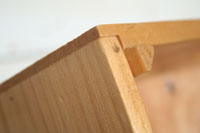
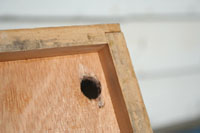
The end pieces are half-lapped, or rabbeted, over the sides of the box and fastened with three-penny box nails (or one inch brads) and carpenters glue at each corner. This produces a stiff, sturdy and light box. Rabbets can be cut carefully with a hand saw, 1/4-inch deep and 1/2-inch wide, with multiple parallel saw cuts that are then chiseled out, or they can be cut in one pass on a table saw with a dado blade. Rabetting the corners makes aligning them for nailing easier, provides more surface area for the glue bonding, and produces an elegant, strong and simple joint. Small triangular pegs that extend slightly more than a 1/4-inch above the end pieces provide additional corner bracing. Oak, maple or other hardwood provides a little more strength than pine for these critical pegs, which are glued and tacked into place with brads. The bottom of each box is 1/4-inch (nominal) Luan mahogany plywood held by grooves, or dados, sawn 1/2-inch up from the lower edges. The space below the bottom fits neatly over the triangular corner braces so that the boxes lock together when stacked for transport and provides an additional half inch of headroom for your big heirloom beauties. The same locking feature allows you to use 4×4 blocks to tilt the boxes from either end or side so that the boxes lean invitingly toward your customers.
Three 1/2-inch drain holes are drilled through the plywood bottoms at each end and along each side to prepare for that inevitable rainy market. The boxes are then sealed with three coats of shellac. Small holes are drilled in the upper edges on each side and end to accommodate stiff sign support wires. The final touch is to place a white towel in the bottom of each box, which contrasts with the brilliant colors of your fruit and gives a clean, fresh appearance to your display. The towels are available from restaurant supply outlets cheaply as “bar mops.” They provide a little cushioning during transport, and can be scrunched up to keep the tomatoes from rolling around in a partially filled tray. They also provide a valuable clue to “leaker” tomatoes by showing a wet stain around any offender that slips by your careful grading process. Depending on the height of your tables, two or more boxes of the same variety tomato can be stacked attractively for display. Restocking them only requires removing the top box, transferring any remaining tomatoes to the next box in the stack, replacing the variety/price sign and putting away your empty box.
Just be careful not to let any of your wholesale accounts get a look at your boxes, or you may find yourself back in the wood shop, when you really ought to be out in the field picking more tomatoes!
Copyright Growing For Market Magazine.
All rights reserved. No portion of this article may be copied
in any manner for use other than by the subscriber without
permission from the publisher.