











We’re growing multi-colored cherry tomatoes this summer, driven by a hunch that this is going to be one of 2009’s trendiest, most profitable crops.
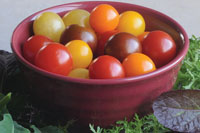
I started thinking about this last summer, when a friend brought a many-colored selection of cherry tomatoes to a tomato tasting party. Nearly everyone agreed that the white and brown varieties were delicious, dispelling any qualms I might have had about flavor. Next, I saw a tomato mix of several sizes and colors at a supermarket for $6 a pound, thus confirming the high-dollar theory. Then Johnny’s Selected Seeds sent out a newsletter earlier this year with a photo of colorful cherry tomatoes, all the same size, like the photo at left.
I believe in the rule of threes when it comes to trends — when something pops up three times, it’s got to be a trend.
So I called up Johnny’s for growing advice, and was put in touch with Howard Anderson, one of the growers responsible for tomato production on the seed company’s farm. To hear Howard describe it, this crop couldn’t be much easier.
First, the varieties: ‘Brown Berry’, ‘White Cherry’, ‘Favorita’, ‘Sun Cherry’ and ‘Sun Gold’. (Some of those varieties are not in the Johnny’s catalog, but are available on the web site, www.johnnyseeds.com or by calling 877-564-6697.) All are indeterminate varieties and range from 58-65 days to first harvest. And all the fruits are about the same size, 1.25 inches in diameter.
Howard said the tomatoes were grown in a high tunnel with drip irrigation underneath ground cloth to eliminate weeding. They were spaced 12-14 inches in the row, and pruned starting at 2 inches to create two vines. String was tied to the high tunnel purlins, and the vines were trained onto the string with Johnny’s tomato clips. Howard recommends that if you plan to keep any indeterminate tomato all season in a high tunnel, leave extra string after attaching it to the purlin. Tomato plants can get so tall you will need to let the strings down late in the season to harvest the fruits.
Howard said that the high tunnel tomatoes had few pest or disease problems. Nor was pollination an issue: “Just walking through the high tunnel vibrates them enough to pollinate themselves,” he said.
The variety ‘Sun Gold’ is prone to cracking if it gets too much moisture, so he recommended putting a valve on the drip line to those plants and reducing the amount of water they get relative to the other varieties. Howard didn’t have yield data, but he said the plants produce “more than you can handle sometimes.” Everyone admits that labor is the biggest issue with cherry tomatoes — they need to be picked every day and they are time-consuming, pound for pound, compared to regular tomatoes. But we happen to have a son who really wants to earn enough money to go abroad next year, so we aren’t too worried about the labor requirements. If every pint is worth $2 or more, that’s a pretty good incentive to pick.
Our only qualm is with the packaging we’ll need to sell to a grocery store. Most cherry tomatoes are sold in plastic clamshells, and I’m researching alternatives including paper boxes and corn starch-based containers, to find the most environmentally benign. I welcome ideas at lynn@growingformarket.com or 800-307-8949.
Copyright Growing For Market Magazine.
All rights reserved. No portion of this article may be copied
in any manner for use other than by the subscriber without
permission from the publisher.