











Consider this variation on selling at farmers market: You know ahead of time exactly how much you will sell, so that’s what you harvest and pack. You spend an hour selling it — in the afternoon, not at dawn. You set your own prices. And you get a check for everything you’ve brought, as soon as you finish unloading it. Only in your dreams?
Not at all. This is the reality at dozens of farmers markets operating or starting up around the United States this year. It’s based on an internet ordering program called LocallyGrown.net that also is being used by CSAs, buying clubs, farm stands, and other direct farm marketing ventures. More than 100 local food sellers nationwide are using the online ordering system, which will generate about $750,000 in sales this year.
Best of all, LocallyGrown.net is available to anyone who wants to use it to sell farm products. It costs nothing to sign up — no software to purchase and no initiation fee. The user simply pays 3 percent of sales to the developer of the program, Eric Wagoner.
Eric is a farmer himself (who has written for Growing for Market several times) at Boanns Banks Farm near Athens, Georgia. He has a day job as a software developer, so it was natural that when he looked for a way to supplement his farmers market sales, he turned to the internet. Seven years ago, he launched Athens Locally Grown, with five other farmers selling through his web site. Today, nearly 100 farmers sell at his online market to more than 1,800 customers.
“It’s been going gangbusters,” Eric said. “Every year it doubles in size, in the number of farms, amount of sales and number of customers. This year, we’re seeing 20% growth — and any growth is good in this economy.”
Eric started offering his web-based virtual farmers market program to other farmers in February 2007 and it has been adopted coast to coast in various formats. Most commonly, it’s an alternative farmers market, where vendors offer products online, customers order online, and then the orders are delivered to a specific location once a week.
“It’s a good complement to farmers markets, and it allows farmers markets to exist where they might not otherwise, in rural areas. But I don’t think it’s going to replace physical markets,” Eric said.
Chuck Crimmins sells through two online markets in Arkansas and is pleased with the system because he knows everything is sold before he picks it. “Farming has finally caught up with the internet; it’s pretty neat,” he said.
Here’s how LocallyGrown.net works when used as an online farmers market:
•A farmer or other organizer signs up to start a market at www.locallygrown.net. That person becomes the “market manager” and is responsible for recruiting farmers and customers, adding custom content to the web site, and organizing a pick-up time and location. The manager also sets whatever fees he or she wants to charge. At Athens Locally Grown, farmers pay 10% of sales to the market manager, and customers pay $25 per year.
•Once a week, producers upload to the web site descriptions, photos, prices and quantities of the products they will have available that week. The ordering system is open for a few days a week. During that time, customers can browse the market’s offerings and place their orders, just as they would at any other online store.
•Once ordering closes, the software generates a list of orders for each food producer to use as a pick list as they harvest and pack over the next few days. It also generates labels with the customers’ names, so the farmers can customize packaging for each customer.
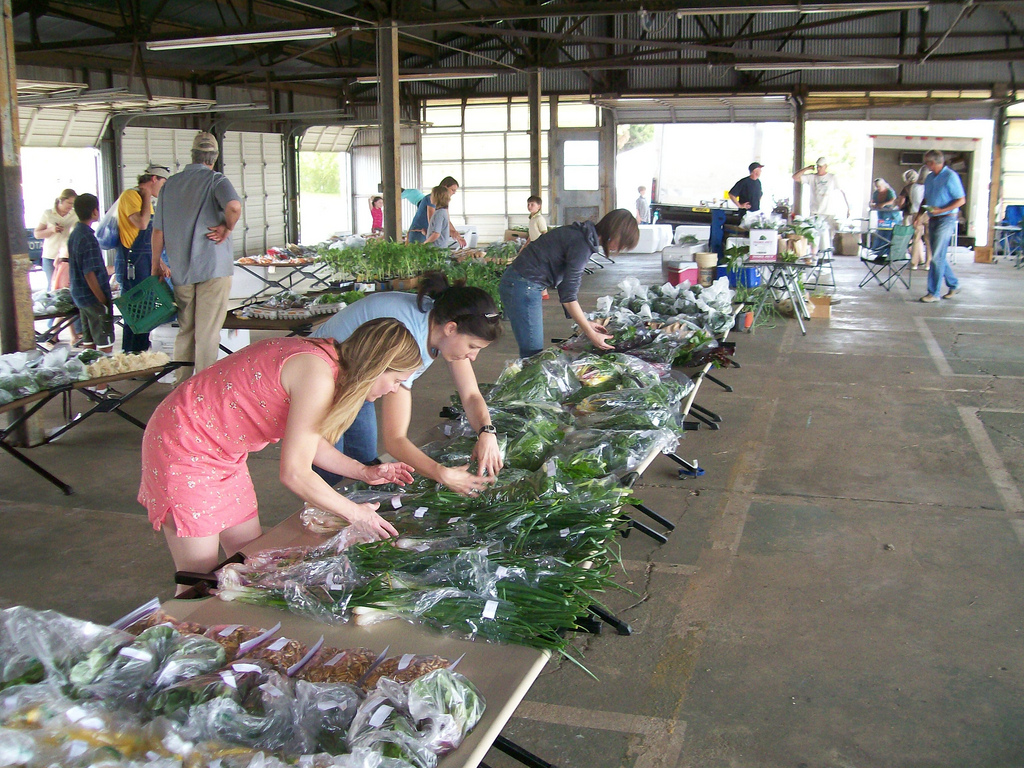
•On market day, producers deliver to the market site and unload their products onto display tables. Once they have finished unloading, they can go to a cashier who writes them a check for the total of products delivered, less any fees.
•Customers arrive and pick up the products they ordered, paying with a single check made out to the market, no matter how many producers they purchase from.
Variations on the theme
There are probably as many variations as there are markets at LocallyGrown.net. Fees are determined by each market manager. Some charge only customers, some charge only farmers, some charge a fee and some a percentage. The only invariable cost is the 3% of sales paid to Wagoner.
The system is being used by a few physical farmers markets that allow customers to pre-order products and pick them up on the regular market day. It also can be used by single farms to pre-sell products for pickup at a farmers market or an on-farm market. One small grower in the Northeast uses the system in conjunction with a driveway honor-pay stand. His customers order online, pick up the produce he leaves for them at an unstaffed stand, and put their money in a cash box. Some markets allow customers to make a payment online of at least $100, and then draw down from it (which the software does automatically for each customer).
The program also can be used by CSAs to ensure that members have choices about the food they get. Instead of offering a one-size-fits-all box of produce, the farmer can post available quantities online and have shareholders order the items they want. The farmer harvests only what is going to be picked up, saving time, preventing waste, and building member satisfaction with CSA.
Because the online marketing system is so new, no one knows whether it will be subject to state and local regulations on food sellers. Wagoner says that, as a farmers market, his online market is exempt from many food rules. He warns that a for-profit LocallyGrown.net market could trigger state and local regulations on food sellers.
“Regulators have a hard time figuring out where we fit, ” Eric said. “I run things so it breaks even. I have to make sure there’s no way I can be interpreted as being a wholesaler or retailer, because then I would have to treat my operation as though it were a grocery store.”
For more information, visit www.locallygrown.net, which includes details about the program and links to the 100-plus markets using it. A video interview with Eric about Athens Locally Grown can be viewed at the University of Georgia online journalism site: http://www.gradyjournal.com/?p=3655
Copyright Growing For Market Magazine.
All rights reserved. No portion of this article may be copied
in any manner for use other than by the subscriber without
permission from the publisher.