











If my article on beekeeping in the April issue of GFM piqued your interest, then your next question should be, “How do I make money with bees?” While improved fruit and vegetable quality and quantity should be reason enough to have honey bees on your farm, the wide variety of hive products can add income, especially in the off season. Here are some of the many ways to make money:
Honey
Honey is ready to harvest when the bees have placed a wax cap over the surface of the comb. Most small-scale beekeepers will harvest honey only once a year, typically in mid to late summer, depending on location and nectar flows. Yields per colony typically range from 50 to 100 pounds of honey.
Honey is sold in a variety of forms: extracted (liquid) honey, comb honey, chunk honey, and creamed honey are the most common. Extracted honey requires the beekeeper to remove the wax capping and spin the honey from the comb using an extractor. This operation lends itself to a cooperative effort and many beekeeping clubs share the equipment and labor required to uncap and extract honey.
Extracted honey must be strained to remove bee parts and wax bits. Beekeeping supply firms sell combination strainer and bottling buckets that are economical and allow you to put up a quality product. Your honey will not be crystal clear, as the product that appears in grocery stores is. Large-scale commercial beekeepers often sell to packing houses that heat the honey so that it can be forced through fine filters to remove tiny wax particles and pollen. You can improve the clarity of your honey by letting it sit in the bottling tank overnight so the air bubbles and wax particles rise to the surface. Many of my customers prefer minimally processed honey as it preserves the subtle aroma and flavors. Anecdotal testimonies by allergy sufferers are that some find relief with honey that contains traces of pollen from local flora.
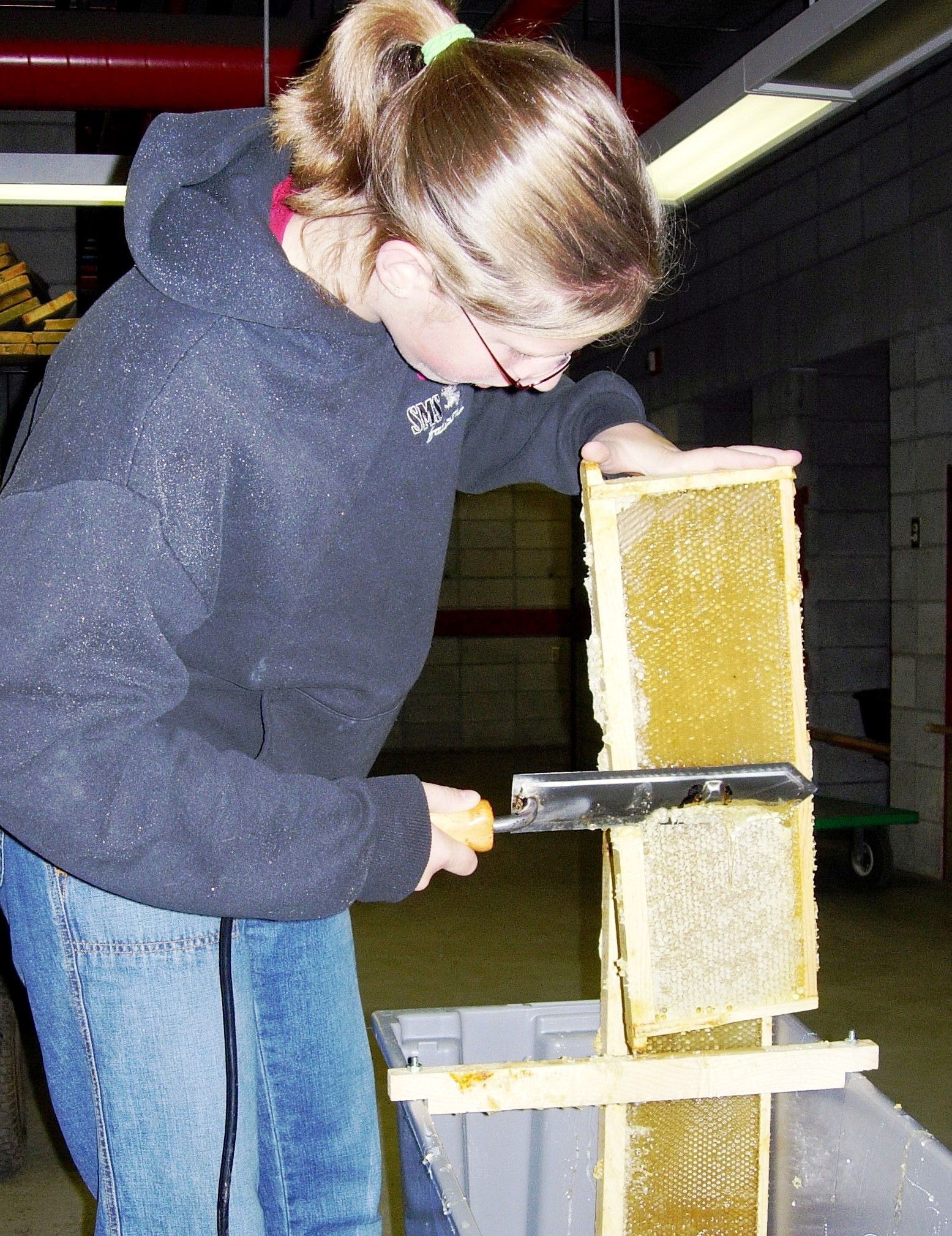
Comb honey is sold capped, either as cut portion of the frame (cut comb) or produced in sections, such as basswood boxes, “Ross Rounds”, or other commercially available comb honey systems. Comb honey is the purest form of honey and is wonderful on warm biscuits or toast. With comb honey you can offer a high dollar value product without the expense of owning extraction equipment. Comb honey is very popular at farmers market and craft fairs and is an excellent conversation starter.
Chunk honey is a combination of a small piece of comb honey placed in a jar and then filled with extracted honey. It is an old-fashioned product and is usually offered in an attractive, clear glass jar.
Creamed honey is crystallized honey, where the process is controlled and results in a fine textured, spreadable honey. Seed batch cream honey (somewhat akin to sourdough starter) is blended with pasteurized liquid honey and stored in a cool location for a few weeks. Creamed honey is common in Europe, and is gaining popularity in North America. Dried fruit powders may be added during the blending process to create fruit-flavored creamed honey.
Honey prices vary regionally and seasonally. Both Bee Culture and the American Bee Journal magazines print monthly price surveys for wholesale and retail honey products. Honey is sold by the pound in containers ranging from honey bears to five-pound jugs. Guidelines for honey labels can be found on the National Honey Board’s website (www.honey.com). Many beekeeping supply firms offer a label printing service.
The Backyard Beekeeper’s Honey Handbook by Kim Flottum (Quarry Books, 2009) will guide you through honey production and processing. Flottum’s emphasis is on artisan or varietal honeys, and it has excellent sections on honey plants and the nectar they produce, how to extract and bottle honey without altering the flavor and aroma, and marketing tips. High quality photography and recipes are an added bonus.
Beeswax
The wax cappings left over from producing extracted honey may be processed to separate the wax from honey and other debris. Gentle heating of the cappings in a double boiler will cause the wax to melt and rise to top. This wax is excellent for candle making or the production of lip balm, skin care products or soaps. There are many good books with recipes for balms and creams. Roxanne Quimby, the founder of Burt’s Bees, got her start by making lip balm and hand salve with wax from her hives and recipes from turn of the century issues of the American Bee Journal. Kits for getting started in these products are available from the beekeeping supply houses. The beeswax yield per colony is very small, as the bees are amazingly efficient at making the thinnest possible wax cap. We got enough wax for two candles out of our first wax harvest!
Health care products
Pollen, propolis, royal jelly, and venom are secondary products from the hive. Establish a relationship with a health food store before jumping into any of these products, as the market is small and volatile. Pollen is collected from pollen traps placed on your hives. These traps strip pollen from the pollen baskets on the bees’ rear legs as they enter the hive. Care must be taken not to over harvest pollen as you are robbing the colony of its protein source. Fresh pollen is highly perishable and must be dried or frozen to prevent spoilage.
Propolis is a compound the bees fabricate from tree resins, and is used in the hive to seal cracks. Propolis can be collected by inserting a propolis trap in the hive, allowing the bees to cover it in propolis. The trap is removed, placed in a freezer to harden the propolis, easing its removal from the trap. It has antibiotic properties and is used in natural remedies.
Royal jelly is the high octane feed for larval bees that is reported to have medicinal properties. There are specialized management techniques the beekeeper may employ to maximize royal jelly production. Collection is a time-consuming process and that effort is reflected in the high price of royal jelly.
Apitherapy involves the use of bee venom or live bees to administer stings to afflicted joints or body parts. Do not be surprised if approached at your farmers market stand by folks wanting to buy a few bees from you so that they can administer stings for relief from a wide variety of illnesses. Consult the American Apitherapy Association (www.apitherapy.org) for more information on the medicinal uses of hive products.
Queen bees and nucleus colonies
Beekeeping is gaining in popularity and there is a need for more suppliers of queen bees and starter nucleus (nucs) colonies. A common swarm management tool is to make nucs from overpopulated colonies. These new colonies can be used to increase your production or sold to other beekeepers. Locally adapted queen bees — reared from colonies that are gentle, good honey producers and disease resistant — are in high demand. This is a more advanced beekeeping technique, but one to keep in mind if you enjoy dabbling in genetics. Amazingly, just as in cattle, there are practitioners of artificial insemination of queen honey bees. That’s a skill that takes keen eyesight and a steady hand!
Even if becoming a beekeeper doesn’t fit in your farm plans, I hope you have a greater appreciation for honey bees and the folks who keep them. At a minimum, make a little space on your farm for a beekeeper to place a hive or two, and enjoy watching these fascinating insects at work.
David, Sara and Carol Baumbauer have been keeping bees in Bozeman, Montana, for the past five years. When not tending bees, Baumbauer manages the Plant Growth Center at Montana State University. He can be reached at beekeeping@montana.edu.
Copyright Growing For Market Magazine.
All rights reserved. No portion of this article may be copied
in any manner for use other than by the subscriber without
permission from the publisher.