










A pallet fork, or 3-point-mounted fork, is a simple, relatively inexpensive implement for the back of the tractor that cansave time— and backs — in a number of ways. Pallet forks essentially turn your tractor into a very limited forklift, allowing you to use the tractor’s hydraulics to lift pallets, bins, or whatever you need to move that weighs too much for a couple of people but can fit onto the forks. A basic 3-point model costs somewhere in the $500 range depending on the quality and load capacity. There are also versions that clamp, or mount in other ways, to bucket loaders or loader arms, and these can be just as useful, even more so in some cases. I’ll talk here about how to use forks for moving t-posts and also make a few general comments on them. Then, in a second article next month I’ll detail a few of those that are specifically related to moving harvests around.
Forks and posts
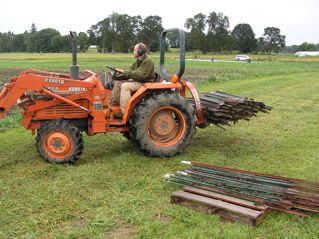
One of the primary uses for the forks around farms I’ve worked on is moving t-posts used for trellising. These posts are heavy and every year we put up hundreds of posts for tomatoes, cucumbers and other crops. Then we take them down again at the end of the season. To make this job easier when we’re done with posts at the end of the year they get carefully stacked on used pallets in the field. The crew distributes the needed number of empty pallets into the field so that posts don’t have to be carried far. The tractor then picks up the pallets with the forks and shuttles them to the yard for the winter.
For our 30 hp tractor, the 3-point will lift about 1,500 pounds. Different makes of forks have different load limits. At about 10 pounds per t-post, we can fit about 100 on a pallet after we take into account the weight of the forks themselves, the pallet, and leaving a little extra wiggle room. Having an even number on each pallet also helps when pulling them back into the field and estimating how many pallets need to go to a particular location.
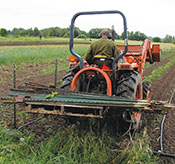
If you’re a very careful tractor driver, you can use the forks to help put up the posts as well. We pile the posts toward the tractor end of the pallet, leaving a platform for a person to stand on at the back of the pallet. The tractor drives over the crop, stopping every six to eight feet to set a post. A second person walks behind the tractor, pulling posts off the pallet and setting them for the person standing elevated on the pallet with a post pounder. This requires three people, but means no manual hauling posts into the field, and a convenient platform to pound the posts from. The tractor driver has to drive very slowly, and start and stop very smoothly so as not to throw the person standing on the pallet but this is relatively easy in a low gear. Clear communication between the driver and the post setters is key to safety and efficiency here, especially with everyone wearing hearing protection. A well-coordinated team can set posts very quickly and ergonomically, as many as 100 per hour. To see a short video on the process, visit my web site: http://www.slowhandfarm.com/settingposts.MOV
Why not just use a forklift?
On the small farms I’ve worked on, a forklift is too big an investment. Forklifts are generally much heavier than tractors, and not as capable of driving off road, not to mention they don’t have the clearance to drive over crops, so having forks on the tractor, even if you have a forklift, is a good idea for moving pallets or bins into and out of the fields.
That said, there are a lot of things the tractor forks won’t do and limitations you should consider when using them. 3-point mounted forks will lift only a few feet off the ground, so stacking high is not an option, nor is unloading most trucks. Bucket-mounted forks can lift higher, but they sometimes don’t have the same load capacity as the 3-point versions. It can also be very difficult to see where the forks are with bucket loader mounted forks. A “top and tilt” hydraulic adjustment on your 3-point is helpful in lining up the forks and adjusting loads. “Top and tilt” hydraulics let you adjust the top link length and the level between the bottom links from the tractor seat.
You also can buy forklift attachments for tractors. Some of these have special mounts, some mount on the 3 point. Depending on the size of your tractor and the size of the forklift attachment, these will lift a large load, and lift it high, just like a forklift, only with the off-road capability of a tractor. Forklift attachments are much more expensive than simple pallet forks and they also require hydraulic remotes on the tractor.
Safety considerations
Be careful when driving with heavy loads on the forks, especially if they’re unstable or you’re driving on bumpy, sloped ground, and tighten up your sway bar to keep the load from swinging. It’s also easy to overload front wheels and flatten tires by overloading bucket mounted forks. In general, drive very slowly when moving heavy loads. Going over a big bump with 1500 pounds of vegetables or posts on the back that aren’t tied down is the kind of excitement you probably don’t need.
Josh Volk, a regular contributor to GFM on tools and equipment, farms and writes at the edge of Portland, Oregon. He also helps farmers around the country improve their farming systems. Visit www.slowhandfarm.com
Copyright Growing For Market Magazine.
All rights reserved. No portion of this article may be copied
in any manner for use other than by the subscriber without
permission from the publisher.