











When I asked cut flower growers to write me about their most profitable crop (in our October email contest), I got some surprising answers: dahlias, spuria iris, sedum, and gomphrena. Granted, I did tell people not to write me about zinnias, because they are the top money-maker on most flower farms, and everyone knows how to grow them. And several people confessed that sunflowers are actually their most profitable, but they correctly guessed that I didn’t want to hear about those, either. But I didn’t expect to see gomphrena mentioned. And sedums? Who would have thought?
Interestingly, our correspondents all measured profitability in terms of how little labor is required to grow these plants. Smart! But I’ll let them tell you all about it.
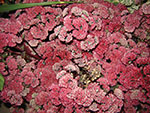
Diane Szukovathy, Mount Vernon, WA
Our favorite perennial star for 2009 was sedum. We planted a 2’ wide x 160’ long bed from plugs and 4-inch pots in spring of 2007 and harvested for the first time this year. Six of the eight varieties we planted have turned out to be fabulous and profitable cuts. They can be harvested at many stages from tight bud to open flower and keep for weeks in the cooler. While many perennials will sell well for a few weeks then taper off as florists/customers look for the next new thing, sedum sales stayed steady for months. The season of harvest for us was eight weeks with an additional two weeks of sales from stored stems extending through September and into October, our peak sales time. Sedums pretty much grow themselves, requiring good drainage, minimal irrigation and are reliably hardy well below our zone 6b. We mulch once a year with pea hay and do not fertilize at all. They do require netting to get good, straight stems. This year we sold 199 five-stem bunches at $4 each and additionally used approximately 132 bunches in mixed bouquets. Not counting the two varieties we didn’t harvest, that’s $1,324 or $5.52/sq. ft. of revenue. We expect to harvest from this bed for another three years with very minimal inputs.
Varieties we love for cut sales:
Sedum spectabile ‘Autumn Fire’
S. spectabile ‘Autumn Joy’
S. spectabile ‘’Frosty Morn’
S. ‘Green Expectations’
S. ‘Matrona’
S. telephium ‘Red Cauli’
Varieties we love but couldn’t harvest for cuts:
S. ‘Mohrchen’ — short stems, not productive
S. spectabile ‘Neon’ — sizzling pink bloom, but too short
David Kulp, Ashfield, MA
Probably my most surprising success has been gomphrena (globe amaranth), specifically ‘Carmine’. I have foundgomphrena to be surprisingly robust — I grow it thickly in flats and don’t bother pricking out the seedlings into cells, but rather transfer them directly to the field. When they bloom for me in mid-summer I have 18-inch or longer stems that last for almost two months and do well even after frosts. I’m surprised at how well it sells both at market and wholesale. I sell by the stem at market, as I make bouquets on the spot. Most flowers that aren’t showy rarely sell except in bouquets, but my customers will often grab large handfuls of just gomphrena. Vase life is excellent, and some of my customers have returned the following week to say that their gomphrena is still looking great so they won’t be buying more flowers from me!
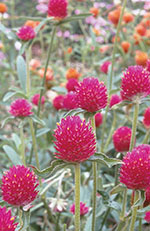
On the wholesale side, I was also surprised to find that the florist I sell to was thrilled with ‘Carmine’; she fawns over it almost weekly. On the other hand, florist and most retail customers aren’t very excited by other varieties like ‘Bicolor rose’ or ‘Strawberry Fields’. ‘Carmine’ has a much better growth habit than other varieties for me — branching just at the base and having lovely thin leaves making it easy to harvest and for arrangements. My only trouble is that the leaves on all varieties tend to age even while the flower continues to improve, but my customers don’t seem to mind much.
OK, gomphrena isn’t my most profitable (that would be sunflowers, hands down), but it’s easy and a surprising success.
Deb Jackson, Valley Center, KS
One of the flowers we grow that seems to have a lot of potential is spuria iris. Spuria iris are grown from a rhizome like bearded iris but look more like a Dutch iris in form. They don’t need to be divided nearly as often as bearded iris, are very drought tolerant, and require very little care. We got our original starts (a yellow variety) from a relative, kept dividing them, then traded some of the yellow for a light blue variety. We also purchased some deep purple and some maroon rhizomes.
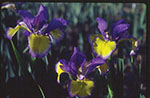
We’ve sold the iris at farmers market in mixed bouquets. They bloom at the same time as our peonies, Bells of Ireland and larkspur. And we sell them by the stem for 60 cents to $1 each. Customers love them, as they are tall (30″ or more) and very elegant. Their foliage can even be used as a spiky accent in arrangements. We just started offering them to some local florists this year, and they seem to like them — none of the florists had ever heard of spurias, so it’s been a matter of educating them. We sold them in 10-stem bunches for $6, and hope to move a lot more to florists next year.
Our iris are planted in beds at the edges of the field, and once well-established (two to three years) have produced well. I lost count, but would estimate we cut around 800 stems this year from three 2′ x 50′ beds. We don’t have to irrigate the beds, only fertilize every other year, and the only maintenance is cutting back the foliage in late winter/early spring. Once established, the plants form a thick enough mat that very little weeding is necessary within the row. The iris are easy to cut; even new help can cut them at the proper stage (pencil stage), and they store several weeks in the cooler if cut tight. There is also not a lot of bending over in order to harvest, since the flowers are so tall — something we really like the older our bodies get!
For our operation, since we hire very little, if any help, time is a very valuable commodity. When we determine which flowers are profitable enough to keep growing, the amount of time involved is a big factor to consider. The spuria have really fit the bill.
(Editor’s note: The nursery where Deb originally purchased hers appears to be out of business. For other suppliers, see the links on the Spuria Iris Society’s website, www.spuriairis.com.)
Kate Swift, Cedar Farm Wholesale, Ghent, NY
I would have to say that dahlias are probably my most profitable cut with approximately $8,000 in wholesale sales and farmers market revenue. I grow two double rows in a 95-foot unheated single poly hoophouse. Even though I farm in zone 5/6, I leave them in the ground under row cover all winter and only dig them up if I’m culling or dividing tubers. This saves a tremendous amount of labor costs (and aching muscles). They are not exactly maintenance free, but this year I lined the hoop house with netting to keep the Japanese beetles at bay and it worked like a charm.
Second most profitable cut flower is peonies at $6,500. Again, low maintenance wins the game. I have seven double rows at 60 feet each with 2-foot spacing. Spring 2009 was only their third year, so I will expect even more in 2010. I fertilize with soybean meal and lime in the fall after all foliage is cut back and removed. Since I have a large cooler to store the cut buds in, I can hold the harvest for weeks. Picking can get a little frantic, as they need to be picked at the proper stage. That means twice a day no matter what the weather!
Ahhhh, and then there’s sunflowers … dollars on a stick.
Emily Watson, Stems Cut Flowers, Milwaukee, WI
My most profitable flowers are the Karma dahlias. The colors that sell the best for me are ‘Naomi’ (that is my number 1,excellent color and quality) as well as ‘Bon Bini’ and ‘Corona’ (both very eye catching at the farmers market.) I sell at farmers markets, and I charge $2 each or $5 for three. Many people find them so striking that they will buy one when they had intentions of buying nothing. I also sell to florists at $7.50 for 5 stems. I have two florists who will take all that I have with me regardless of stem length or color. Not being a very good bookkeeper, I do not know the exact amount but I estimate that 20-25% of my total sales are due to these little beauties.
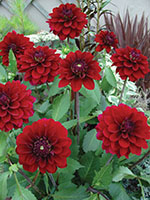
As for how I grow them: I pinch them after about three to five leaf pairs show and stake them when they start to get tall. They bloom some during the summer, then in August they get eaten by bugs, but by September I can’t keep up with all the flowers. I cut into plain water and they usually last a week or longer.
These growers will each receive a copy of The Organic Farmer’s Business Handbook by Richard Wiswall, which was just published by Chelsea Green. To sign up for Growing for Market’s email update, go to www.growingformarket.com and scroll down the right-hand column to “Free E-mail Newsletter.”
Copyright Growing For Market Magazine.
All rights reserved. No portion of this article may be copied
in any manner for use other than by the subscriber without
permission from the publisher.