











Of all the flowers we grow on our little farm, sweet peas are my all-time favorite. I have never seen a flower have such a strong impact on the recipient as these exquisite blooms. Tears, joy, nostalgia; no matter how tense, cold or brittle a person, sweet peas always cut through and touch the heart. Sweet peas are often requested by brides, coveted by designers, and recognized by even the most unaware floral consumer. Something about these beauties is pure magic.
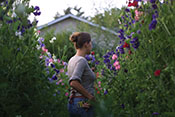
When we left our city cottage and moved to the country, the first flowers I grew in my new garden were sweet peas. My great-grandmother had always grown them and in the long hot summer days of my childhood it was my job to cut bouquets and arrange them by her bedside. When she passed away it only seemed fitting to plant a row in her memory. There hasn’t been a year since that my garden hasn’t had a little patch of them blooming somewhere.
When I started growing flowers commercially, sweet peas were at the top of my list. Actually, my very first paying floral delivery consisted of mason jars filled with handfuls of them. The receiver cried when I delivered them. It was amazing!

But over the years I have had mixed results with my crops. Some years I’ve had stunning crops and others the vines only grew 3 feet tall and produced inferior short-stemmed blooms that were plagued by disease and aphids. I could never figure out what the secret was to getting a consistently high-quality crop outdoors. My hoophouse vines yielded the best crop of all — long strong stems, enormous plants (many touching the 10 ft. ceilings) and perfect flowers.
Last spring one of my biggest clients requested that I grow Sweet Peas since they were a fast seller in their stores. We would need volume to satisfy the demand and needed to figure out how to bring this many to market . By the time I had gotten their request I had already filled my hoophouse with other spring treasures and there wasn’t enough room to load it with peas. So I scoured the ASCFG Bulletin Board, every article I could find, looking for the magic recipe for growing top-quality flowers in the field. But there really wasn’t anything solid to be found. Finally, I stumbled upon a small pamphlet written in 1900 by George J. Ball called Better Sweet Peas. It was the ticket! It was loaded with very useful, low-input ideas on how to produce sweet peas for the local market. The operations of the early 1900s are similar to mine and I took notes feverishly.
So as spring approached I selected my varieties, sowed the seed in late January (2 seeds per 4” pot) and set about prepping the site.
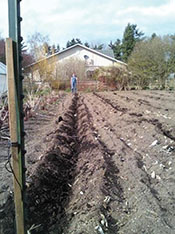
First we applied a large dose of lime to bring the soil ph into a neutral range. Then each bed was amended with rock phosphate and bone meal to help promote strong root growth. Mr. Ball declared that “getting the plants deep rooted before warm weather drives up growth is the secret to long-stemmed outdoor peas.” Next we ran a trench down the center of each bed with our walk-behind tiller. This was filled with very strong rotted cow manure and then covered, the idea being that once the peas sent their roots down there would be a feast waiting below. Then we set our T-posts 10 feet apart down the rows, and top-dressed each bed with more rotted manure and 3 to 4 inches of compost. At the time, all of this prep seemed a bit overkill but we crossed our fingers and hoped it would pay off in the end.
While the seedlings grew in the warm greenhouse we let the soil mellow for a few weeks and got the rest of the siteready. Each bed received three lines of drip tape, one down the center and two nearer the edge. Mr. Ball stressed in his book that consistent, adequate water was a huge factor in the success of the crop. He wrote, “if your ground becomes too dry between watering, the plants harden, and if hot weather follows no amount of water will revive them.” He also concluded that when the plants hardened they began to throw much shorter stems which signaled the end of a crop.
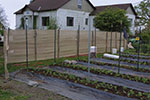
We attached Tenax netting vertically to the T-posts using zip ties. In the future, we will space the posts closer than 10 feet, even as close as 6 feet, because of the weight of healthy vines. We also will use 8-foot-tall posts since our vines reached the top in no time. We covered the paths between beds with landscape fabric to help with weed suppression and create a visually appealing patch.
The last thing we did before setting out plants was erect a wind barrier. Our goal was to mimic the conditions of the hoophouse as closely as possible. To do this we set a line of wooden posts about 6 feet apart to the south of our rows. We then attached a double row of burlap, creating a 6-foot tall wall to filter wind. With our hoophouse running the length of the patch on one side and the wall wrapping around the other two sides, we essentially created a micro-climate that was nearly 10 degrees warmer and almost wind-free.
Seedlings were set out in late March/early April and mulched with composted cow manure/wood shavings from a local dairy. I would not recommend this type of mulch since it was too woody and robbed the plants of nitrogen the first few weeks as it mellowed. In the future I will use rotted straw or pea hay. To combat the negative, almost deadly effects of the bad mulch, we set about immediately applying a strong dose of compost tea with fish twice a week while the plants recovered. Another thing I hadn’t anticipated was the hungry spring robins. They would follow behind me while I was planting and pull the seedlings out of the ground, nibble away the seeds and leave them to die on top of the soil. We raced around frantically covering the newly planted crop with scraps of row cover to protect them as they got rooted. The birds were tenacious and any gap in the covering was pulled back and they feasted on the tiny babies. So we had to anchor the row cover with buckets, boards and rocks. But it only took about two weeks until the plants were rooted well enough to hold their own against the robins. But what a pain to pull the row cover, apply tea and re-cover before the hungry flock could get them. We will hopefully find a better solution to the problem this spring!
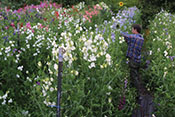
After the row cover was removed, we continued to apply compost tea with fish and kelp weekly. We also ran the drip twice a week to ensure good moisture throughout the beds. As the vines exploded into lush growth, keeping them tied to the netting was a huge issue. We went through weekly with bailing twine and added support for the heavy vines. If we missed tying them by even a day and a heavy rain came, vines tumbled into the paths. What a mess! So after a few evenings spent readjusting plants and doing damage control, we vowed to drop everything and tie vines before this happened again. Healthy vines grow over a foot a week, so be sure to keep that in mind!
We had our first flowers in late May and cut twice a week to keep ahead of the vigorous plants. The crop was amazing! Our average stem length was 14 to 18 inches with consistently high-quality blooms. In order to have a nice staggered harvest, I selected varieties with varying day length/bloom time requirements. ‘Winter Elegance’ and ‘Winter Sunshine’ were first, followed by the ‘Mammoth’ series and ending with the Spencers. I have grown many, many different varieties over the years and trialed nearly all of the ones recommended for higher heat blooming. Spencers are really the only way to go for high summer temps while still producing long stems with good fragrance. These are the varieties grown exclusively in England for competition. Two wonderful sources for seed are Fragrant Garden Nursery in Brookings, Oregon (www.fragrantgarden.com) and Gloeckner. Last year Gloeckner started carrying a range of Spencers called ‘Summer Sunshine’ that is sourced from the English breeder Owl Acres Sweet Peas. Be sure to visit Fragrant Garden’s site for a real treat. Pat Sherman, the owner, has gone to great lengths to provide beautiful photos and helpful descriptions of each variety she offers. I can never get out of there without spending a fortune!
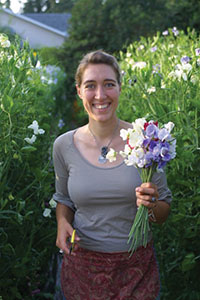
I sold my first bunches in late May and my last on July 16 (6-7 weeks). I sold these primarily to my wholesale customers, fetching $3-3.50 for a 15-stem bunch. From six rows, each 60 feet long, I made roughly $1,700. I could have easily continued sales through the end of July but the vines grew so large that they took down their support fencing, leaving an enormous mess in their wake. Note to self: Use taller posts!
It is my sincere hope that this information will aid other growers in producing a sensational crop and generous revenue stream, and also that the magic of these beauties will open hearts and wallets everywhere!
Erin Benzakein runs Floret, a small organic flower farm in Washington state. www.floretflowers.com.
Copyright Growing For Market Magazine.
All rights reserved. No portion of this article may be copied
in any manner for use other than by the subscriber without
permission from the publisher.