











Winter squash is a rewarding crop, providing high yields for little work. It offers big results for CSAs with fall or winter shares, late-season farmers markets, or those growing for food banks, schools, and other institutions. Stored winter squash also comes in handy to supplement early spring offerings. Squash blossoms can be a profitable side crop for restaurant sales.
Varieties
Pumpkins are squashes, even though we sometimes call them as if they were a different vegetable or fruit. There are four main types of squash, and some hybrid crosses. Suzanne Ashworth’s book Seed to Seed has excellent descriptions and long lists of varieties for each type.

The Pepo squash species (Cucurbita pepo) includes summer squash, zucchini, pattypans, acorn squash, delicata, dumplings, spaghetti squash, and New England Pie, Luxury Pie and Connecticut Field Pumpkins. Pepo squash are fast maturing, non-storing (beyond a few months), and mild flavored. They have prickly leaves and stems. They are susceptible to vine borers. Southern Exposure Seed Exchange suggests people plagued by borers plant luffas or Tromboncino (Moschata) and eat these at the immature stage, as an alternative to regular Pepo summer squash and zucchini. Pepos have hard, five-sided stems, and the fruits are often ribbed.
The Maxima squash species (C. maxima) includes many large squash, some of which will store quite well, from a few months up to a year. Flesh is fine textured and good flavored. Maxima plants have soft, round stems and huge hairy leaves. Fruits have thick round stems. This group includes buttercups/kabochas, hubbards, bananas, the Big Max extra-large pumpkin, Jarrahdale, Candy Roaster, Galeux d’Eysines and Rouge Vif d’Etampes. Maxima plants are very susceptible to wilts, borers and squash bug damage. We have found Jarrahdale to have relatively high resistance to squash bugs compared to others in this group. It and a hybrid Kabocha, Cha-Cha, are the only Maximas we grow.
The Moschata species provide the best keepers. They usually have bright orange flesh, which is sweet and tasty. Plants have large hairy leaves, and fruits have flared angular stems. This species is the one to focus on if you want trouble-free squash, with no damage from borers and cucumber beetles. The tougher stems are more able to repel invaders. They need warm growing temperatures above 60ºF. Butternuts and similar tan-colored squash, such as Seminole, Cheese, and the Tahitian Butternut and Lunga di Napoli are in this group.
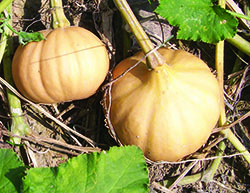
The fourth species, Argyrosperma, or Mixta, includes many old-time varieties from the south. Flesh is often yellow rather than orange, and these squash are often cooked with sweeteners. Plants are rampant; leaves are large and hairy. Fruit stems are slightly flared, slightly angular, and hairy. This group has the best drought-resistance and also good resistance to borers and beetles. Cushaws are Mixta species.
Crop requirements
Squash plants are tender, not at all frost hardy as young plants. Mature vines, however, can take one or two frosts. Squash needs warm days and nights to grow well, with full sun, and well-drained, generously fertilized soil. They take a lot of space, which could be problematic if the vines overrun a smaller crop next door. Some can take 90-120 days to reach maturity, so plan carefully to be sure of getting a harvest before fall frosts.
Squash needs at least an inch (2.5cm) of water per week, in the main season. “A rapidly growing pumpkin plant has been reported to use up to 150 gallons of water per hour on a hot sunny afternoon,” says Missouri grower Steve Salt. They do have deep roots, so you can get away with irregular watering. Also, I understand that if you need to dryland farm them, without irrigation, it is important not to move the vines to new positions: the dew and rain drips from the leaf edges encourage root growth, and so the roots tend to grow below the vines, where they get the most water (and shade). Long vining types have more stress tolerance than bush types, because they grow extra roots at the stem nodes (if not on plastic mulch). The critical period for water is the first 30-35 days of fruit development. Feedback on your lack of watering during this period will be found when the stems shrivel early in storage.
Bees are important for pollination: any of honeybees, bumblebees or the native Squash Bee will do the job. Insufficient pollination leads to fewer and smaller fruit, with more irregular shapes.
Sowing
Soil should be at least 60°F, and all danger of frost should be past. Optimum germination temperature is 86°F but don’t wait for that, unless you have extremely long growing seasons. At our farm in Virginia, we sow on May 25 and get plenty of squash before the end of October. Fast-maturing Halloween pumpkins can be sown in late June in our area, following an earlier crop, such as strawberries. Sow 0.5-1” deep. Either “station sow” 2 or 3 seeds at the desired final spacing, or make a drill and sow seeds 6” apart and thin later. Rows will need to be 6’ apart or more. Some growers plant in a square pattern so that spaces between rows can be mechanically cultivated in both directions. There are various stick planters and jab planters that can be used for this kind of station sowing.
Bush varieties take less space than the vining types, and rows can be 4’ apart. The vining ones can need 9’ or more between rows.
One version of the traditional Three Sisters planting has a vining winter squash plant in the center of a circle of 8 field corn plants which are 6’from the squash and 1’ apart from each other. Outside this circle, each corn plant has two climbing beans planted nearby.
No-till planting is an option with squash, if you have grown a suitable winter cover crop, which can be killed by mowing or rolling. Information is available from ATTRA.
Transplanting
Usually, winter squash are direct seeded, which is part of what makes them so easy, but if you get a horribly wet season, preventing timely soil cultivation, or your growing season is short, or your rotation very tight, it’s good to know you can get very satisfactory results from transplants. Just start the seeds in cell packs or soil blocks a week or so earlier than you would direct sow (to allow time for recovery from transplant shock). Snip off extra seedlings to leave one strong one in each cell. Cucurbits don’t transplant well from open flats, as their recovery from root damage is poor. If your decision to transplant is a last-minute change of plan, take a look at the days to maturity of the varieties you planned, and switch out the slow maturing ones, which might not make it in time in your shortened season.
Row cover can be used to protect young plants from unsuitable weather, and from pests. If possible, use hoops, as cucurbit leaves are easily damaged by abrasion.
Cultivation
At first, squash plants grow slowly, and you will have time to cultivate between the rows, or even plant a fast cover crop, such as buckwheat or mustard. One day, the vining types will decide to start running, and you’ll need to be ready with clear space for them to cover. An alternative is to undersow with crimson clover before vining. If necessary, fold the vines over to one side to cultivate and sow, then fold them back over the other side to deal with the next aisle. Cucurbits don’t like to have the vines turned upside down, so be sure to restore order before leaving the field. We tried this undersowing scheme in central Virginia and it was a hopeless failure, as the vines grew rampantly and smothered any clover seedlings that were emerging.
After vining, the only weeding possible is to wade in and hand weed. Tall rubber boots (or at least long pants) are best worn for this job, as the leaves are scratchy. Pull the weeds if your soil allows, or else clip them with pruners to prevent seeding.
Hoe and thin the squash to 18” apart for the smaller bush varieties, and 24” for the vining types. Some people like to use organic mulch, but this should not be applied until the soil is warm or growth will be slowed.
Rotations
Our winter squash follows the previous year’s white potatoes and a winter cover crop of rye with crimson clover and/or winter peas. (We need to sow crimson clover by Sept. 20, winter peas by Oct. 31.) The clover can supply all the nitrogen the squash needs. Winter peas don’t provide as much nitrogen as clover, so we might supplement with some compost when we use peas.
The squash get a bit of extra growing space late in the season by over-running a finished bed of strawberries which we till in after harvest. We finish up our winter squash by Halloween, and sow rye and winter peas again. The following year, that patch is used for sweet potatoes and our last planting of sweet corn. These late sowings give the peas plenty of time to reach flowering and produce nitrogen in the root nodules.
Pests and diseases
Striped cucumber beetles cause direct feeding damage to the leaves and skins of the fruits. They also vector Bacterial Wilt. Row cover can be used until flowering to reduce damage, but then the plants must be uncovered for pollination. This year we are trying the sticky traps with pheromone lures. Fall cultivation, if done while the beetles are still active, can kill as many as 40 percent of them.
Squash bugs can do a lot of direct damage to leaves, and they also vector yellow vine disease. Plants attacked by squash bugs look baked to a crisp, with curled, bronzed leaves. This pest can be killed with pyrethrum or sabadilla, if your certification doesn’t ban these botanical pesticides. Destroy the gold eggs on underside of leaves; trap the bugs overnight under boards. Moschata varieties are the best ones for areas with high levels of squash bugs.
Squash vine borer is a large caterpillar that chews into the main stems. They appear when the vines start to run. One approach is to pinch the tips when vines are 1-2’ long, causing multiple vines to grow, increasing the chance of some escaping damage. Some growers mix wood ash or charcoal with the seed when sowing, but I haven’t tried this, as we are lucky enough not to have borers. Another approach is to make a collar of aluminum foil for each stem. There are pheromone lures for this pest too. If your plants do get attacked, cut the damaged stem and remove each larva. Or inject BT using a syringe. Pile soil over the damaged stem after treatment, so that new roots can grow.
Powdery mildew occurs during hot, dry periods, never below 50°F. PM-tolerant varieties get as much PM on their leaves as non-tolerant ones, but the plant survives the attack. Research in Pennsylvania showed no relationship between mildew tolerance or resistance and yield. Downy mildew occurs in cool, damp weather. Leaves become black or purplish and die to a crisp. If the weather dries up and gets warmer, your plants can recover.
Bacterial wilt and Gummy Stem Blight (Black Rot), which appears as sunken black spots on the fruit once they are in storage, can also be problems.
Having a healthy canopy of foliage maximizes photosynthesis, which in turn increases the sugars in the squash.
Harvest
We start harvesting the quicker squash varieties in early September. It would be possible to grow more of the acorn and delicata squash types here and start harvesting in August, but we’ve decided that August is too busy already, and some crops are better appreciated later!
Not all the squash will be ripe at the same time, but they come to no harm sitting in the field (provided there is neither frost nor groundhogs). We harvest just once a week, using pruners. I tell the crew about three times never to set the pruners on the ground, and also describe the signs of ripeness of the different types, and then we line up like a search party and cross the patch with a 6-8’ lane each. We use 5-gallon buckets for the smaller squash, and separate the “Use First” squash from the storing squash as we go. The larger squash we carry individually to the edge of the patch. We usually designate a garden cart of a particular color to be the one for the Use First squash. We bring the truck alongside and load up the buckets and the big squash. Harvesters need to be reminded to handle squash as if they were eggs, not footballs. Bruising leads to rot in storage.
Back in the September 2000 Growing For Market, Chris Blanchard wrote on squash harvesting. The first rule is to leave the squash on the vine as long as possible. Once the vine is dead, the squash will not get bigger, but it can ripen, change color, and convert starches to sugars, resulting in better flavor. With jack-o’-lantern pumpkins, the stems harden 20-35 days after fruit set, and full color is reached 45-50 days after fruit set. If the vine dies before the pumpkin is fully mature, the fruit will collapse. In general, squash are fully mature and storable when the skin cannot be pierced by fingernails, but using this criterion to test each one would leave ugly scars and reduce shelf life
Pepo squash, when ripe, usually have an orange or earthy spot where they touch the ground. When the groundspot is the color of pumpkin pie filling after the cinnamon is stirred in, or else bright orange, the squash is ready. The stem will still be bright green. Wait till at least 45 days after pollination. Harvesting too early will disappoint: the squash will be watery and fibrous, without sweetness.
Maxima squash are ripe when at least 75 percent of the stem looks dry and corky (tan, pocked, wrinkled). These are the varieties with thick round stems, as opposed to the angular stems of the other species.
Moschata squash are ready when the skin is an even tan peanut-butter color, with no pale streaks or blotches. These squash also have angular stems, but unlike the stems of pepo squashes, moschata stems flare out where they join the fruit. Many have green lines radiating down the squash from the edges of the stem. In some varieties, these green lines disappear when the squash is ripe, but not in all kinds. If in doubt, cook one and see. Or try a slice raw.
We cut the squash with fairly long stems, which helps them store best. Those who need to pack squash in big crates might need to remove the stems so that they do not injure their neighboring squash. If you do this you need to cure the open ends (see below). Some growers wipe each squash with a piece of burlap, as they harvest, to remove potential rot organisms.
Our harvest period runs for two months, September and October. We used to harvest as late as possible in the fall, but now we prioritize getting a good cover crop established, to replenish and protect the soil, so we have a Grand Finale harvest just before Halloween, when we harvest all the large interesting almost-ripe squash, and give them away for lantern carving. Some go to the chickens too. Harvest before the fruits get frosted, which is shown by a water-soaked appearance of the skin.
Curing and storing
If needed, cure the squash by exposing the stemless ends to wind and sun (or fans and warmth indoors) for five to 10 days. Ideal conditions are 75-80 percent humidity and 80-85°F, although I think many farms use ambient temperatures very different from these ideals. Cover with row cover or tarps if frost threatens. Acorn squash do not need curing.We store our squash in a vermin-proof cage in a big basement, using large plastic crates or trays. Once a week, these are sorted through to remove anything nasty. Pancake turners are handy tools for sliding jelly-like squash into a compost bucket! Growers with larger-scale storage use pallet bins.
Store between 55-60°F. Temperatures below 50°F can cause chilling injury, which will reduce storage life. Squash need good air circulation, and 50-70 percent humidity. Never store squash together with potatoes or onions. Like most ripe fruit crops, squash “exhales” ethylene, which increases sprouting in roots and bulbs.
Acorn and buttercup squash will keep for a few months – they are best used before the end of the year. Moschata squash, such as butternuts, will keep until the next May. Seminole squash will keep as long as a year after harvest.
Season extension
If you have a short growing season, you might want to use row cover to get plants started, and again at the end of the season, to get beyond the first couple of fall frosts and buy some more ripening time. And, as mentioned, you can get a jump start by using transplants. Avoid the slow-maturing types, unless you want the challenge. Black plastic mulch helps speed growth considerably.
Seed saving
Crossing occurs easily between varieties of the same species, and rarely (but occasionally) across species. Check your seed catalog to be sure you are not planting more than one kind in the same group. Suzanne Ashworth’s Seed to Seed is an excellent resource. Isolate varieties of the same species by one eighth of a mile for home use, and at least 0.3 mile for commercial crops. It is possible to grow a pepo, a butternut, a kabocha and a cushaw and have pure seed from each. Hand-pollination is safest.
ATTRA has a very good publication, Organic Pumpkin and Winter Squash Production. www.attra.ncat.org/attra-pub/PDF/pumpkin.pdf.
Pam Dawling writes regularly for GFM about vegetable production. She is the garden manager at Twin Oaks Community in Virginia; the gardens produce all the fresh produce for 100 residents. She can be reached at pam@twinoaks.org.
Copyright Growing For Market Magazine.
All rights reserved. No portion of this article may be copied
in any manner for use other than by the subscriber without
permission from the publisher.