











Four years ago, I was working at Sauvie Island Organics just outside of Portland, Oregon. We were cultivating about 9acres of mixed vegetables for CSA and restaurant sales. Shari Raider, the farm owner, had started with less than an acre 11 years before and had slowly been building up production. She decided that in my last year at the farm we would concentrate on upgrading equipment and systems around the farm with the hope that we could identify some key savings in the long term and set the farm up for further growth. As part of the process, I took at trip down to California to visit some of the “big guys” down there and to see what they were using that might help us. I felt very fortunate to make connections with a number of excellent growers on that trip and to tour farms like Full Belly Farm (roughly 300 acres), River Dog Farm (also about 300 acres), Eatwell Farm (105 acres) and Fry Family Farm (70 acres) in southern Oregon, plus a number of smaller operations. One of the things that surprised me, and was fairly consistent, is that everyone was pretty much using the same kinds of equipment. Of course, the size of that equipment was bigger on the bigger farms, 30 hp tractors were replaced with 90-150 hp or more. There were all variety of makes, ages, and customized setups among different types of equipment, but generally the same pieces were there.
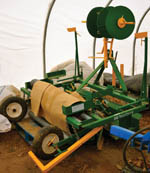
The step up into mechanization of diversified vegetable farms seems to happen in the 5-10 acre range. In the last few weeks, I have surveyed a number of growers here in the Northwest, down in California, and out in the Midwest and Northeast asking about their experiences in scaling up their production over the years. All of these farms started out small and over the years have grown, some significantly. Their generosity in sharing information was really wonderful and I wanted to share a few of the equipment recommendations that were passed on to me.
Mechanical cultivation
Adding a cultivating tractor to the mix seemed to be the most common step up for folks. Jamie Kitzrow from Spring Hill Organic Farm in Oregon said, “We were farming 5-8 acres for seven or eight years, not doing too well financially, and saw we needed to jump up to the next level to make more money, and take out some of the back-breaking manual labor at the same time if we were to keep farming. An Allis Chalmers-G tractor for seeding and cultivating gave us more uniform stands and reduced 75% of our hoeing labor. It took us two to three jumps to get to our current 35 acres in production. Without the added equipment and added acres I feel we would have burned out years ago and not be currently farming. We’re heading into our 21st year.”
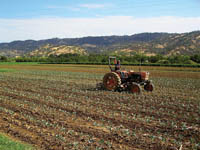
Benjamin Shute from Hearty Roots Farm in New York also put cultivating tractors at the top of his list, but warned that when he first bought one it took a few seasons to get it set up to work efficiently. During those years it was important to have enough labor to hoe and hand weed beds that weren’t cultivated as well as he would have liked. Hearty Roots has grown from 1/2 acre to 18 acres in the last seven years. To reduce mechanical cultivation requirements, they also purchased a plastic mulch layer. They were able to borrow one from a neighboring farm for a year before they decided that it was a worthwhile investment.
Transplanters and seeders
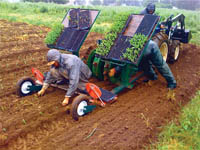
Anne Swartz of Blue Heron Farm in Washington has been growing berries, mixed vegetables, and nursery stock for the past 31 years. For a number of years her farm was 5-6 acres but they’re up to 10 acres now. She says, “A couple of years ago, I borrowed an older strawberry transplanter to speed up my brassica transplanting. It plants a double row, 24 inches apart and 16 inches in the row; of course, these old transplanters are very adjustable if you have access to all the wheels that come with them. Nothing new about any of this but it did speed up that part of my operation considerably.” When I talked to farmers in the Northeast, water wheel transplanters were frequently mentioned as key additions to their operations, saving time and effort.
Tractor mounter seeders were mentioned by a number of farmers as well. Martin Lemos from the Green Earth Institute in Illinois has been growing for eight years and currently farms 14 acres. “A real obvious machinery need, I would say, is a tractor-mounted seeder: we have a gang of Jang seeders and I’m happy with them.” Similarly, Pete Johnson from Pete’s Greens in Vermont says that adding a number of implements that attach to the 3-point of a tractor made a big difference and he highlights the Sutton seeder as one of the keys to his growth beyond 10 acres. Pete currently farms 50 acres of crops after building up the farm from 1/2 acre 13 years ago.
There isn’t consensus on this issue, though. John Tecklin from Mountain Bounty Farm in California says, “I still don’t think transplanters and fancy seeders are warranted at our scale.” John, who has been farming for 16 years, is growing on 12 acres after starting with a 1/2 acre. He does say that he’s looking for an old corn planter for his sweet corn successions, which are up to 1/2 acre now. His experience mirrors my own and points out that even at 10 acres, diverse plantings can create situations where the individual plantings are still small enough to make hand push seeders and hand transplanting more efficient. Jamie Kitzrow once mentioned to me that when they switched to mechanical transplanting they started to do fewer, but larger, plantings to take advantage of the equipment. That kind of rethinking of systems is necessary as the farm grows and moves to larger equipment.
Spreading and tillage
The issue of getting fields prepared in a timely way came up repeatedly. Part of this was spreading compost and other amendments quickly and precisely. John Tecklin says, “my little manure spreader is perfect for up to 4-5 acres (still a lot of work) but beyond that it’s almost impossible to do in a timely way.” Pete Johnson bought “a brand new manure spreader that never breaks in order to fertilize for timely plantings.” Read between the lines there; I believe he’s trying to tell you that equipment in poor condition can really slow things down at inopportune times. Jamie Kitzrow cited his Millcreek compost spreader as one of the tools that allowed him to farm more acres and to spread material more quickly and accurately. Jamie also mentioned that acquiring a second large tractor for primary tillage allows him to take advantage of narrow weather windows to get field prepped and planted quickly. Mowers, chisels or subsoilers, disks and tillers are all popular choices among the farmers I talked to for getting fields prepared quickly. John Tecklin also mentioned that he hires a friend who has much larger equipment to work up fields when he has a big section to take care of.
Materials handling
Out of the field, most of the growers mentioned that sizing up walk-in coolers and vegetable storage space was a part of growing the farm. Trucks were also a big topic, as almost all of the farms I talked to do their own deliveries, driving to markets and CSA drops. One of the differences I did notice with the larger farms in California when I made my trip four years ago was that as farms grow, palletizing loads and using pallet jacks, fork lifts, and loading docks makes a big difference in efficiently moving loads around the packing and storage areas. These require flat, smooth cement slabs for the most part, and they certainly save time and strain. Having the capability to quickly and easily move large objects around the barn and the farm makes a big difference in the way tasks are approached and how they fit into the day.
As the farm becomes more mechanized it’s important to not forget the people part and also that those people have to interact with the machinery. Elanor O’Brien from Persephone Farm in Oregon points out “it takes adequate staffing and management to be able to pursue new or adapted equipment, to tinker and work out the kinks so that it becomes something truly functional within the farm system. If the farmers who begin a venture do not have these design and tinkering skills, it is worth looking for someone to join the farm who does. To say nothing of maintenance and repairs!”
Josh Volk farms and writes at the edge of Portland, Oregon, and helps farmers around the country improve their systems. He can be reached through his website, www.slowhandfarm.com.
Copyright Growing For Market Magazine.
All rights reserved. No portion of this article may be copied
in any manner for use other than by the subscriber without
permission from the publisher.