











In 2009, our farmers’ market in Tulsa, Oklahoma, found itself facing an exciting but stressful problem: We had entirely outgrown our market space. The parking lot where we held our activities was filled to the brim with vendors and customers. We had a new vendor waiting list four pages long and no place to accommodate them. Many existing vendors wanted to expand their operations to two booths but had nowhere to go. The market’s Board of Directors had a decision to make. Either we stayed put and remained satisfied with the level of customers and vendors the old location could support, or we moved to a new spot.
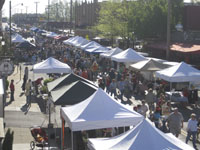
No business likes to uproot itself from an established site, and our market was no exception. After conducting a summer survey of vendors and customers, we found they were both just as averse to a change of place as was the Board. For its first 12 seasons, the market was housed in a restaurant parking lot on the corner of a busy intersection, yet within the charm of a neighborhood shopping community. No one wanted to give up the ambience of the cafés, local stores, and historic buildings or the convenience and visibility. Our very name, the Cherry Street Farmers’ Market, was tied to that place. Yet vendors and customers alike complained of cramped spaces and claustrophobic crowding.
The all-volunteer board, comprised of a mixture of vendors and market shoppers and supporters, divided itself up into committees to scout out possible locations for a move. We looked at the County Fair Grounds, a bank parking lot on the same street, several nearby parks, and even some abandoned warehouses. We needed electricity, ample parking, access to restrooms, and a low- or no-cost lease. Plenty of options combined several but not all of our criteria, and no place could replace the value of our established setting. Of course, convincing the City of Tulsa to build a permanent structure would be ideal, but that wasn’t a viable option during a recession.
So where was the market to go? To the street! If we could persuade the key stakeholders, closing down a two-block section of the street in front of our old parking lot sounded like the most practical plan. We could keep our name, our history, and our location.
Like many cities, Tulsa has a rigorous review process for all street closings. A special event application would need to be filled out for each of the market’s six months (April to October). Public transportation officials, traffic engineers, emergency responders, and many other entities would have to sign off, affirming that the street closing would not impede their services and duties. Eventually the application would go before the City Council to determine the broader impacts and community benefits.
But, like many ideas, proposing it was one thing; getting the area businesses, neighbors, and leaders on-board was another. We started our efforts by contacting the area merchants’ association. We immediately secured their approval, but unfortunately, not all of the stores were members. That meant hours of pounding the pavement and talking door-to-door with area businesses to share our concept, solicit feedback, and try to resolve any concerns. Although it took several attempts and conversations with a couple of business owners, we eventually secured more than 50 signatures on a letter of support.
Obviously, not everyone thought closing a two-block stretch of a major thoroughfare was going to be good for business. A handful of businesses expressly disapproved of the idea under concerns their sales would suffer. Others were non-committal—unwilling to sign a letter of support but not worried enough to organize an opposition. Most were excited by the prospect of a “street party”-style farmers’ market and saw the marketing benefits of having thousands of customers in front of their stores.
The City Councilor representing the district housing the market was supportive from the beginning. Without this, the idea would likely have died quickly and quietly. She helped put the Board in touch with the surrounding neighborhood associations. Traffic from the main street would have to be diverted into residential neighborhoods along the detour routes. Luckily the neighbors consider the market a key feature of their area. No one wanted the market to move elsewhere. The City Councilor also helped us win over skeptics, including a church worried about parking for weddings, funerals, and special events.
The city police department’s special events office assisted us in determining the easiest detour route and mapping and pricing out traffic barriers. A local businessman obtained aerial drawings of the proposal to help the City Council visualize our request. Vendors all signed a letter of support explaining the importance of the market to maintaining their livelihoods. A coffee shop kept a petition on its counter and secured over 150 signatures. By emailing the market newsletter/customer list to request their attendance at the city council meeting, we created a standing room-only evening that one attendee described as a “farmers’ market love-fest”. Dozens spoke on behalf of the market, and with a unanimous vote the street closing was approved at the end of February 2010!
With one evening’s celebration under our belt, the board got busy mapping out vendor spaces in our new space, arranging for electricity with adjacent business owners, and setting up a vendor meeting to assign spaces. One of the main arguments for moving to the street was opening up the waiting list to new vendors. The market made the strategic decision to allow a 15-20% growth in vendors the first season so that customers could keep pace with the new members. The vast majority of vendors showed overwhelming support and patience with the process. Sure, the random disgruntled vendor had to be placated, but overall the enthusiasm caught hold like a prairie fire.
The logistics of closing down a street are noticeably more complicated than driving into a parking lot and setting up shop. Street barricades have to be placed along four intersections and notices alerting drivers of the approaching detour in another four. The market had to recruit and hire an assistant market manager to set up the barricades before vendors arrive in the morning and to take them down when the market is over in the early afternoon. A trailer had to be purchased to house and store the barricades. Fortunately, with an early set-up time of 5 a.m. we have had no problems getting the street shut down, though opening it back up again at noon is a little trickier.
Opening day was a fairy tale come true. There were thousands and thousands of people. In previous years, we were excited for 2,000 customers in a day. The first market on the street blew that number out of the water. Customers were packed shoulder-to-shoulder in an 18-foot wide walkway that was 400 feet long—for four hours straight! Customer flow has continued to be more than double that of last year. Media coverage has been extensive and regular, making this a city-wide story that people across town are enthusiastic to follow. So many newspaper, television, and radio stories have been featured that minimal advertising was purchased to tell customers about our move or recruit new shoppers. Most vendors report their income is up; many say way up. More importantly, the market traditionally had a lull in sales during the final two hours of operations. Not anymore. Transactions are frequent and brisk from the opening to the closing bell. In fact, at times it’s hard to get the customers to leave.
As successful as we’ve been, the process is not over yet. The market still has to go before the city to re-apply for next season. But we are not the same market. We have more vendors, more customers, and more recognition throughout the region as a valued and treasured community service.
The difference between the parking lot and street are overwhelming. The market went from being a place for those in-the-know to something the entire city was aware of and interested in. Each day is festive. As one customer noted, there is something about being in the street, a place normally reserved for cars, which is thrilling. This celebratory mood is recreated each week. Customers who come for the first time as a Saturday morning novelty quickly become regular enthusiasts.
Looking back now, the decision to move seems like an obvious one. On opening day an astute vendor observed: “We didn’t know the market was being held back until it moved and had the chance to grow.” Expanding the market showed us that our loyal customers appreciated the extra room, character, and additional vendors a bigger space permitted, and new customers were nurtured by an exciting environment and atmosphere.
Emily Oakley runs Three Springs Farm in Oaks, Oklahoma, with her partner, Mike.
Copyright Growing For Market Magazine.
All rights reserved. No portion of this article may be copied
in any manner for use other than by the subscriber without
permission from the publisher.