











After my equipment profile of Sauvie Island Organics two months ago, a reader wrote me to ask about the spacing on the tractors at SIO. Great question, and I have to apologize for forgetting to put that in their profile, but it also gives me a perfect opportunity to write up some of my thoughts on bed spacing in general.
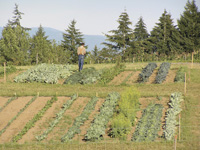
I’ve played with a number of different bed spacings and approaches and I’m still going back and forth on this one for reasons that I’ll try to lay out in the following article. I’m not really going to talk about the separate, but related, topic of how to set your wheel spacing on the tractor, although I may in a future issue. The short answer to that question is that there are lots of options for a tillage tractor, and a cultivation tractor just has to be set so that it doesn’t run over the plants.
Rows or beds?
Just to clarify, I’m a bed kind of a guy, and in the field I think about making beds and then putting my rows on beds. I find this to be the common approach in intensive vegetable production at most scales. Row style thinking seems to be more common in larger field scale crops, like potatoes, beans, and corn. In reality, on wider spaced crops like tomatoes, pole beans, and cucumbers, even though I think of them as being on a bed, what I’m doing is no different than row cropping. What I can’t make up my mind on, or at least what I’m not consistent on, is what the width of a bed should be.
The wide option
When I first started thinking about food production, I was pretty heavily influenced by John Jeavons’ writing in his book How To Grow More Vegetables. One of the points that he makes, and it’s a good one, is that a wider bed has less pathway. This sounds a little silly at first but think about making a single 4’ wide bed versus a single 6’ wide bed (center to center). If each of those has a 1’ wide pathway in the field, with the 4’ wide bed you’re using 75% of the field for growing area and in the wide case you’re using 83%. For every $100 you pull out of the field with 4’ beds you would theoretically pull out $111 on the 6’ beds. Not only that, but if your tractor matched the bed width, you’d make fewer passes in the field, and you’d be putting the same effort into irrigating the field in both cases. You’d make more money with less work; sounds good to me.
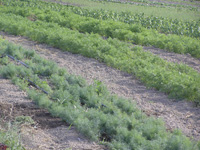
This is not just theoretical, it’s why on very large vegetable farms growing crops like spinach and broccoli, the beds can be very wide, 7’ or more. I’ve heard that large scale potato producers are looking at planting on wide beds for this reason as well.
The narrow option
For the past three years I’ve been helping to set up Skyline Farm just outside of Portland, Oregon. It’s a pretty small operation, under 3 acres of a very wide variety of annual vegetables, perennial herbs, berries and fruit, and some small grains. Because the farm is part of a larger property, there is a tractor and tiller that is far oversized for the vegetable part of the operation. The tiller is 6’ wide and there are many times that we only want to plant 100 or less square feet of a crop at a time. I also started working with the farm at a point in time where I was having a lot of back problems and squatting and reaching is a bad combination when you have herniated disks in your lower back (it can probably also lead to disk problems if you don’t already have them). To make bed widths proportional to the quantities of crops we were planting, and to make the space more ergonomic for the level of hand work that goes into the operation, I decided to make the beds with 3’ centers (1’ pathway, 2’ bed top) and run them 50’ long. With lots of crops we run up to 3 rows on a bed, and 3’ centers ends up being good for single row spacing of many of the wider spaced crops like peppers, eggplant, pole beans. For crops like squash we simply make 6’ center beds, essentially combining two beds into one. Because most things, besides tillage, are done by hand on the farm, it’s also possible for us to create beds that are any width we want, and for tomatoes we make a special exception and put beds 5’ apart (turning 5 beds into 3 rows).
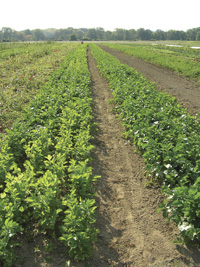
Hearty Roots Farm in Tivoli, NY uses a 70″ bed with a 48″ bed top
The medium option
I’ve found beds in the 4-5’ range (center to center) to be a good compromise on many mid-sized operations that I’ve worked with. When I worked at Sauvie Island Organics, for 7 years we worked with nothing but 4’ wide beds on 9 acres of mixed vegetables. A 4’ bed was wide enough to work a 3-2-1 row system with reasonably tight spacing and pathways (see my article on cultivation in the August 2008 GFM for more on this). Many farms prefer a bit more pathway and space between rows and so they are more comfortable with 5’ or even 6’ centers which allow 16-18” pathways and 16-18” between rows.
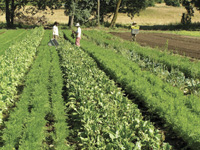
Sometimes the medium option feels like a bit of a compromise, too wide for some of the single row crops, but narrower that would be ideal for three or more row crops. On a highly diverse farm, with limited numbers of tractor set-ups, compromise is sometimes the best strategy for keeping things a little simpler. At SIO we had a single cultivating tractor that had to be able to run over all of the beds so we were limited to one width bed.
Actually, my 7th year on the farm I finally realized that we could also cultivate 40” wide beds that had single row crops with the same 48” spaced Allis Chalmers G, at least while the crops were young. This did allow a better option for crops like potatoes, peppers, and eggplant, which were a little too big for 24” between rows, but didn’t really need 48”. After I left the farm they bought a second G and have spaced that one narrow for those crops.
More considerations
In my thinking, more space between rows and more pathway is just more land to take care of. A wider bed top does make reaching to the center more difficult, encouraging people to walk on the bed tops, which I prefer to leave loose. If the row spacing feels a little too tight for a crop I either bump up to the next wider row spacing, or I just increase my in-row spacing.
This thinking is based on my climate and irrigation practices. Here in the Northwest, we don’t see summer rain (or at least not much) and so we irrigate regularly. The one place I spread out my spacing is when I’m trying to take maximum advantage of limited natural rainfall and fertility. In this case I do spread things out much more to give them a larger soil reservoir to draw from.
My practices are also influenced by the level of hand work that happens on the farms I work with, which is typically relatively high. If I were on a much more mechanized operation, where transplanting and direct seeding was primarily off the back of a tractor and cultivation was almost exclusively by tractor, I would favor very wide bed tops for single-harvest crops. Multiple-harvest crops, where being able to reach the crop easily from a dedicated pathway is necessary, would still favor narrower beds.
Existing equipment and local equipment availability is almost always one of the biggest considerations in deciding on bed widths. Beyond tractors and tillers, things like commonly available plastic mulch widths, floating row cover widths, and lengths of header pipe for irrigation lines all deserve some consideration. For example, when I decided on 4’ wide beds those conveniently worked with our 40’ aluminum pipes so that laterals would run down pathways. If we had been working with 30’ pipe every other lateral would have been on a bed top and a 5’ bed might have been a better width.
After setting up Skyline Farm I started my own farm two years ago, Slow Hand Farm. It’s an incredibly small, almost entirely hand worked operation. I settled on 5’6” bed centers with a 4’ top. Do I like it? Sure, but I’ll keep thinking about the advantages of other options, and as I build and collect more tools specific to the 4’ bed top I’ll be less likely to change.
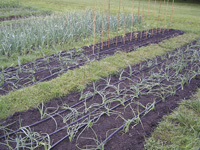
At Slow Hand Farm in Portland, OR, beds are made by hand and are on 66″ centers with a 48″ bed top. Often the paths are maintained in sod, which is nice in the winter but a pain to maintain, the author says.
Josh Volk farms and writes at the edge of Portland, Oregon. He also helps farmers around the country improve their farming systems. www.slowhandfarm.com.
Copyright Growing For Market Magazine.
All rights reserved. No portion of this article may be copied
in any manner for use other than by the subscriber without
permission from the publisher.