











By Josh Volk
Most of my experience comes from working on farms that are under 20 acres, but there are lots of folks I know who are working significantly more than that. In March I took a trip down to California, hoping to see a little sunshine after what has turned out to be an incredibly cool, wet winter here in the Northwest. I arranged visits with Eatwell Farm in Dixon and Full Belly Farm in Guinda and hoped I might get some photos of their equipment in action and compare their operations to the under-20-acre operations I profiled in February and March.
It was obvious to me that there was no way I could list all of the tools both farms use as I attempted to do in the profiles of SIO and Hearty Roots I wrote earlier this year. I’ll do my best to summarize what I’ve seen at Eatwell and I’ll work on a future article to talk about Full Belly’s approach.
California is a huge vegetable-growing state, and a lot of that growing is done on a very large scale. Eatwell is located between San Francisco and Sacramento in California’s massive Central Valley. The area has warm winters, with only occasional freezes, and very hot, dry summers. To me, Eatwell’s 90 acres of production makes it a huge farm, but by California standards, it’s relatively small. And their equipment isn’t all that different from what is used on much smaller operations (just a little bigger).
Production includes chickens for eggs, tree crops, perennial herbs and small grains in the rotations, but the majority of space for the farm is devoted to annual vegetable production. Eatwell Farm sells about 90% of its product through a year-round CSA; the rest is sold at the Ferry Plaza Market in San Francisco, and a very small portion from some herb sales to specialty markets. The land has been farmed organically since 1993.
Unfortunately for me, and for Eatwell, I didn’t escape the cool, damp Northwest winter when I visited. We dodged rain showers all day while farm owner Nigel Walker generously took time to walk me through soggy fields to talk about his operation and point out equipment, mostly buried in tall winter rain-fed grass, waiting for the fields to dry out a little.
Eatwell’s choices
Eatwell sits on a beautiful silt clay loam that Nigel calls boy’s soil: easy to farm; no men necessary is the joke. His farm is set up with beds on 80” centers, which can also be split to make two 40” beds. All of the fields are contiguous, including neighboring fields that he leases. His home ground is one big rectangle, perfectly flat, surrounded by more perfectly flat farm fields. The only trees in the area are a few orchards down the road and the Lombardy Poplar windbreaks separating his fields into neat rectangles and providing a little shade and protection in what can be a brutally hot, dry summer climate.
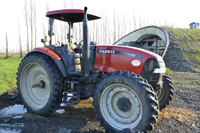
His equipment choices are straightforward, with many operations standardized, and a few extra pieces for special situations. The farm has two Case Maxxum 125 hp tractors. A typical tillage scheme would include use of the farm’s Rears flail mower, several iterations of a Sundance System disk to rip, break down, and list back up beds, followed by a Schmeiser ring roller. The Sundance System incorporates ripping shanks with angled disks that break down and then list up two 40” wide beds (see a video of the disk in action with commentary by Nigel on Eatwell’s Youtube channel or at http://eatwell.com/2011/04/12/cultivating-our-soil/). The ring roller helps break up clods and smooth the surface to keep it from drying out unevenly. A John Deere manure spreader is used to spread compost on the beds, typically at a rate of about 10 tons per acre. Final bedding is performed with a BWImplement mulcher which makes a perfectly flat, smooth, raised bed top.
Using the mulcher allows Nigel to use a seeder that was custom built for him by Snow Seeds. The seeder uses Cole seed pots and can plant up to 12 lines at once, with 5” between the rows. For more widely spaced, transplanted crops, the farm has a custom planting sled which has simple plywood seats and floor. Shanks in front mark planting lines and holes in the floor allow the crew to plant as the sled is pulled by the tractor. The shanks can be fitted with tubes to allow seeding of fava or potatoes.
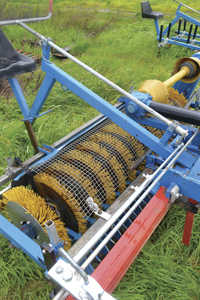
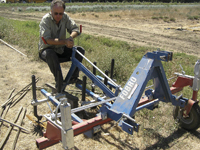
For cultivation, Nigel imported two tools from Switzerland, a finger weeder and a brush weeder. The finger weeder works 3 rows on an 80” bed, weeding in line with the plants. The brush weeder allows cultivation between the tightly packed 12-row crops. Both implements are guided by a rider on the implement itself, allowing the tractor driver to look forward while the cultivator is guided from the rear. Rolling Lilliston cultivators and a variety of sled-mounted cultivating frames which are guided with cone wheels are also in the cultivation mix.
Irrigation tools depend on the crop selection. The farm relies on irrigation canal water and uses a veggie oil-powered diesel pump to pull water from the canal. They have just installed a small pond to act as buffer between the canal and the irrigation pump. Irrigation water is delivered to widely spaced crops with 7/8” drip tape. Beds are 600’ long and to help even out pressure over the entire run they use headers on both ends of the field. The farm has a tape winder that works with a hydraulic motor powered by the tractor. This allows them to quickly roll up and roll back out tape.
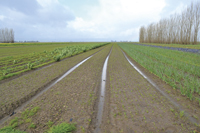
For narrow spaced crops, 3” aluminum hand line is used with Nelson Windfighter heads. I’ve used the Windfighter heads on small scale and wondered about the durability of the plastic heads when used with larger pipes. Nigel tells me the crew is careful with them because they know if they break them they’ll have to repair them, and really they’re no different than brass heads, durability wise.
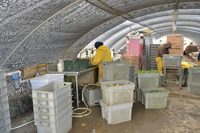
The farm has no barn and the first permanent structure, an earthen farm house, is being put up this year. The farm relies on shipping containers for storage and hoophouses covered with plastic and shade cloth for dry, protected workspace. Washing and packing is done in a very simple space in a shade cloth-covered hoophouse, shown below. A simple double stainless sink with drainboards and hard-plumbed spray heads above the sinks works for any cleaning. Collapsible skate-wheel tables are used for moving boxes around.
Deliveries are made with two Sprinter vans which replaced a bigger box truck with a lift gate that died after many years of use. I love that the box truck has a huge chalk board on the side that could be used for advertising while on the road. I also noticed a well-used skid steer with pallet forks on it while I was there. With no paved surfaces on the farm, and need for maintaining gravel roadways, I’m sure the skid steer doubles as a maintenance tool.
Noticeably absent from the farm were propagation houses. The houses that looked like propagation houses to me were filled with boxes, and tractors, keeping things dry from the rain. Nigel told me that most of the propagation is contracted out to reduce their costs of heating and cooling the houses.
Some of the most noticeably different pieces on their farm were chicken and grain related. The chickens are housed in 50’ trailers that can be moved around the farm onto new pastures and old vegetable fields. The farm also installed grain storage bins when they couldn’t find storage in the valley for their wheat crop a few years ago. They share an old John Deere 7700 combine with another farm to harvest the wheat which they have ground into flour to sell at market.
I’m sure there were many pieces that I missed on my brief tour. I hope to make it back some day to see some of what I missed and to see how the farm’s selection and systems change over time.
Josh Volk writes regularly about tools and equipment for Growing for Market. He also helps farmers around the country improve their systems. Visit www.slowhandfarm.com
Copyright Growing For Market Magazine.
All rights reserved. No portion of this article may be copied
in any manner for use other than by the subscriber without
permission from the publisher.