











USDA researcher Fumiomi Takeda has demonstrated that strawberries can be coaxed into fall production in an unheated hoophouse with no loss of yield the following spring. But he is not aware of any commercial growers who have adopted his system to date. This seems like something that hoophouse growers might find worthwhile, at least on an experimental basis. If you are curious, here are the details you need to know.
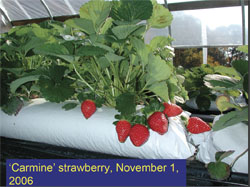
First, you will have to produce your own transplants, which means you need to have access to appropriate varieties of mother plants, either from your own strawberry planting or another grower’s field. Takeda had the greatest success with short-day varieties, especially Chandler and Carmine. The plants should be sending out runners that are not in contact with soil; for example, in a suspended growing system or pots in a greenhouse, or on plastic mulch in the field.
Takeda found that it’s critical to take runner tips on July 1 for transplant production. He tried rooting the tips of Chandler strawberry plants on August 1 and found that none of the plants flowered in fall. When he plugged the tips on July 1, all of them flowered and fruited. Each plant produced about 3/4-lb. of berries from late October to the end of December. What’s more, the transplants started July 1 also produced more fruit the following spring than those started later.
Strawberry transplants are easy to produce in a greenhouse, hoophouse, or shade house. Runner tips should be cut off when little white or brown pegs (called root initials) are visible and no bigger than 1/2 inch. Each tip needs to have at least two leaves between 2-1/2 and 4 inches in length. Any larger or smaller, and the plant may not root. About 1/2 inch of the runner should be removed along with the leaves, to anchor the plant. Tips should be planted immediately into 48- or 50-cell trays, with the root initials and anchor just below soil surface.
The flats of transplants should be placed under a misting system so the leaves can be misted every 5 minutes at first, gradually decreasing to about every 12 minutes as the plants start to root. A runner tip will produce a well-rooted plug in about four weeks; it should be left to grow in the plug tray for another month.
Takeda, whose research was conducted in the mid-Atlantic region, transplanted the strawberry plugs on September 1 into a plasticulture system in an unheated hoophouse. Raised beds were covered with black plastic mulch and water and fertilizers were provided by a drip irrigation system. When temperatures threatened to drop below 34°F, the plants were covered with 1.5 oz. row cover.
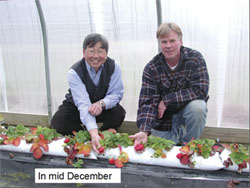
This photo shows Dr. Takeda and Michael Newell, Horticultural Crops Manager at Wye Research and Education Center, University of Maryland, Queenstown, MD. That year, the research was conducted in grow bags of perlite and fertigated 2-3 times a day. Since then, plants have been grown in raised beds with similar results.
A publication about growing strawberry plugs from runner tips:
http://extension.usu.edu/files/publications/publication/Horticulture_Fruit_2010-01pr.pdf
Copyright Growing For Market Magazine.
All rights reserved. No portion of this article may be copied
in any manner for use other than by the subscriber without
permission from the publisher.