










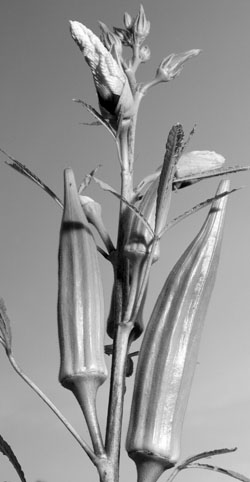
Okra is a tropical annual in the mallow family, widely adapted where the frost-free season is long enough. Those in cold climates should choose fast-maturing varieties and transplant into black plastic. Those in hot climates will need to deal with its exuberant growth in mid-summer. Okra is heat- and drought-tolerant and has few serious pests or diseases.
Varieties
Cow Horn: 55 days. A heavy yield of 8-14” pods on 7-8’ plants. The large pods remain spineless and tender up to 10”, but the best quality pods are 5-6” long. We get Cow Horn okra from Southern Exposure Seed Exchange. It is one of a few varieties that can grow relatively large pods without their becoming tough. We are sometimes not good at finding all the pods when harvesting, so it is an advantage to us if they are still good to eat when bigger than normal. We have educated our cooks and diners to know not to make assumptions about toughness without testing with a thumbnail.
Clemson Spineless: 56 days. A spineless variety with dark green pods. Plants with few side-branches reach 4-5’. Medium-sized ribbed pods grow to 8” long, but are best harvested when 3” or smaller. This variety is easy to pick, because of the lack of spines.
Star of David: 61 days. An heirloom producing fat pods, with a moderate yield, on tall plants. Has a distinctive flavor, which might be appreciated by okra lovers who want something different. Can grow to 8-10’ with few side branches. Pods left to mature average 6” in length, but harvest when small and keep well picked. Purple coloration on top of leaf stems and the bigger veins. Tolerant of root-knot nematode.
Evertender: 50 days. This unbranched, spineless variety grows 5 ½’ tall and produces 7” pods of good eating quality, similar to Clemson Spineless. Easy to harvest.
Jade: 55 days. A high-yielding, early maturing heirloom, tender-podded, few side branches, and good ability to maturein late plantings. Plants average 4 ½’ tall and the straight, dark-green pods remain tender to 6”.
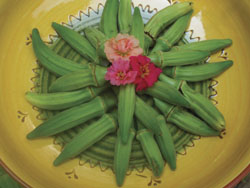
Cajun Jewel: 50 days. Another high-yielding, early maturing, good-flavored heirloom. Short plants, 3-4’ tall, produce an early crop of spineless, tender 1” diameter pods up to 7” long.
Burmese: 58 days. High-yielding dwarf heirloom. Starts to bear when plants are 18” tall. Huge leaves, slightly curved, almost spineless pods 9-12” long. Tender and sweet enough to be eaten raw in salads. Pods are less mucilaginous than other okra.
Red Burgundy: 49 days. Has magenta stems, emerald green leaves and 5-8” maroon pods. Short bushy plants 3-4’ tall. Red Burgundy okra is reported to do well in cooler areas, although it will not do much until day time temperatures reach 80°F. Slim spineless pods.
The Kerr Center in Oklahoma trialed heirloom varieties in 2008. http://www.kerrcenter.com/publications/heirloom-okra-report.pdf
Crop requirements
Okra does best in well-drained, fertile, loamy soils with high organic matter. Wet clay soils can drown the plants. It grows best with a pH between 6.5 and 7.0, although as high as 7.6 is still manageable.
Optimum soil temperatures for okra are 70-95°F. Germination takes 27 days at 59°F, 17 days at 68°F, 12.5 days at 77°F, 7 days at 86°F, 6.4 days at 95°F, and back up to almost 7 days at 104°F. The highest percentage of normal seedlings emerge at 77°F.
There are approximately 20 seeds per gram. 5gm sows 50’ at 6” spacing. 6-7 lbs. of seed are required to plant one acre.
Average yields are about 3-4 tons per acre on bare ground in the south. Yields on black plastic are considerably higher. For smaller plantings, expect 50-100 pounds/100’. We grow 90’ for 100 people.
Sowing
When we direct sow, we “station-sow”: We put three seeds ½-1” deep at each spot where we want a plant to grow. We do this on May 1, with row cover, as this is around our last frost date, and we want to avoid disasters! Later we thin to the strongest seedling.
More usually we transplant, especially if we are intercropping with cabbages that have had a hay mulch, which cools the soil below what okra likes best. For transplants we sow April 15, using soil blocks or 50-cell flats.
According to a Rodale publication, 600 Answers, germination speed can be improved by freezing the seed overnight, then soaking in hot water for ½-1 hour before sowing. Or else soak the seed at room temperature for 24 hours. Another approach is to rub the seed in sandpaper, or nick the seed-coat with a knife. For larger quantities, roll a piece of coarse sandpaper with the grit to the outside, and use it to line a screw-top jar. Put in the seed, close the lid and swirl the seed around in the jar for a while.
Transplanting
Okra has fragile taproots, so care is needed when transplanting. We transplant 3-4 week old starts, the 3- to 4-leaf stage, at 18” spacing in a single row in the middle of a bed. The transplant date is 10 days later than the direct-sowing date, and a plant with 3 or 4 leaves is ideal. In the past we used a wider in-row spacing, but found we could get a higher yield with the “hedge-like” closer spacing.
Some growers plant as close as 6” in the row, with 5’ between rows, or plant double rows with 12” between plants, and wider spacing between the beds. Over-thick planting requires very fertile soil, and risks diseases from poor air circulation. Over-wide spacing can lead to better branched plants, but maybe a later start to the harvest.
Immediately after the initial transplanting, we bump up any leftover seedlings into bigger pots, and fill any gaps a couple of weeks later.
Cultivation
Okra is a long-season crop, so cultivation to keep down the weeds will be needed, or else black plastic mulch. We hoe until hot weather arrives and then mulch with spoiled hay. During the rest of the growing season, the okra bed becomes a useful repository for any mulch-like materials from other beds.
Okra has a great ability to withstand drought compared to other vegetables, but for good growth and production, you’ll need to water at least an inch a week, just like other vegetables. If there is an extended dry period and you can’t water everything, okra will be the last to suffer.
Rotations
Okra is about the easiest vegetable to fit into a rotation as you are unlikely to have any other mallow-family crops to worry about, and you are not so likely to be growing a huge amount. We find it easy to locate a spot that hasn’t grown okra for the past several years. Cotton, hibiscus, roselle and the fiber plant kenaf are also in the mallow family, but do not cross-pollinate okra.
Intercropping
Okra is slow-growing until hot weather arrives. We sometimes take advantage of this, and its upright growth habit, to transplant okra in a bed of early cabbage. The cabbage is transplanted two rows in a 4’ bed on March 10 and the okra in a single line down the middle on May 11. This year we are planting the okra in our second spring cabbage, which was planted out April 1. At first the cabbage are relatively small, and the okra uses the open space in the middle of the bed. As the plants grow, we remove outer leaves of the cabbage that might overshadow the okra. Finally we harvest the cabbage and leave the okra to grow to full size. This method saves space, and efficiently uses our time to help two crops with one weeding.
I have read of intercropping cucumbers and okra, giving each plant 3 sq. ft. Again, this uses the very different growth habits of sprawled cucumbers and tall okra to get more crops from the same piece of land. Good soil fertility is needed if the two crops are not to stunt each other.
Generally only one planting is made each year, although it is possible to sow in spring and fall in warm climates, using a fast-maturing variety for the later sowing. Or to choose to sow only in the summer for a fall crop, and not fight cold spring soil temperatures.
Pests and diseases
Cool weather will stress okra, and the plants may then suffer from verticillium and fusarium wilts, which are soil-borne diseases that cause plants to wilt and die. Foliage blights may occur, but generally they do not reach serious levels. Blossom blight can be a problem in long rainy periods.
Old varieties of okra tend to have deeper root systems and are more tolerant of root-knot nematode, to which okra is very susceptible. If you have nematodes, choose heirloom varieties and do not plant okra after sweet potatoes or squash. It will do fine after grains, such as sweet corn, or following a winter rye cover crop.
Insect pests that you may run into include Japanese beetles, stink bugs, aphids, corn earworms, flea beetles, blister beetles and cucumber beetles. Ants may be seen climbing the plants to drink nectar but they don’t seem to cause damage.
Harvest
Once the pods appear, we harvest six days a week, using pruners, or sometimes a small serrated knife. The stems are quite tough. Some people have trouble with the spiny leaves, and like to wear long sleeves when harvesting. We tell crew to cut at 3” or bigger, and try to have the same few people do the picking on a regular basis for consistent results. Some years we have attached a piece of card to the special pruners for the job, showing the size to cut. New crew sometimes lack a sense of measurement! We’ve also been surprised to find it necessary to show new people the difference between a rounded “empty” pointed flower bud, and an angular firm pod.
For maximum yields it is important to harvest at least every second day. If pods are missed, they will mature and limit the future flowering and therefore the yield. It takes only a few days for a bloom to open, close and produce a pod ready for harvesting.
Our harvest starts in the middle of July and runs till frost, a period of 12 weeks or so. At the end of the season, we find we need to dig out the massive trunks and consign them to a spot on the edge of the woods which we call “The End of the World”. This is where we put all our woody plant waste and also evil weeds we don’t trust to the compost pile, such as wiregrass.
Postharvest
Okra does not like to be chilled! Chilling injury causes dark, damp spots on the pods, which lead to pitting and a slimy breakdown. Okra can be stored at 45-50°F in unperforated plastic bags for up to 15 days. This compares favorably with only two days without a bag, or seven days in a perforated bag. The plastic bags keep the humidity high.
Season extension
Black plastic mulch, row covers and transplants can all help get the crop going earlier. In hot climates, such as Texas and Alabama, okra plants benefit from being rejuvenated in the middle of the summer, by cutting them back to a 6” stub after the first heavy harvest, (perhaps in the fifth week), and after market prices start to decline. For large areas, use a mower. The plants will produce again in the fall, when prices have risen again. Alternatively, to avoid losing all your crop at once, do this progressively along the row, say cutting 5% of the plants each day, starting after they reach shoulder height. As well as revitalizing the productivity, this process keeps the plants at a manageable height. Side-dressing at this stage can also boost production. See http://www.aces.edu/pubs/docs/A/ANR-1112/ANR-1112.pdf This process is called “ratooning” in the southeast. Fall yields of ratooned plants can be higher than spring crops.
Other growers tell of cutting back plants to a height of 4’, which causes the plant to branch more.
Seed saving
Saving seed from okra for your own use is a simple matter, if you are only growing one variety. We have saved seed by decorating chosen plants with colored plastic surveying tape, like tinsel on a Christmas tree. Then we don’t pick from those plants for eating. We wait till the pods are big and dry, then harvest them before they split and shed, and put them in bags or cardboard boxes indoors to dry further, or until we have time to deal with them. Mature okra seed are almost black. For small quantities, just twist the pods and break them open, over a container of some sort. Empty pods make good weed-free mulch.
Okra is outcrossing but can self-pollinate. Okra varieties need to be isolated from each other by 1/8 milefor home use, or 1/2 mile or greater for seed for sale. A plant population of 10-20 plants is needed for genetic diversity, and more than 20 plants is best, for seed for commercial sale. It takes 30-50 pods to provide one pound of seed.
Seed sources
Southern Exposure Seeds, VA: www.southernexposure.com 540-894-9480.
Baker Creek, MO: www.rareseeds.com. 417 924 8917.
Sand Hill Preservation Center, IA: www.sandhillpreservation.com 563-246-2299
Sustainable Seed Company, CA: http://sustainableseedco.com/home.php 877-620-SEED
Pam Dawling is the garden manager at Twin Oaks Community in Virginia. pam@twinoaks.org.
Copyright Growing For Market Magazine.
All rights reserved. No portion of this article may be copied
in any manner for use other than by the subscriber without
permission from the publisher.