











Fava beans (known as broad beans in the UK), are easy to grow and have an unusual earthy, nutty flavor. Botanically, they are a kind of vetch. Like all legumes, they can fix nitrogen in nodules on their roots, leaving a fertilizer boost in the soil for the next crop. Their flowers are surprisingly fragrant and are very attractive to pollinators and other beneficial insects. They are usually eaten fresh and shelled, but they can also be dried, then cooked. In the UK, there has been some research into making foods like hummus, falafel, or tempeh from locally grown fava beans, to reduce dependence on imported garbanzos or soybeans. There are also small-seeded varieties which are mostly grown for cover crops or livestock feed.
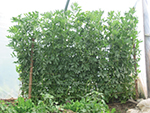
How and when you grow fava beans will depend on both your winter and summer climate. According to Frank Tozer, in their ideal habitat they are indeterminate and so can produce over a long season. Above 70°F, flowers may drop, causing the plant to act like a determinate. This means that in climates with hot summers (such as central Virginia) the plants produce a single harvest. In zones 7 and warmer they can be sown outdoors in the fall, for a spring or early summer harvest. In colder zones they are spring sown, and can be succession planted to last all summer.
Fava beans have a high protein content (26%), similar to kidney beans (25.3%) or peanuts (26%), although not as high as soybeans (36.5%). The beans contain Levodopa, so eating favas may help people with Parkinson’s Disease, and the effect is believed to be longer lasting than synthesized L-dopa.
A small percentage of people of Mediterranean, African or South Asian descent (a total of 400 million people) have an inherited genetic sensitivity (Favism), which causes illness when they eat fava beans in quantity. Favism is often erroneously called an allergy, and I am grateful to Richard Moyer for educating me on this. In people with favism, an enzyme in red blood cells functions poorly. Fava beans (and certain drugs) contain a compound that oxidizes red blood cells, and in affected people, favas overwhelm the ability of the weakened enzyme to reverse the oxidation quickly enough to keep the red blood cells alive. The dead red blood cells can cause swelling and inflammation, which may look like an allergic reaction, but those are secondary symptoms, and treatment for favism is not the same as treatment for allergies. Favism is more severe in men than women, and in children than in adults. I’ve never met anyone with this condition, but it may be wise to mention this to your customers.
Varieties
Broad Windsor 80 days spring sown, 240 days fall sown. A 4’ tall variety with large beans, up to 6 of them in 6-8” pods. Windsor fava beans are the main ingredient in Brown Windsor soup. Windsors are not generally reckoned to have the best flavor, but are the easiest variety to find in the US. Buff-colored seeds. 17 seeds/oz. Reliably hardy to 12°F.
Aquadulce and other Longpods are hardier and tastier than the Windsors. (80-90 days). Well-filled pods to 8”. Big reddish-brown seeds (green before they dry.). Seeds from Italy has Aquadulce. Peace Seeds carries small quantities of Longpod Major. 5-6 large seeds per pod on 3’ plants.
Express 95 days. 3’. Up to 3 dozen 8” pods per plant. The beans do not discolor when frozen. White seeded. Thompson and Morgan.
Cascine. Slightly earlier than other varieties. Long, slim pods with 6-7 beans each. Beans are a bit smaller than most favas and very tender. Seeds from Italy has certified organic Cascine grown in Washington state.
Jubilee Hysor 95 days. A high yield of broad, well-filled pods, each containing 6-8 beans. Thompson and Morgan.
Statissa (75-95 days spring sown.) Dwarf plants, 24-28” tall. Early maturing, short, slender pods, small beans. Buff colored seed. 50 seeds/oz. Thompson and Morgan, Territorial Seeds, www.territorialseed.com
The Sutton is a fast maturing dwarf variety, 12” high, that produces lots of 5-6” pods each bearing 5 small, tender beans. Hard to find in the U.S.
Seville dwarf is the most hardy variety grown for food. Hard to find in the U.S.
Negreta (70 days spring sown. 240 days fall sown). Height: 3’. A fast maturing variety with large purple seeds. When overwintered (only possible in mild areas), this Italian variety can mature almost a month before others, allowing other spring crops to be planted after the fava harvest. The 9-10” pods are filled with 6-7 bright green seeds. Territorial Seeds.
Thompson and Morgan has a good selection of 12 varieties available on their UK website www.thompson-morgan.com, but only three in the United States.
As a cover crop, favas are a vigorous and adaptable legume, often mixed with peas, vetch, radish or oats. They produces lots of organic matter, and fix nitrogen if inoculant is used. In the UK, “tic beans” are small-seeded cover crop or animal feed varieties sown in spring, and “winter beans” are varieties sown in the fall. In the U.S., I believe both are known as “bell beans.” Bountiful Gardens sells one.
Banner (60-75 days) is one variety usually grown as a cover crop. Hardy down to 7°F. Sow in the fall, or early spring in cool weather areas, the same time as peas. High yielding. Grows very thick stands 6’ tall by late spring. Tolerant of some waterlogging in winter. Besides producing silage or green manure, these small favas make good eating too. Sow up to 3” deep for the best stand, but they can also be broadcast and tilled or raked in. Territorial Seeds, Bountiful Gardens.
Sweet Lorane, previously available from Territorial, will be sold by Southern Exposure Seed Exchange beginning in 2012. Very hardy, good tasting. www.southernexposure.com
Crop requirements
Fava beans thrive in well-drained, fertile soil with a pH of 5.5-7.0. Deeply cultivated soils can yield almost twice as much as poorer soils. Sow in a sunny location, or partially shaded if you are pushing them into the hot end of their preferred temperature range.
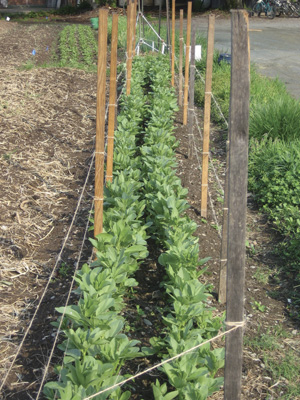
For growing as a cover crop, broadcast at 150-250 lbs/ac or 5-10 lbs/1,000 sq ft. For food crops, sow staggered double rows 12-18” apart, planting seeds 1.5-2” deep every 6-8”. For multiple pickings over a longer harvest period, try seeds closer, about 4-5” apart. For maximum yield for a single harvest aim to have 2-3 plants per square foot. Dwarf varieties can have closer rows, 9” apart. It’s probably better not to sow pre-sprouted seeds if the conditions are cold, as the seed may rot. On the other hand, if you are sowing a bit late in the spring, pre-sprouting might help you get a good harvest before summer gets too hot.
Twenty plants per person will be enough. The seeds are large and heavy, and seed counts vary a lot by variety. 17-50 seeds per oz or about 300-1,000/pound. The usual storage life of the seed under refrigeration is 2-3 years.
When to sow
Fava beans like mild, damp weather best and dislike heat. When temperatures are 40-75°F they germinate in 7-14 days. They are cold tolerant down to at least 15°F, some varieties 7°F. Because they are so cold-tolerant, favas are usually direct-sown. But like almost all plants, they can be successfully transplanted with care, if your situation justifies the extra time and attention. William Woys Weaver in zone 7a sows favas in small pots in the greenhouse about Jan 25. He has a short, hot spring and transplants about April 10 in order to have them in full bloom by May 15 and harvest by June 1. He induces tillering (bushing out, producing side shoots), by pinching out the tops when the plants are 6-8” tall. This increases the yield.
If your winter-hardiness zone is 7 or warmer, you can overwinter for an earlier harvest, (using one of the hardier varieties if your climate is borderline). Row cover can be used to protect fava beans from temperatures between 10-15°F. Or you can overwinter in a hoophouse and provide a crop before the summer gets too hot.
Don’t sow too early: for best winter survival, aim to have short plants with about 6 leaves before you get to really cold weather. Overwintered plants will tiller in the spring (grow multiple stems). Spring sown plants do not tiller, so the yield from overwintered plants can be higher.
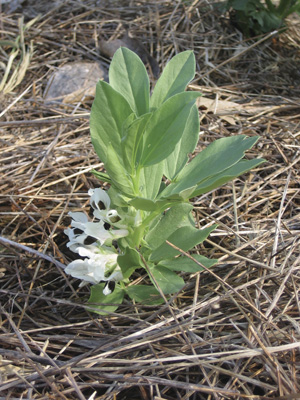
In warmer zones, such as Gulf Coast states and southern coastal areas, according to Southern Exposure Seed Exchange, favas are sown from October to December for harvest in March. They will still germinate in the fall at temperatures up to 90°F, but do need average daytime temperatures below 70°F during flowering.
In the Pacific Northwest favas are sown Oct 1-Nov 15 or in late February. Temperate maritime climates offer the best conditions for fava beans for both fall and spring sowings. Carol Deppe recommends sowing after the fall frost has killed the aphids. When I lived in England we would sow hardy varieties in October or early November and again in late February/early March, then switch over to the less hardy varieties for a later spring sowing.
In zones with cold winters and summers below 70°F, favas are spring sown only, and can be succession planted to last all summer. Sow as early as the soil can be worked in spring and then sow a second and possibly a third crop later in spring to harvest throughout summer.
Here in central Virginia, we have sown them in November, but our rate of winter-kill was too high for it to be worthwhile. Last year we sowed on Feb. 15 and they popped up March 15, a whole month later, so even if it is too cold for them to germinate they will just sit there in the soil until conditions are right. We need to get an early spring start with ours, as summer heats up quickly. Our single harvest happens in mid-June, a good time of year to have an unusual crop come in.
Cultivation
The best conditions for growing fava beans are temperatures around 65°F, but anywhere in the range already given for sowing will work. Grow fava beans like peas, except that they don’t need trellising. They have sturdy, non-branching stems 1-4’ tall, depending on the variety. They may be OK with no support at all, or you can “corral” them as we do: put a stake or short T-post in the ground every 8-10’ along each row just outside the plants, and then string-weave around the double row, boxing the plants in. This will keep them upright in windy locations, and when the heavy load of beans threatens to pull the plants down.
Don’t over-water early in their life, or you will get too much soft vegetative growth, and will be susceptible to problems with aphids. During dry spells, water enough to keep the plants actively growing. When plants are in full flower and pods are beginning to form, water more generously. Water during flowering will increase the number of pods set; watering as the pods swell increases the size of the beans.
Once the plants have reached close to their full height, you can pinch out the top 4” of each stem to limit vegetative growth and hasten ripening. Pinching out the tops will condense the harvest period into 2-3 weeks, even in a mild climate. Removing the tops also discourages black aphids which may attack plants in late spring (at least, they do in the UK and the Pacific Northwest). The pinched-out shoots can be eaten, lightly steamed or sautéed.
Season extension and rotations
For a continuous supply, sow at 2-3 week intervals, as long as the weather is suitable and will remain in the 40-75°F range for at least the first 6-8 weeks of growth.
We’ve sown fava beans in our hoophouse Nov. 15, and harvested them mid May, a full month sooner than our outdoor spring sowing. This worked well, and legumes add diversity to the rotation.
In most climates, fava beans finish up in summer, and the space can then be used for sowings of salad greens or fall brassicas.
Harvest and postharvest
From a spring sowing, most varieties take 90-120 days till harvest. The pods stand upright in pairs or fours from the leaf axils, ripening up from the bottom of the plant. Harvest by bending the pod down and pulling it downwards from the plant. Some people harvest the pods young and cook them whole, although this does, of course, reduce the yield from the plants. Generally, people let the pods get big, when the beans can be felt inside. They are then shelled and cooked.. There is quite a bit of leeway in when you can harvest them for eating as shelled beans. The pods start to get thinner-skinned and spotty, then leathery and dark. If you wait too long, the beans will be demi-sec (partially dry) and need longer to cook.
Favas can be refrigerated and stored in the shell for three to four days, or shelled and used within two days. The beans tend to get unpleasant looking brown spots if kept for too long after shelling. Some growers sell them ready-shelled, in plastic bags.
Some people squeeze the beans out of the skins after cooking, but this is not necessary unless you want to make a dish from mashed beans without using an electric gadget.
Seed saving
Isolate fava bean varieties by at least 100’ for home use, and a mile for commercial sale. They do not cross with other types of bean. Because the pods dry to a leathery wrinkled state, they do not shatter and so they are forgiving about harvest date.
Copyright Growing For Market Magazine.
All rights reserved. No portion of this article may be copied
in any manner for use other than by the subscriber without
permission from the publisher.