











The first year I grew flowers, my cutting garden was a jungle of flowers and waist-high weeds. While I loved the process of selecting varieties, planting, tending and picking, I hadn’t anticipate just how much energy would be used battling weeds to ensure a healthy and abundant harvest. The following spring, determined to have a more successful experience, I borrowed a thousand bucks from my Mom and ordered enough landscape fabric to cover my barely half-acre plot. While it was a huge investment, it was the only way I could see being able to manage the weed issue, while wrangling our two small children and growing my budding business. My amazing husband Chris burned close to 15,000 holes in landscape fabric that spring. I finally had a thriving and relatively weed-free garden. A lot has changed since then; both the kids and the business have grown rapidly but that initial batch of landscape fabric is still in use and has been added to each season.
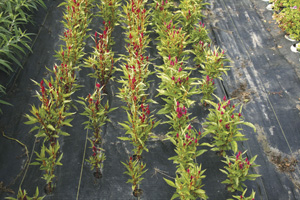
While weed suppression is the main reason for using landscape fabric, there are a few additional benefits worth noting. First, unlike plastic, landscape fabric is reusable. The majority of mine is in its fourth season and shows little to no wear. I recently inherited a batch from a former flower farmer that originated in the ‘90s, is still in pretty good shape, and I think we’ll easily get 3-4 more seasons out of it. Some of the heavier weights of landscape fabric are rated to last at least 20 years.
Second, crops such as zinnias, celosia, basil, lisanthus and others that like warmer soil thrive when planted into fabric. In our rainy, cool climate, many of these crops wouldn’t mature in time without the fabric. Third, moisture retention seems greatly increased with the use of fabric. Fourth, fabric makes for a tidy, clean-looking garden — always a bonus! Fifth, plant spacing is a snap when the holes are already made. Finally, we generally do just two early rounds of weeding on the fabric beds before they can coast for the rest of the season. Compared to the typical 4+rounds on our plain soil crops the cost of the fabric quickly pays for itself in saved labor.
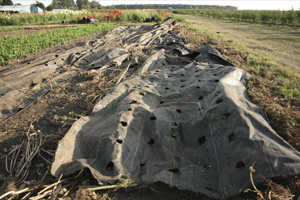
DeWitt Weed Barrier is the brand we always buy. We buy the one that is shiny on both sides (we avoid the type with a fuzzy bottom), is super-durable and comes in a number of different lengths and widths. I almost always get the 6×250’ rolls. The 6 foot width allows 4 feet for a planting bed and, if overlapped with another strip of fabric, a 2-foot wide path between beds. That’s just enough room to get down for planting, weeding and harvesting.
We generally stick with three different hole spaces. 12×12 with 4 rows per bed, 18×18 with 3 rows per bed and 9×9 with 5 rows per bed. I’d say about 70-80% of everything we grow goes into the 9×9 fabric. Sweet Williams, Campanula Champion, zinnias, basil, plume celosia, Frosted Explosion grass, snapdragons, ageratum, bupleurum, cerinthe etc. Most medium sized cut flowers love this spacing. The 12×12 is best for plants that are on the larger side. Things like amaranth (pinched at a foot tall) Lavatera, bells of Ireland, large millets, ammi. And for really big items like branching sunflowers, sweet Annie, tithonia, Salvia leucantha, scented geraniums, perennials and dahlias from cuttings (Karmas and regular) the 18×18 is ideal.
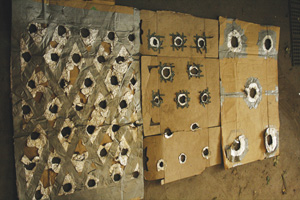
While I have heard from many growers that 6×6 spacing works well on crops like asters, lisianthus, single-stemmed snapdragons etc. we have found that fabric burned with this spacing always ends up a weedy nightmare since the holes are so close together and so much soil is exposed to the sun. After just two beds worth we retired this template, opting for the wider instead.
The small propane canister with a fine-tipped nozzle needed for the job can be found at most hardware stores for under $15. For perfect spacing and increased efficiency a burning template should be created beforehand. I am about the least handy person ever and was so impatient to get started burning that first season that I made my templates out of cardboard, tin foil and duct tape. As cheesy as they look, we’ve used them for years! While a more permanent set would be ideal this rigged set has served me well.
Fabric is anchored into the soil with earth staples. We always go heavy on them since a flyaway piece of fabric is a real bummer! If laying fabric immediately after tilling, you might want to set some heavy items down the paths until the soil has settled, you’ve walked on it a few time and the staples are firmly secured. We use soggy bags of leaves, bricks, chunks of concrete, basically anything heavy enough to keep the fabric down during gusty spring weather.
Over the years we’ve made about every mistakes possible when it comes to using fabric. Hopefully this list of don’ts will help you avoid some of the same irritating issues we’ve struggled through.
Avoid burning fabric in an unventilated space; the fumes are toxic and you should wear a breathing mask. While burning outside seems ideal, it too can pose challenges. Wind is the flame torch’s enemy. Even a tiny breeze will make the process of burning holes pure hell. Second, if there is dry grass, wood chips, sawdust or dry debris on the ground, it will likely catch fire and you’ll spend half your time stomping out little flames. My favorite spot to burn fabric is in the garage with all of the doors wide open. It gives enough ventilation but keeps wind to a minimum.
If you would rather cut the fabric, be prepared for hard, slow work. The fuzzy backed kind of landscape fabric is a better choice for cutting because the smooth kind frays unless the edges are melted. However, the fuzzy kind collects dirt and debris, making the fabric heavier each season.
Never mow down a crop planted in fabric with a riding lawn mower. Even with the blades on their highest setting, therisk of sucking up the fabric and ripping huge gashes in it is too great. One year, in a hurry to get our snapdragons out and a new crop in, we chewed massive holes in a couple of strips of fabric. Now every spring, when we lay out the garden, there is a lovely reminder of our lame mistake. We now use the brush hog on the tractor raised about a foot off of the ground and so far haven’t had any incidents. A weed whacker with the saw blade attachments works great too but is slower and definitely more work.
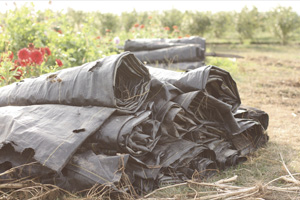
Try not to leave the fabric down through the winter thinking that it will be easier to pull up in the spring. Truthfully there’s nothing more irritating than trudging out to the field in March with a huge mess awaiting your attention. Always clean it up in the fall!
Don’t use the flame weeder to burn holes! Yes it looks like it will work perfectly with the nice big wand and a flame nozzle the exact size of your intended holes but it only makes a huge, smoking, melted mess. This bright idea is pure disaster, trust me!
If possible, try to avoid pulling it up by hand. I’ve had the glorious job of taking up our half acre of fabric each fall and it is an exhausting, back-breaking task. Last fall in a fit of desperation we roped some onto our new tractor and my life was forever changed. You can even pull two out at a time! The few holes you run the rope through will get a bit stretched out but, let me tell you, it’s totally worth it!
Don’t leave fabric down in the winter on perennial plants if you have voles. A few seasons back we lost $450 worth of Limelight Hydrangeas due to a hungry family of voles who were nesting under the cozy fabric.
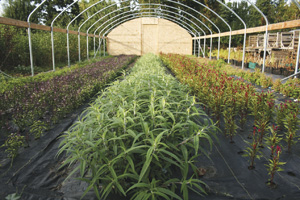
Always place your drip irrigation lines underneath the fabric; otherwise plants may not get enough water.
Above all, never try to lay fabric in the wind! Especially with someone you care about like your spouse or children. The slightest gust of wind can instantly transform a 60ft. piece of fabric into a sail, and jerk you half way across a field before you regain composure. But scarier than a runaway strip of fabric is the fight you and your partner will engage in while trying to catch said fabric. Always aim for calm days with wind ideally less than 5 mph.
Using landscape fabric does have a few disadvantages. First, it can be an expensive investment. A 6×250’ roll runs about $150. Burning, laying, pulling up and storing large amounts of fabric is time consuming and sometimes exhausting. Using fabric adds additional steps to flipping beds midseason when energy and labor are limited.
But even with its quirks and handful of problems, using fabric is still a central part of our small scale but highly intensive and wildly productive farming operation.
Erin Benzakein runs Floret, a small organic flower farm in Washington State. www.floretflowers.com
Copyright Growing For Market Magazine.
All rights reserved. No portion of this article may be copied
in any manner for use other than by the subscriber without
permission from the publisher.