





Planning is a cyclical process, and tweaking the plan for better results is an annual task. However, if you are starting from scratch, or if things are going really wrong, where should you start in planning your enterprise?
ATTRA’s Market Gardening: A Start Up Guide has a set of questions to help clarify goals and develop a business plan, along with links to many other resources. An assessment of your available land, your preferred crops, your customers, your location and your financial situation will be the base on which you build your plan. Ellen Polishuk of Potomac Vegetable Farms links her success to decisions based on her seven core values: Fun (a high quality of life); making a living; no or low debt; enjoying people; enjoying machines; continually investing in capital assets and using organic practices.
Many growers will want to start with the money. The incoming money, that is. See Crop Planning for Organic Vegetable Growers by Brisebois and Thériault, and ATTRA’s Holistic Management: A Whole-Farm Decision Making Framework and Sustainable Vegetable Production from Start-up to Market. The Organic Farmer’s Business Handbook by Richard Wiswall includes a CD you can copy and use to create your own budgets, timesheets, payroll calculator, and more, compatible with Windows, Mac and Linux.
Set financial goals and then figure out how to achieve them. Plan your income (gross sales), then your profits (salary), then your expenses, which could be anywhere from 25-75% of your gross sales. Clearly, keeping expenses down will boost your income, so long as you don’t make the farm nonviable.
To set your gross sales goal, consider how much produce you can grow and what the financial value of that is. If you are brand new, you will need to ask other farmers for help, study prices at the farmers’ market and see what other growers offer. The Roxbury Farm website is helpful on this. A full time farmer might work 2,000 hours in a year, and average $18/hour gross if things go according to plan. But a beginning farmer needs more slack while learning, and might expect to earn considerably less than the $36,000 of an experienced grower. Perhaps only $5,000-$10,000, according to Anne Weil, quoted in Crop Planning for Organic Vegetable Growers. Out of these gross sales come all the business expenses. So subtract your hoped-for earnings from the gross sales and look at how much will be available for covering the expenses. Consider if this is a reasonable amount, by listing all your expected expenses and then adding in something for contingency expenses (the unexpected but unavoidable).
SPIN-Farming (Small Plot Intensive vegetable growing) is geared to new growers using city plots and prepared to pay for the fairly expensive manuals. The website has a calculator to convert square feet into farm income using their methods.
Which crops to grow
Some crops require more skill or are less dependable. If your climate is marginal for okra, avoid relying on it for a large part of your summer income. Gardening When it Counts by Steve Solomon has a table of “Vegetables by level of care needed.” On his list of highly demanding crops: Brussels sprouts, cauliflower, celeriac and bulb onions. Steve’s list also includes asparagus, Chinese cabbage, early cabbage, cantaloupe, leeks, large fruited peppers and spring turnips and spinach. Although that last set grows well for me, I have challenges in my climate with rutabagas, drying beans and shelling peas.
Some crops offer high yields or high market value for a small space. Do you have a lot of labor or a lot of land? In terms of yield per unit area, the best include carrots, summer squash, onions, potatoes, sweet potatoes and tomatoes. Peas, sweet corn, radishes and bush beans are among the worst. But in terms of tonnage per hour worked (“efficiency”) the best are sweet corn, potatoes, cucumbers, cabbage, summer squash, peas, peppers. The worst include pole beans, radishes, onions, carrots, bush beans, lettuce.

Neither high retail price nor high yield is the same as most profitable. See Richard Wiswall’s Organic Farmer’s Business Handbook for 25 sample crop enterprise budgets which you can use to make a comparison of costs, sales and profit from each vegetable. This is a book about number-crunching that’s accessible and inspiring. (One of the author’s main goals is to help create less stressed-out farmers.) Beware preconceived notions on what is most profitable – get real numbers. His highest to lowest net profit per bed are: greenhouse tomatoes, parsley, basil, kale, field tomatoes, cilantro, dill, peppers, carrots, parsnips, celeriac, spinach, beets, lettuce, summer squash, bulb onions, cabbage, potatoes, cucumbers, broccoli, winter squash. Peas, beans and sweet corn all ran at a loss. Remember – your results may vary! One lessons from this list is the ability of long season crops such as kale with an extended harvest to provide high yields for the time put into soil preparation, planting and cultivation. Another lesson is that while bunched herbs can bring a good profit, people will only use a certain amount, and a diversity of crops is needed to keep customers returning.
What the market wants
Contents of CSA shares are posted by many CSAs, including Roxbury Farm. Sometimes you will want to grow certain crops even if they are not the highest money-earners, because they enhance what you have to offer. Perhaps they round out your market display or your CSA boxes. Perhaps you’ll grow a crop because it is extra early, or eye-catching. If you are growing for farmers markets, you can choose to grow just high value crops, but if you are doing a CSA, your customers may expect to receive some of everything, and you will need to grow some low-value crops. But don’t be afraid to say no to growing a crop such as sweet corn or shelling peas that just doesn’t work for your farm. CSA has the advantage of money up-front and guaranteed customers, as well as avoiding the costs associated with going to market. On the other hand, a farmers market booth can take a flexible range of produce, and so is easier if plans go awry.
Producing crops when you want them and in the right quantities is a complex task, due to many variables, not all of which are in the control of the grower. However, for the best chance of success, make decisions in a logical sequence. Once you’ve decided which crops you want to grow, here is a step-by-step process to determine how much to plant:
Figure out how much of each crop you’d like to harvest, how often, and over what length of time.
Calculate how many plants will be needed. This depends on the yield per plant and how long the crop will stand in the field. Add a percentage (perhaps 10%) to allow for culls.
Decide the dates for the sowings to meet the harvest date goals.
Likely yields
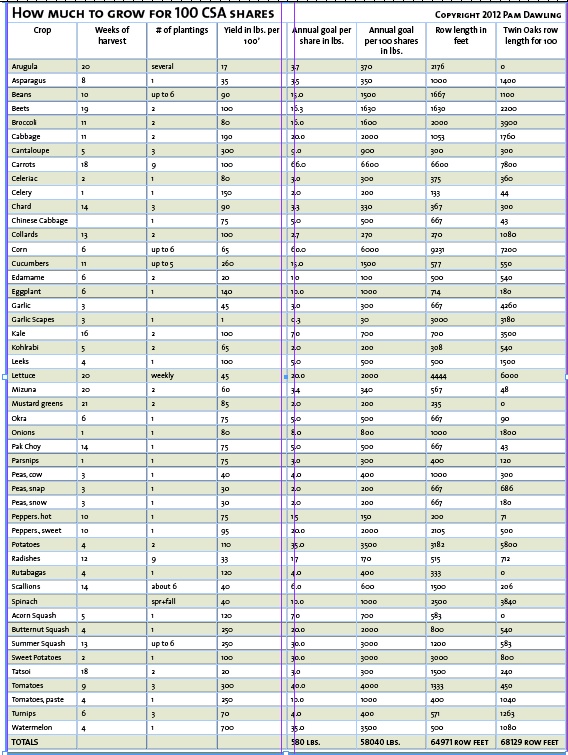
Charts of possible crop yields are available in the Roxbury Farm’s Field Planting and Seeding Schedule and their Greenhouse Schedule. Some seed companies have tables of likely yields in their catalogs, although these are sometimes more for the home gardener than for market growers. The Center for Agroecology and Sustainable Food Systems at the University of Santa Cruz has a lot of useful information including a 30-page Crop Plan for a 100 member CSA, with planting requirements including total bed length for a range of 36 crops in its Unit 4.5 CSA Crop Planning. Their Appendix 9 includes the area requirements translated into fractions of an acre. A further source of this kind of information is Sharing the Harvest by Elizabeth Henderson and Robyn Van En. A two-page table includes yield per 100 row feet.
How much to grow
If the average person needs 160-200 pounds of vegetables per year, and the average household (=1 CSA share) is 2.5 people, then 1 share will be 400-600 lbs per year, roughly 10 lbs per week for a full year.
Deciding sowing dates
It might be hard to orchestrate your annual start-up so that you have a generous bounty. It’s OK to tell your CSA members that their boxes at the beginning of the season boxes will be less full, and the summer ones will be more bountiful. Johnny’s Seeds website has a Harvest Date Calculator which you can copy and use to calculate sowing dates to meet a target date (e.g. the first or last market of the year). www.johnnyseeds.com/t-InteractiveTools.aspx
Resources
These books are available from Growing for Market at www.growingformarket.com or 800-307-8949.
Crop Planning for Organic Vegetable Growers, Daniel Brisebois and Frédéric Thériault.
The Organic Farmer’s Business Handbook, Richard Wiswall
Sharing the Harvest: A Citizen’s Guide to Community Supported Agriculture, Elizabeth Henderson and Robyn Van En
Sustainable Vegetable Production from Start-up to Market, Vern Grubinger
Publications available from ATTRA at www.attra.ncat.org:
ATTRA: Market Gardening: A Start Up Guide, Janet Bachmann
Holistic Management: A Whole-Farm Decision Making Framework, Preston Sullivan
Other publications:
Holistic Management: A New Framework for Decision Making, Allan Savory and Jody Butterfield, Island Press
Roxbury Farm 100 Member CSA Plan. See Information for Farmers at www.roxburyfarm.com/content/7211
Planning For Your CSA, Mark Cain, Dripping Springs Garden, www.drippingspringsgarden.com/index.html or at www.Slideshare.net (Search for Crop Planning)
Teaching Direct Marketing and Small Farm Viability, The Center for Agroecology and Sustainable Food Systems at the University of Santa Cruz.. Unit 4.5 CSA Crop Planning
63.249.122.224/wp-content/uploads/2010/05/4.5_CSA_crop_plan.pdf
Pam Dawling is the garden manager at Twin Oaks Community in Virginia. The gardens provide nearly all the fresh produce for the community’s 100 residents. Her book, Sustainable Market Farming: Intensive Vegetable Production on a Few Acres, is scheduled for publication this fall by New Society Publishing. She can be reached at pam@twinoaks.org.
Copyright Growing For Market Magazine.
All rights reserved. No portion of this article may be copied
in any manner for use other than by the subscriber without
permission from the publisher.